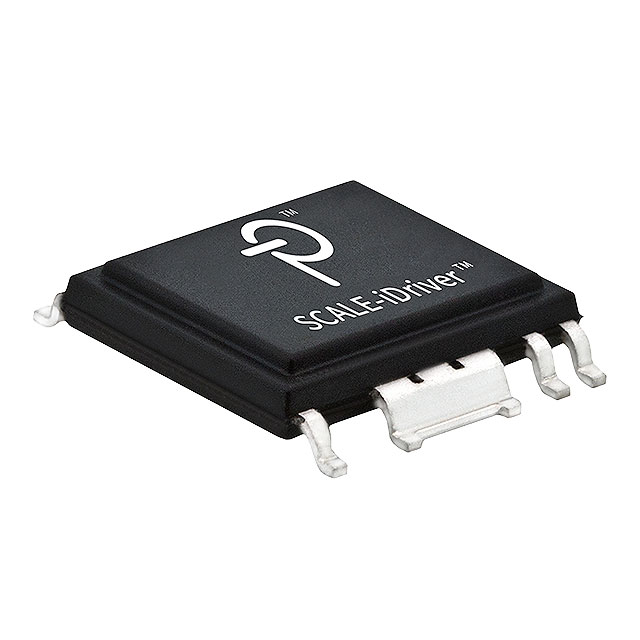
Key Specs
| Spec | Value | Condition | Source |
|---|---|---|---|
| Technology | Magnetic Coupling | Digi-Key | |
| Number Of Channels | 1 | Digi-Key | |
| Voltage Isolation | 5000Vrms | Digi-Key | |
| Common Mode Transient Immunity (Min) | 50kV/µs (Typ) | Digi-Key | |
| Propagation Delay Tplh Tphl (Max) | 305ns, 325ns | Digi-Key | |
| Pulse Width Distortion (Max) | - | Digi-Key | |
| Rise Fall Time (Typ) | 475ns, 447ns | Digi-Key | |
| Current Output High Low | 7.8A, 7.3A | Digi-Key | |
| Current Peak Output | 8A | Digi-Key | |
| Voltage Forward Vf (Typ) | - | Digi-Key | |
| Voltage Output Supply | 18V ~ 28V | Digi-Key | |
| Operating Temperature Range | -40°C ~ 125°C | Digi-Key | |
| Mounting Type | Surface Mount | Digi-Key | |
| Package Case | 16-PowerSOIC (0.350”, 8.89mm Width), 15 Leads | Digi-Key | |
| Supplier Device Package | eSOP-R16B | Digi-Key | |
| Approval Agency | UL | Digi-Key |
When To Use
-
Use in isolated gate driver applications requiring reinforced isolation up to 5000 Vrms and high common-mode transient immunity (50 kV/µs typ). Ideal for driving SiC MOSFETs in medium-voltage motor drives or inverter stages where isolation and fast switching are critical.
-
Use when a single-channel magnetic coupling isolation is sufficient, with a supply voltage range from 18 V to 28 V on the secondary side and up to 6.5 V on the primary side.
-
Do not use in applications requiring multi-channel isolation or where switching frequencies exceed 150 kHz max; consider alternative multi-channel isolated drivers with higher frequency ratings.
-
Avoid in environments demanding isolation voltage beyond 5000 Vrms or peak isolation voltage above 1414 V, or where operating junction temperature exceeds 150 °C max; select devices with higher isolation ratings or extended temperature ranges.
When Not To Use
-
Output current above 8 A peak: The peak gate output current max of ±8 A limits drive capability for larger MOSFETs or parallel arrays. Use a high-current synchronous buck with external FETs to handle the higher gate charge and current demands without distortion or excessive delay.
-
Switching frequency above 150 kHz: The max switching frequency rating of 150 kHz restricts applications requiring smaller magnetics or tighter transient response. For switching frequencies exceeding 500 kHz, choose a high-frequency buck controller optimized for fast gate transitions and low propagation delay jitter.
-
Very low output voltage differential (<1 V) with noise-sensitive loads: This part lacks low-dropout and low-noise regulation capabilities, and the logic output voltage max is 0.5 V (max) which is insufficient for linear regulation at low voltage differences. Use an LDO regulator for tightly regulated, low-noise outputs with small input-to-output voltage differentials.
Application Notes
-
The GH pin (Pin 13) switches the gate drive on the secondary side and requires the smallest possible loop area to minimize parasitic inductance and voltage overshoot during fast switching transitions (rise time typ 10 ns).
-
The SNS pin (Pin 11) is noise-sensitive and must be routed carefully with proper filtering to ensure reliable short-circuit detection. Use shielded or twisted pair routing if necessary.
-
A heatsink is generally not required for typical operation up to 125 °C ambient temperature, given the maximum dissipated power of 1.79 W max; however, thermal management should be considered for continuous operation near the upper temperature limit.
-
The primary supply voltage (VCC Pin 1) and secondary supply voltage (VISO Pin 14) must be stabilized within specified voltage ranges (VISO: 18 V to 28 V, VCC: 6.5 V max) to maintain device performance and
Gotchas
-
Incorrect Gate Resistor Connection:
- Mistake: Connecting the gate resistor intended for turn-on to the GL pin or turn-off resistor to the GH pin.
- Failure: This reverses the gate drive currents, causing improper switching, increased losses, and possible device damage.
- Fix: Ensure turn-on gate resistors connect to GH pin (Pin 13) and turn-off resistors to GL pin (Pin 16) as specified.
-
Insufficient Bootstrap Capacitor Sizing:
- Mistake: Using a bootstrap capacitor smaller than the minimum 3 µF or omitting it entirely.
- Failure: Leads to unstable VGXX voltage, causing erratic gate drive and potential switching failures.
- Fix: Use at least 3 µF low-ESR capacitors between VEE and COM and between VISO and VEE as specified.
-
Neglecting SNS Pin Filtering:
- Mistake: Not applying an appropriate filter capacitor or miscalculating the discharge time constant on the SNS pin.
- Failure: Results in false or missed short-circuit fault detection, risking device damage.
- Fix: Implement the recommended filter capacitor with a discharge time constant matched to the SNS fault monitoring time (450 ns to 900 ns).