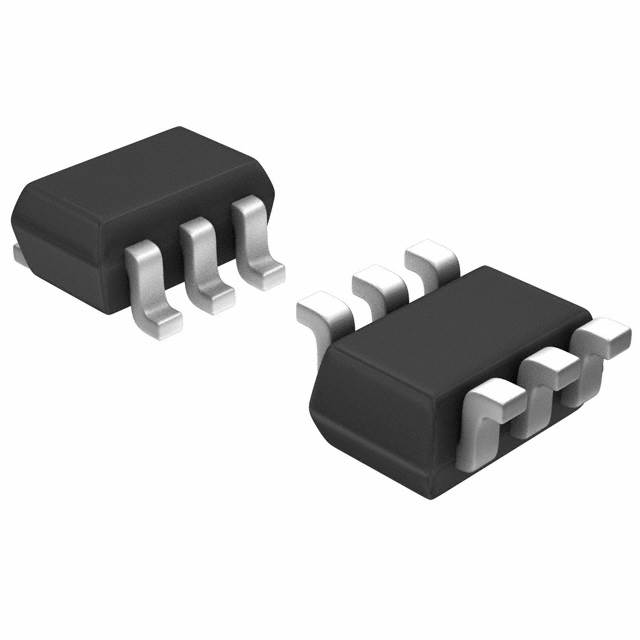
NX3008NBKS,115 vs UM6K33NTN MOSFET Arrays: A Detailed Comparison for Hardware Engineers
Quick verdict
For low-voltage switching with moderate current demands up to 350mA and a focus on automotive-grade reliability and higher power dissipation, the NX3008NBKS,115 is the stronger choice due to its higher current rating and AEC-Q101 qualification. Conversely, the UM6K33NTN suits applications requiring a higher voltage margin (50V max) and very low gate threshold (1V @ 1mA) at lower currents (200mA max), trading off power handling and Rds(on) for extended voltage capability and slightly better input capacitance.
Spec comparison table
| Spec | NX3008NBKS,115 | UM6K33NTN | Notes |
|---|---|---|---|
| Configuration | 2 N-Channel (Dual) | 2 N-Channel (Dual) | Equivalent |
| Drain-Source Voltage, Vmax | 30 V | 50 V | UM6K33NTN supports higher voltage, better for 36–50V rails |
| Continuous Drain Current @ 25°C | 350 mA | 200 mA | NX3008NBKS,115 offers 75% higher current capability |
| Max Power Dissipation | 445 mW | 120 mW | NX3008NBKS,115 supports nearly 4× power dissipation, better for thermal margin |
| Rds(on) Max @ Id, Vgs | 1.4 Ω @ 350mA, 4.5 V | 2.2 Ω @ 200mA, 4.5 V | NX3008NBKS,115 has 36% lower on-resistance at rated current |
| Gate Threshold Voltage, Vgs_th Max | 1.1 V @ 250µA | 1.0 V @ 1mA | UM6K33NTN has slightly lower threshold, beneficial for very low gate drive voltages |
| Input Capacitance (Ciss) | 50 pF @ 15 V | 25 pF @ 10 V | UM6K33NTN has half the input capacitance, reducing gate charge and switching losses |
| Gate Charge (Qg) | 0.68 nC @ 4.5 V | Not specified | NX3008NBKS,115 gate charge is low, but UM6K33NTN data missing—assume unknown |
| Operating Temperature Range | -55°C to +150°C | Up to +150°C | Equivalent |
| Package | 6-TSSOP (SC-88, SOT-363) | UMT6 (6-TSSOP compatible) | Similar small-outline packages, but UMT6 may have slight mechanical differences |
| Power Dissipation | 445 mW | 120 mW | NX3008NBKS,115 better for higher dissipation designs |
| ESD Rating | 2000 V | Not specified | NX3008NBKS,115 offers defined ESD robustness |
| Drain Current Spiking Max | 1.4 A | Not specified | NX3008NBKS,115 can handle short transient spikes better |
| Gate Leakage Current | ~1 µA typ @ 25°C | Not specified | NX3008NBKS,115 leakage known and low |
| Technology | MOSFET (Metal Oxide) | MOSFET (Metal Oxide) | Equivalent |
| Fet Feature | Logic Level Gate | Logic Level Gate, 1.2 V Drive | UM6K33NTN requires lower gate drive voltage, helpful in low-voltage digital control |
| Thermal Resistance Junction-to-Ambient | 300 K/W (device typical) | Not specified | NX3008NBKS,115 data allows thermal modeling |
| Total Power Dissipation (typical) | 280 mW | Not specified | NX3008NBKS,115 better thermal headroom |
Design trade-offs
The NX3008NBKS,115 excels in current handling and power dissipation capabilities, making it suitable for applications where higher continuous current (350mA) and transient spikes (up to 1.4A) are expected. Its Rds(on) max of 1.4 Ω at 350mA is significantly lower than the UM6K33NTN’s 2.2 Ω max at 200mA, resulting in lower conduction losses and improved efficiency in medium-power switching or load driving scenarios. The 445mW power dissipation rating also offers better thermal margin, which simplifies heat management in densely packed designs or automotive environments where ambient temperatures reach +150°C.
On the other hand, the UM6K33NTN supports a 50V drain-source rating, which provides more headroom for higher-voltage rails or inductive load switching where voltage spikes may exceed 30V. This makes it a better candidate for systems with 36–50V buses or where voltage derating is a concern. The lower input capacitance (25pF @ 10V) reduces gate charge requirements, which can translate into lower switching losses and faster switching times when driven from low-current logic sources. Its logic-level gate drive at 1.2V threshold is advantageous in ultra-low-voltage control schemes, although the continuous current and power dissipation limits restrict its use to lighter loads.
For firmware or gate driver design, the NX3008NBKS,115’s slightly higher gate charge (0.68nC @ 4.5V) and gate threshold (up to 1.1V) means that a stable 4.5V or higher gate drive voltage is recommended to fully enhance the MOSFET and keep Rds(on) low. The UM6K33NTN can switch fully at lower gate voltages (1.2V drive threshold), easing interfacing with low-voltage MCUs or FPGAs, but without explicit gate charge data, exact switching losses are harder to estimate.
From a layout perspective, both devices come in compact 6-TSSOP packages, but the UM6K33NTN uses the UMT6 variant which may have subtle pin spacing or thermal pad differences. Thermal resistance data for the UM6K33NTN is not provided, so conservative thermal design is advised. The NX3008NBKS,115’s defined transient thermal impedance and junction-to-ambient resistance allow more accurate heat dissipation calculations.
Cost-wise, the NX3008NBKS,115’s automotive qualification (AEC-Q101) and higher performance specs generally come at a premium, justified in safety-critical or harsh environment designs. The UM6K33NTN likely offers a more economical solution for consumer or industrial applications where voltage headroom is prioritized over current and power dissipation.
Use-case fit
Choose NX3008NBKS,115 when…
- Designing automotive or industrial systems requiring AEC-Q101 qualified MOSFET arrays for robust operation up to +150°C ambient.
- Switching or driving loads up to 350mA continuous current with occasional transient spikes up to 1.4A.
- Operating on 12V or 24V rails where the 30V maximum is sufficient without voltage derating.
- Thermal management is constrained, and the design benefits from the higher 445mW power dissipation capability.
- Gate drive voltages of 4.5V or higher are available to fully enhance the MOSFET and minimize conduction losses.
Choose UM6K33NTN when…
- Operating from higher voltage rails up to 50V where NX3008NBKS,115’s 30V max is insufficient.
- The load current requirement is modest (≤200mA), and power dissipation is limited to ~120mW.
- Gate drive voltages are limited to low-voltage logic levels near 1.2V, enabling direct MCU or low-voltage logic control.
- Minimizing input capacitance and gate charge is critical to reduce switching losses in high-frequency or low-power switching circuits.
- Cost sensitivity is high, and automotive qualification is not required.
Drop-in compatibility
Both devices are dual N-channel MOSFET arrays in small 6-pin packages, but the NX3008NBKS,115 uses a 6-TSSOP package while the UM6K33NTN comes in a UMT6 package. Although both are surface mount and similar in size, the pinouts and exact package dimensions may differ. Without explicit pinout diagrams or footprint comparison, drop-in substitution cannot be guaranteed. Designers should verify pin assignments, thermal pad presence, and footprint dimensions before substituting one for the other.
Alternatives to consider
- NX3008N (Nexperia): Similar automotive-qualified dual MOSFET with slightly different Rds(on) and current ratings for marginally different power budgets.
- SI2302 (Vishay): A low-voltage, logic-level N-channel MOSFET with lower Rds(on) available in small packages, suitable for low-current switching.
- BSS138 (ON Semiconductor): A popular low-voltage MOSFET with a lower gate threshold, useful for low-current, low-voltage switching applications where cost is critical.