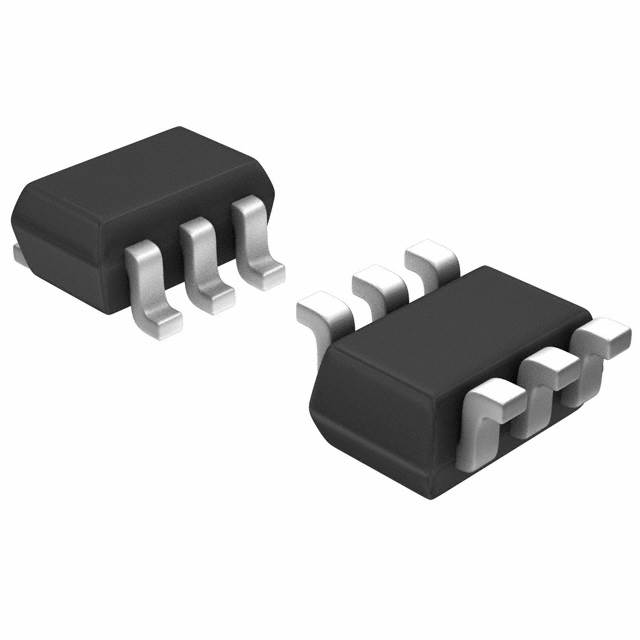
Component Comparison: NX3008NBKS,115 vs SSM6N67NU,LF
Quick verdict
For low-current, low-power switching in automotive or industrial control with strict AEC-Q101 qualification, the NX3008NBKS,115 is the better fit due to its automotive grade and low gate charge. For higher current loads up to 4A and more demanding power dissipation, the SSM6N67NU,LF outperforms with significantly lower R_DS(on) and higher power rating, making it suitable for power rail switching or load drivers.
Spec comparison table
| Spec | NX3008NBKS,115 | SSM6N67NU,LF | Notes |
|---|---|---|---|
| Configuration | 2 N-Channel (Dual) | 2 N-Channel (Dual) | Equivalent |
| Drain-Source Voltage (V_DS max) | 30 V | 30 V | Equivalent |
| Continuous Drain Current (I_D @ 25°C) | 350 mA | 4 A | SSM6N67NU,LF supports >10x higher current |
| Power Dissipation (P_D max) | 445 mW | 2 W (Ta) | SSM6N67NU,LF supports ~4.5x higher power |
| R_DS(on) (Typ @ 25°C) | 1.0 – 1.4 Ω @ 350 mA, 4.5 V | 39.1 mΩ @ 2 A, 4.5 V | SSM6N67NU,LF is ~25–35x lower resistance, vastly more efficient for conduction |
| Gate Charge (Q_g max @ 4.5 V) | 0.68 nC | 3.2 nC | NX3008NBKS,115 has ~5x lower gate charge, easier drive for low-current logic-level gate |
| Input Capacitance (C_iss max @ 15 V) | 50 pF | 310 pF | NX3008NBKS,115 has significantly lower input capacitance, beneficial for fast switching |
| Gate Threshold Voltage (V_gs_th max) | 1.1 V @ 250 µA | 1.0 V @ 1 mA | Comparable; SSM6N67NU,LF has slightly lower threshold at higher test current |
| Maximum Ambient Temperature | +150 °C | +150 °C | Equivalent |
| Operating Temperature Range | -55 °C to +150 °C | Up to 150 °C | Equivalent |
| Package | 6-TSSOP (2.2 x 1.35 mm) | 6-µDFN (2 x 2 mm) | Different footprints; SSM6N67NU,LF smaller and with exposed pad for better thermal performance |
| Mounting Type | Surface Mount | Surface Mount | Equivalent |
| ESD Rating | 2 kV | (Not specified) | NX3008NBKS,115 ESD rating documented, useful for automotive environments |
| Drain Current Spiking Max | 1.4 A | (Not specified) | NX3008NBKS,115 limited to 1.4 A spike, SSM6N67NU,LF likely higher but not specified |
| Transient Thermal Impedance (typical) | 0.01 – 1 K/W (various time scales) | (Not specified) | NX3008NBKS,115 data-rich; SSM6N67NU,LF lacks transient thermal impedance data |
| Total Power Dissipation (typical) | 280 mW | (Not specified) | NX3008NBKS,115 typical power dissipation given; SSM6N67NU,LF only max power specified |
| Gate Leakage Current (typical @ 25 °C) | 0.2 – 1 µA | (Not specified) | NX3008NBKS,115 has documented leakage; SSM6N67NU,LF data not provided |
| Technology | MOSFET (Metal Oxide) | MOSFET (Metal Oxide) | Equivalent |
| Qualification | AEC-Q101 Automotive Grade | (Not specified) | NX3008NBKS,115 qualified for automotive use |
Design trade-offs
The most significant difference between these two MOSFET arrays lies in their current handling and conduction efficiency. The NX3008NBKS,115 is designed for low current (350 mA typical) applications with relatively high on-resistance (~1 Ω), whereas the SSM6N67NU,LF supports continuous currents up to 4A with a dramatically lower R_DS(on) of 39.1 mΩ. This translates to roughly 25 to 35 times lower conduction losses in the SSM6N67NU,LF at moderate currents, which is crucial for efficiency and thermal management in power applications.
Thermally, the SSM6N67NU,LF’s 6-µDFN package with exposed pad offers superior heat dissipation compared to the NX3008NBKS,115’s 6-TSSOP package. This allows the Toshiba part to operate at higher power levels (2W max vs. 445 mW max) without excessive temperature rise, reducing the need for extensive thermal management measures like large copper pours or heatsinks. The NX3008NBKS,115’s thermal resistance junction-to-ambient is significantly higher (typical 300 K/W per device), indicating more conservative power dissipation and stricter layout constraints to avoid thermal issues.
Gate drive requirements also differ. The NX3008NBKS,115 has a lower gate charge (0.68 nC max at 4.5V) and lower input capacitance (50 pF max), which reduces switching losses and gate driver power in low-current, low-frequency switching scenarios. Conversely, the SSM6N67NU,LF has a higher total gate charge (3.2 nC max) and greater input capacitance (310 pF max), demanding a stronger gate driver capable of sourcing higher peak currents to switch efficiently. This is a trade-off for the lower R_DS(on) and higher current capacity.
Layout-wise, the SSM6N67NU,LF’s exposed pad package enables better thermal coupling to the PCB, which should be prioritized in high-current applications. The NX3008NBKS,115’s smaller and more conventional TSSOP package is suitable for dense, low-power designs where thermal dissipation is less critical.
Cost at volume is not provided here, but typically MOSFET arrays with higher current and lower R_DS(on) in advanced packages like 6-µDFN command a premium compared to simpler, lower-power dual arrays in TSSOP packages.
Use-case fit
Choose NX3008NBKS,115 when…
- Designing low-current signal-level load switches or level shifters in automotive systems where AEC-Q101 qualification is mandatory.
- Implementing low-power multiplexing or protection switches in sensor interfaces where gate driver power must be minimized.
- Space is limited but the application does not require heavy power dissipation or high current, leveraging the 6-TSSOP footprint.
- Operating in harsh environments requiring wide temperature range (-55°C to +150°C) with proven automotive reliability.
- The design prioritizes minimal gate drive complexity and low input capacitance for faster switching at low currents.
Choose SSM6N67NU,LF when…
- Switching loads up to 4A continuously with minimal conduction losses, such as power rails, battery management, or motor drivers.
- Higher power dissipation (up to 2 W) can be managed with PCB thermal design utilizing the exposed pad for heat sinking.
- The gate driver can provide sufficient current to handle the 3.2 nC gate charge for efficient switching at moderate to high switching frequencies.
- Compact footprint with efficient thermal performance is required, benefiting from the 6-µDFN package.
- The application can tolerate or does not require AEC-Q101 qualification but demands better electrical performance.
Drop-in compatibility
These two devices are not pin-compatible or footprint-compatible. The NX3008NBKS,115 uses a 6-TSSOP package (2.2 x 1.35 mm), while the SSM6N67NU,LF comes in a smaller 6-µDFN (2 x 2 mm) with an exposed pad. Their pin assignments and thermal pad connections differ, so substitution requires PCB redesign and potentially different thermal management strategies. Gate drive circuitry may also need adjustment due to differing input capacitances and gate charge. Without detailed pinout comparison beyond the source data, no direct drop-in replacement is feasible.
Alternatives to consider
- Toshiba TSM6N60NU: Similar dual N-channel MOSFET array with 60 V rating and low R_DS(on), suitable for higher voltage loads.
- Nexperia PMV30ENX: Single N-channel MOSFET with low gate charge and R_DS(on), good for low-power switching with AEC-Q101 qualification.
- Diodes Incorporated ZXMN2F34C6: Single N-channel MOSFET with very low R_DS(on) and low gate charge, suitable for high-efficiency load switching in compact packages.