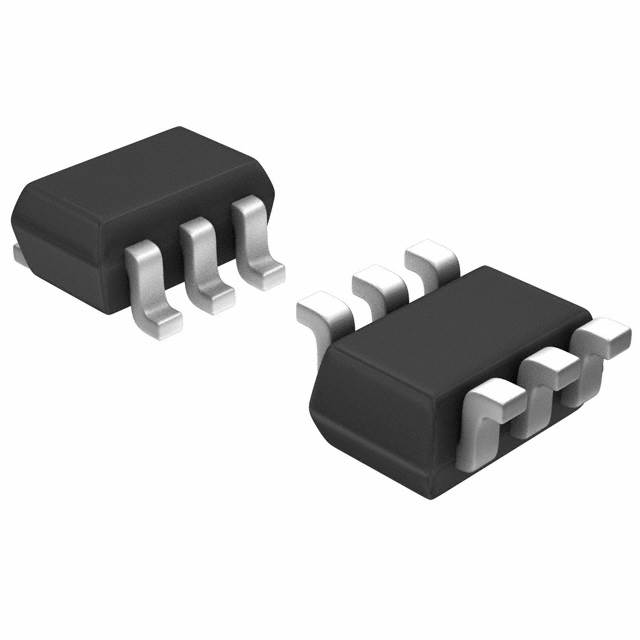
NX3008NBKS,115 vs SSM6N57NU,LF MOSFET Array Comparison
Quick verdict
For low-current, low-power switching or level-shifting applications where a compact dual MOSFET with minimal gate charge and automotive qualification is needed, the NX3008NBKS,115 offers better integration and ease of drive. For higher-current loads up to 4A and higher power dissipation (1W max), the SSM6N57NU,LF is the clear choice due to significantly lower R_DS(on) and higher continuous current rating, though it demands stronger gate drive and careful thermal design.
Spec comparison table
| Spec | NX3008NBKS,115 | SSM6N57NU,LF | Notes |
|---|---|---|---|
| Configuration | 2 N-Channel (Dual) | 2 N-Channel (Dual) | Equivalent |
| Drain-Source Voltage (max) | 30 V | 30 V | Equivalent |
| Continuous Drain Current @ 25°C | 350 mA | 4 A | SSM6N57NU,LF supports over 10x higher load current |
| Maximum Power Dissipation | 445 mW | 1 W | SSM6N57NU,LF can dissipate more than twice the power |
| R_DS(on) Typ @ 25°C | 1.0 – 1.4 Ω (typ) | 46 mΩ @ 2A, 4.5V | SSM6N57NU,LF has roughly 20–30x lower on-resistance, greatly reducing conduction losses |
| Gate Charge Q_G (max @ 4.5V) | 0.68 nC | 4 nC | NX3008NBKS,115 requires much less gate charge, easing gate drive and switching losses |
| Input Capacitance C_iss (max) | 50 pF @ 15 V | 310 pF @ 10 V | NX3008NBKS,115 has significantly lower input capacitance, beneficial for high-speed drive |
| Operating Temperature Range (junction) | -55°C to +150°C | Up to +150°C | Equivalent |
| Package Type | 6-TSSOP | 6-µDFN (2x2) | Different packages; footprint not directly compatible |
| Thermal Resistance Junction-to-Ambient (typ) | ~300 K/W (per device) | Not specified | NX3008NBKS,115 data provided; SSM6N57NU,LF requires reference |
| Drain Current Spiking Max | 1.4 A | Not specified | NX3008NBKS,115 spike current rating low compared to SSM6N57NU,LF |
| Gate Threshold Voltage V_GS(th) (max) | 1.1 V @ 250 µA | 1 V @ 1 mA | Similar threshold; slight variation not critical |
| Electrostatic Discharge Max Rating | 2000 V | Not specified | NX3008NBKS,115 offers explicit ESD rating |
| Power Dissipation (typ) | 280 mW | Not specified | NX3008NBKS,115 typical power dissipation given |
| Gate Leakage Current (typ @ 25°C) | 0.2–1 µA | Not specified | NX3008NBKS,115 has very low gate leakage |
| Gate-Source Voltage Max/Min | ±8 V | Not specified | NX3008NBKS,115 explicitly rated for ±8 V gate voltage |
| Transient Thermal Impedance (typ @ 100 ms) | 0.5 K/W | Not specified | NX3008NBKS,115 data available; SSM6N57NU,LF unknown |
| Drain-Source Leakage Current (typ @ 25°C) | 1 µA | Not specified | NX3008NBKS,115 data available |
| Package Outline Dimensions | 2.2 mm × 1.35 mm | 2 mm × 2 mm | SSM6N57NU,LF smaller footprint but different shape |
| Total Power Dissipation Max | 990 mW | Not specified | NX3008NBKS,115 maximum total power dissipation specified |
| Technology | MOSFET (Metal Oxide) | MOSFET (Metal Oxide) | Equivalent |
Design trade-offs
The NX3008NBKS,115 is designed for low-current, low-voltage switching with a maximum continuous drain current of 350 mA and a relatively high R_DS(on) around 1.0 to 1.4 Ω typ at 25°C. This translates to significant conduction losses if used at higher currents but is sufficient for signal-level switching, load switching in low-power circuits, or level shifting. Its very low gate charge (~0.68 nC max at 4.5 V) and low input capacitance (~50 pF) make it easy to drive with weak gate drivers or microcontroller GPIOs without adding significant switching losses or delay. The 6-TSSOP package is automotive qualified (AEC-Q101), which adds reliability confidence in automotive and industrial applications.
In contrast, the SSM6N57NU,LF targets higher power applications, with a continuous drain current rating of 4 A and a very low R_DS(on) of 46 mΩ at 2 A and 4.5 V gate drive. This reduces conduction losses dramatically, making it suitable for power-handling tasks like load switching, DC-DC converters, or power multiplexing at moderate voltages (30 V max). However, the gate charge is roughly six times higher (4 nC max at 4.5 V), which increases gate drive power and switching losses, necessitating a stronger gate driver and potentially more careful layout to minimize gate ringing and EMI. The 6-µDFN package includes an exposed pad, which supports better thermal dissipation if properly soldered to a PCB thermal pad, but requires more attention to thermal design and PCB layout.
Thermal considerations are critical. The NX3008NBKS,115 has detailed thermal resistance data (~300 K/W junction-to-ambient per device), indicating it is suitable only for very low-power dissipation applications without heatsinking. The SSM6N57NU,LF’s power rating (1 W max) and exposed pad package imply better thermal performance, but the datasheet does not specify thermal resistance values explicitly, so designers must rely on PCB thermal design and measurement to ensure safe operation at high current loads.
The different packages and footprints (6-TSSOP vs 6-µDFN 2x2 mm) mean that the devices are not footprint compatible and will require PCB redesign if swapping. The NX3008NBKS,115’s smaller gate charge and input capacitance simplify gate drive design, beneficial in low-power systems or where microcontroller IO pins drive the MOSFETs directly. The SSM6N57NU,LF’s higher gate charge and current capability require more robust gate drivers and possibly additional components like gate resistors or snubbers.
Cost considerations are not detailed here, but typically the smaller, lower-power NX3008NBKS,115 will be less expensive at volume than the higher-current, lower R_DS(on) SSM6N57NU,LF, which integrates more silicon and requires better package technology.
Use-case fit
Choose NX3008NBKS,115 when…
- You need automotive-qualified MOSFET arrays for low-current switching (≤350 mA) in harsh temperature environments up to 150°C.
- The application involves level shifting or digital logic-level switching where gate drive current must be minimized.
- PCB area is constrained to 6-TSSOP, and a low gate charge reduces EMI and switching losses.
- Low power dissipation (<0.5 W) and minimal thermal management simplify system design.
- Gate drive circuitry is limited to microcontroller or simple logic-level signals without dedicated MOSFET drivers.
Choose SSM6N57NU,LF when…
- Switching loads up to 4 A continuous current at 30 V supply, such as small motor drivers, power multiplexers, or DC-DC converter synchronous switches.
- Low conduction losses are critical; the 46 mΩ R_DS(on) at 2 A reduces system power dissipation significantly.
- Thermal design allows use of the exposed pad 6-µDFN package and PCB layout can ensure adequate heat sinking.
- Gate drivers can supply higher gate charge (~4 nC) without excessive switching loss or delay.
- Compact 2x2 mm footprint is preferred over TSSOP for PCB real estate considerations, and a new layout is acceptable.
Drop-in compatibility
These two MOSFET arrays are not pin- or footprint-compatible. The NX3008NBKS,115 uses a 6-TSSOP package, while the SSM6N57NU,LF uses a smaller 6-µDFN (2x2 mm) package with an exposed pad. Their pinouts and pad arrangements differ significantly, so substituting one for the other requires a PCB redesign. Gate drive and thermal design considerations also differ substantially, so simple drop-in replacement is not feasible without careful verification.
Alternatives to consider
- BSS138 (ON Semiconductor or others): A widely used single N-channel MOSFET with low gate charge and logic-level drive, suitable for