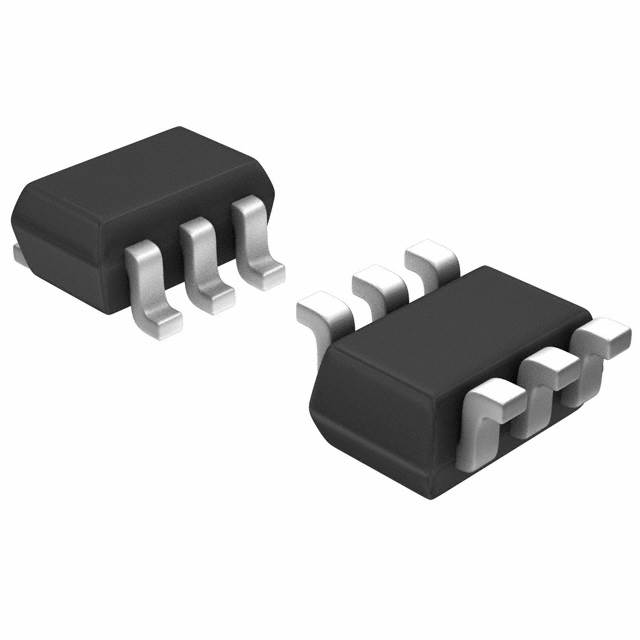
NX3008NBKS,115 vs SSM6L56FE,LM: Component Comparison for Power Electronics Engineers
Quick verdict
For low-voltage, low-current switching where voltage headroom and thermal margin are tight, the NX3008NBKS,115’s higher voltage rating (30 V) and automotive qualification make it preferable. In applications requiring higher continuous current capability and complementary N/P-channel pairs for push-pull or half-bridge circuits, the SSM6L56FE,LM with its 800 mA current rating and mixed channel types is the better choice.
Spec comparison table
| Spec | NX3008NBKS,115 | SSM6L56FE,LM | Notes |
|---|---|---|---|
| Configuration | 2 × N-Channel MOSFET | N and P-Channel MOSFET | SSM6L56FE,LM offers complementary pair, enabling half-bridge designs without extra parts. |
| Drain-Source Voltage (Max) | 30 V | 20 V | NX3008NBKS,115 supports 50% higher voltage, better for 24 V systems or voltage spikes. |
| Continuous Drain Current (Ta/25°C) | 350 mA | 800 mA | SSM6L56FE,LM supports over twice the current, enabling higher load capability. |
| Power Dissipation (Max @ Ta) | 445 mW | 150 mW | NX3008NBKS,115 can dissipate ~3× more power, easing thermal design at similar currents. |
| Gate Charge (Qg max) | 0.68 nC @ 4.5 V | 1 nC @ 10 V | NX3008NBKS,115 has lower gate charge at lower Vgs, reducing gate drive losses. |
| Rds(on) max (Id, Vgs) | 1.4 Ω @ 350 mA, 4.5 V | 235 mΩ & 390 mΩ @ 800 mA, 4.5 V | SSM6L56FE,LM has significantly lower Rds(on) at higher current, improving conduction efficiency. |
| Input Capacitance (Ciss max) | 50 pF @ 15 V | 55 pF & 100 pF @ 10 V | NX3008NBKS,115 has lower typical input capacitance, aiding faster switching. |
| Gate Threshold Voltage (Vgs_th max) | 1.1 V @ 250 µA | 1 V @ 1 mA | Both are logic-level gate, but NX3008NBKS,115 specifies threshold at lower current, slightly higher. |
| Electrostatic Discharge Rating (ESD) | 2000 V | Not specified | NX3008NBKS,115 has explicit ESD rating, beneficial for rugged environments. |
| Ambient Operating Temperature Range | -55 °C to +150 °C | Up to 150 °C | Both support automotive-grade temperature range; NX3008NBKS,115 specifies full range explicitly. |
| Package | 6-TSSOP (SC-88, SOT-363) | ES6 (SOT-563, SOT-666) | SSM6L56FE,LM uses smaller ES6 package, better for dense layouts. |
| Total Power Dissipation (Typical) | 280 mW | 150 mW | NX3008NBKS,115 offers higher typical power dissipation, easing thermal constraints. |
| Drain Current Spiking Max | 1.4 A | Not specified | NX3008NBKS,115 specifies transient spike current, aiding transient design. |
| Thermal Resistance Junction-Ambient | Typ. 300 K/W per device | Not specified | NX3008NBKS,115 provides data to assess thermal performance; SSM6L56FE,LM lacks this detail. |
| Gate Leakage Current (Typ @ 25°C) | 0.2–1 µA | Not specified | NX3008NBKS,115 better characterized for gate leakage, important in low-power or sleep modes. |
Design trade-offs
The NX3008NBKS,115 and SSM6L56FE,LM serve overlapping but distinct niches due to their voltage, current, and configuration differences. The NX3008NBKS,115’s 30 V rating outclasses the SSM6L56FE,LM’s 20 V, making it safer in applications exposed to higher supply voltages or inductive spikes. This voltage margin is critical in automotive or industrial environments where 24 V systems are common.
Current capability is a major differentiator. The SSM6L56FE,LM supports 800 mA continuous current, more than twice the NX3008NBKS,115’s 350 mA. This allows the SSM6L56FE,LM to handle higher loads or lower conduction losses at a given current. Its Rds(on) is also dramatically lower (235–390 mΩ vs 1.4 Ω), improving efficiency and reducing heat dissipation.
Thermally, the NX3008NBKS,115 supports higher power dissipation (445 mW max vs 150 mW), but this is within the context of its lower current rating and higher Rds(on). The NX device’s thermal resistance data is more complete, which helps in detailed thermal modeling. The SSM6L56FE,LM’s smaller ES6 package is advantageous for dense PCB layouts but may impose tighter thermal design constraints.
Gate charge and drive requirements differ: NX3008NBKS,115’s gate charge is lower and measured at a lower gate drive voltage (4.5 V vs 10 V). This means it can be switched with lower gate drive power, beneficial in low-voltage logic-level circuits. The SSM6L56FE,LM requires a higher gate voltage to reach specified gate charge, which can affect driver selection and switching speed.
The complementary N/P configuration of the SSM6L56FE,LM provides an integrated half-bridge solution, reducing component count and PCB area in push-pull or synchronous rectification topologies. The dual N-channel NX3008NBKS,115 is limited to applications needing two N-MOSFETs, requiring an external P-channel or another N-channel device for complementary designs.
Cost and availability at volume are not provided but should be considered alongside package size and performance. The ES6 package of the SSM6L56FE,LM can reduce BOM and PCB costs in high-density designs, while the automotive grade and AEC-Q101 qualification of the NX3008NBKS,115 may command a premium but provide higher reliability assurance.
Use-case fit
Choose NX3008NBKS,115 when…
- Designing low-current (<350 mA) automotive or industrial control circuits where 30 V voltage rating and AEC-Q101 qualification are mandatory.
- Operating in environments with wide ambient temperature ranges (-55°C to +150°C) requiring proven automotive-grade qualification.
- Implementing circuits with isolated low-side switches or level shifters where dual N-channel devices suit the topology.
- Gate drive voltage is limited to 4.5 V or lower, benefiting from the lower gate charge and threshold voltage characteristics.
- PCB space is less constrained, allowing the larger 6-TSSOP package and simpler thermal management.
Choose SSM6L56FE,LM when…
- Higher continuous current (up to 800 mA) handling is required with lower conduction losses at 4.5 V gate drive.
- Complementary N- and P-channel MOSFET pairs are needed in a compact footprint for half-bridge or push-pull converter circuits.
- PCB space is limited, and the ES6 package’s smaller footprint enables denser component placement.
- Switching frequencies are moderate, and gate drive voltage around 10 V is available to fully switch the device.
- Power dissipation requirements are moderate (150 mW max), and thermal design can accommodate the smaller package constraints.
Drop-in compatibility
The NX3008NBKS,115 and SSM6L56FE,LM are not pin- or footprint-compatible. NX3008NBKS,115 is a 6-TSSOP (SC-88, SOT-363) dual N-channel MOSFET array, while SSM6L56FE,LM is packaged in an ES6 (SOT-563, SOT-666) footprint containing one N- and one P-channel MOSFET. Their pin assignments and internal configurations differ significantly, preventing direct substitution without PCB redesign and circuit reconsideration.
Alternatives to consider
- Si2302DS (Vishay): Single N-channel MOSFET with logic-level gate drive and low Rds(on), suitable for low-voltage switching.
- BSS138 (ON Semiconductor): Small-signal N-channel MOSFET with low gate charge, widely used in level shifting and low-current switching.
- FDC855N (ON Semiconductor): N-channel MOSFET with low Rds(on) at logic-level gate drive, in a small package good for power switching and load control.
Each of these alternatives offers different trade-offs in voltage, current, and package size, worth evaluating based on your specific application constraints.