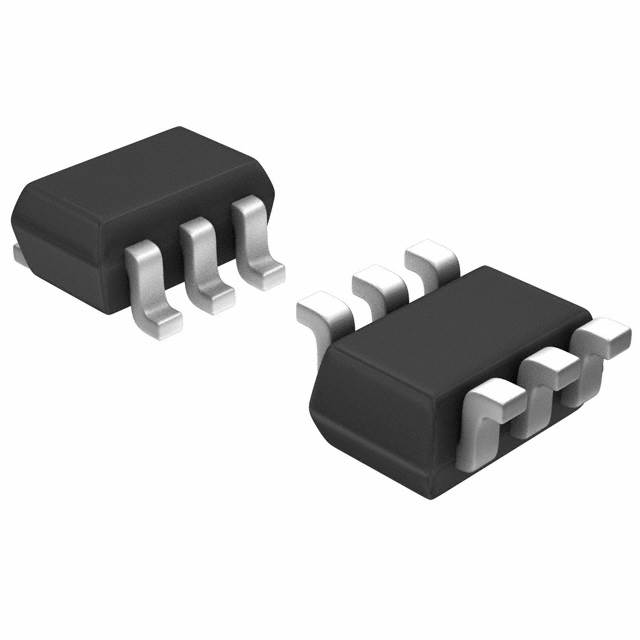
NX3008NBKS,115 vs SQ1922EEH-T1_GE3: Component Comparison for Dual N-Channel MOSFET Arrays
Quick verdict
For low-voltage, low-current switching where board space and minimal gate charge are critical, the NX3008NBKS,115 is preferable due to its smaller package and lower gate charge. Conversely, for applications requiring higher continuous current up to 840mA and higher power dissipation, such as higher load driving or power sequencing at 20 V, the SQ1922EEH-T1_GE3 stands out with its significantly higher current capability and better on-resistance at higher currents.
Spec comparison table
| Spec | NX3008NBKS,115 | SQ1922EEH-T1_GE3 | Notes |
|---|---|---|---|
| Configuration | 2 N-Channel (Dual) | 2 N-Channel (Dual) | Identical configuration. |
| Drain-Source Voltage, Max (V) | 30 V | 20 V | NX3008NBKS,115 supports higher voltage, better for 24–30 V rails. |
| Continuous Drain Current @ 25°C | 350 mA | 840 mA (Tc) | SQ1922EEH-T1_GE3 supports >2x current, better for heavier loads. |
| Pulsed Drain Current | 1.4 A (max) | 3 A (min,max) | SQ1922EEH-T1_GE3 handles higher peak currents. |
| Power Dissipation Max | 445 mW | 1.5 W | SQ1922EEH-T1_GE3 supports over 3x higher power dissipation. |
| R_DS(on) Typ @ 25°C, 4.5 V | 1.5 Ω | 0.35 Ω | SQ1922EEH-T1_GE3 has significantly lower R_DS(on), reducing conduction losses. |
| R_DS(on) Max @ 350mA, 4.5 V | 1.4 Ω | 0.35 Ω | Lower max on-resistance in SQ1922EEH-T1_GE3 allows better efficiency at similar gate drive. |
| Gate Threshold Voltage (V_GS(th)) Typ | 1.75 V | 1.0 V | SQ1922EEH-T1_GE3 turns on at lower gate voltage, easier to drive fully on at low VGS. |
| Gate Charge, Total (Q_g) @ 4.5 V | 0.68 nC | 1.2 nC | NX3008NBKS,115 has about half the gate charge, reducing gate drive losses and switching times. |
| Input Capacitance (C_iss) Typ @ 25°C | 34–50 pF | 50 pF | Marginally lower input capacitance on NX3008NBKS,115, helps switching speed. |
| Output Capacitance (C_oss) Typ @ 25°C | 6.5 pF | 21 pF | NX3008NBKS,115 has lower output capacitance, reducing switching losses. |
| Reverse Transfer Capacitance (C_rss) Typ | 2.2 pF | 10 pF | NX3008NBKS,115 has much lower C_rss, better for fast switching and reduced Miller effect. |
| Maximum Operating Temperature (T_J) | 150 °C | 175 °C | SQ1922EEH-T1_GE3 can operate safely at higher junction temperatures. |
| Ambient Temperature Range | -55 to +150 °C | -55 to +175 °C | SQ1922EEH-T1_GE3 has wider operating temperature range. |
| ESD Rating | 2000 V | Not specified | NX3008NBKS,115 explicitly rated to 2 kV ESD, useful for robust handling. |
| Package Type | 6-TSSOP (2.2 x 1.35 mm) | SC-70-6 (approx. 2.1 x 2.1 mm) | NX3008NBKS,115 is narrower but longer; SQ1922EEH-T1_GE3 is more square footprint. |
| Thermal Resistance Junction-to-Ambient (typ) | 300 K/W per device | ~220 °C/W junction-to-foot | SQ1922EEH-T1_GE3 offers better thermal conductivity through the package (lower thermal resistance). |
| Forward Transconductance (g_fs) Typ @ 25°C | 310 mS | Not specified | NX3008NBKS,115 provides data on transconductance, useful for linear region operation. |
| Turn-on Delay Time (t_on) Typ @ 25°C | 15–30 ns | 15 ns | Comparable turn-on speed. |
| Fall Time (t_fall) Typ @ 25°C | 19 ns | 6–10 ns | SQ1922EEH-T1_GE3 has faster fall time, beneficial in high-speed switching. |
| Gate Leakage Current Typ @ 25°C | ~0.2–1 µA | Up to 10 mA max (gate-source) | NX3008NBKS,115 has significantly lower gate leakage. High gate leakage in SQ1922EEH-T1_GE3 may affect precision analog circuits. |
| Drain Leakage Current Typ @ 25°C | 1 µA | Not specified | NX3008NBKS,115 leakage currents are low and documented; data missing for SQ1922EEH-T1_GE3. |
| Qualification | AEC-Q101 | AEC-Q101 | Both parts are automotive-grade qualified. |
Design trade-offs
The most striking difference is current handling and conduction losses: the SQ1922EEH-T1_GE3 supports up to 840mA continuous current at 20 V and has a typical R_DS(on) of 0.35 Ω at 4.5 V gate drive, compared to the NX3008NBKS,115’s 350mA and 1.5 Ω. This means that for moderate load currents, the Vishay device will dissipate roughly a quarter of the conduction losses per transistor, which directly translates to better efficiency and less thermal stress.
Thermally, the SQ1922EEH-T1_GE3 also has a more favorable package thermal resistance, about 220 °C/W junction-to-foot, compared to the NX3008NBKS,115’s 300 K/W junction-to-ambient typical. This implies that the Vishay device can sustain higher continuous power dissipation (1.5 W vs 445 mW) and junction temperatures (up to 175 °C vs 150 °C) before risking thermal runaway or derating. Designs that push the thermal envelope or operate in hotter environments will benefit from this.
On the other hand, the NX3008NBKS,115 boasts significantly lower gate charge (0.68 nC vs 1.2 nC), lower input and reverse transfer capacitances, and lower output capacitance (6.5 pF vs 21 pF). This reduces the gate drive power and switching losses, which can be crucial in high-frequency switching applications where gate drive efficiency affects overall system efficiency. The lower gate threshold voltage (1.0 V typical for SQ1922EEH vs 1.75 V for NX3008NBKS) means the Vishay device turns on at lower voltages, but the higher total gate charge partially offsets this advantage by requiring stronger gate drivers.
The NX3008NBKS,115’s smaller and narrower 6-TSSOP package (2.2 mm x 1.35 mm) is better suited for ultra-compact designs, compared to the slightly larger SC-70-6 footprint of the SQ1922EEH-T1_GE3. However, the Vishay’s package offers better thermal conduction due to its junction-to-foot thermal impedance, which can be leveraged with appropriate PCB thermal design.
One notable concern is the gate leakage current: the SQ1922EEH-T1_GE3 datasheet lists gate-source leakage up to 10 mA max, which is unusually high and may be problematic in precision analog or low-leakage switching applications. The NX3008NBKS,115 has gate leakage in the nanoamp range, making it more suitable for sensitive circuits.
Cost-wise, volume pricing data is not provided here, but typically Vishay Siliconix parts like the SQ1922EEH-T1_GE3, with higher current and power capability, may carry a premium compared to the Nexperia NX3008NBKS,115. However, the cost difference could be justified by performance gains in higher power applications.
Use-case fit
Choose NX3008NBKS,115 when…
- You need a dual N-channel MOSFET array for low voltage (up to 30 V) and low current (<350 mA) switching in compact form factors.
- Minimizing gate drive losses and switching energy is critical, for example in high-frequency logic-level load switching.
- Your design requires low gate leakage currents for sensitive analog switching or multiplexing circuits.
- The operating ambient temperature does not exceed 150 °C and power dissipation per transistor stays below 445 mW.
- ESD robustness up to 2 kV is desirable to improve manufacturing and field handling reliability.