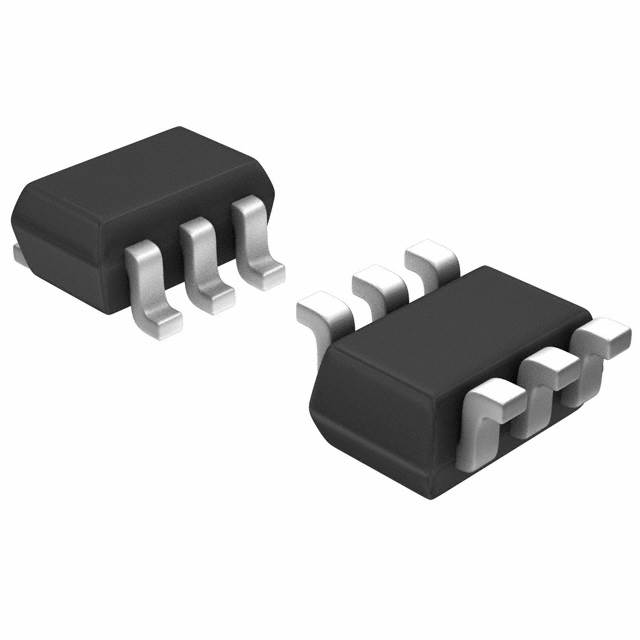
NX3008NBKS,115 vs SQ1922AEEH-T1_GE3 MOSFET Arrays: Component Comparison
1. Quick verdict
For low-voltage, low-current signal switching or level shifting at 30 V max, the NX3008NBKS,115 is better suited, offering automotive-grade qualification and lower gate charge, which simplifies gate drive and reduces switching losses. For higher current loads up to 850 mA and tighter on-resistance at 20 V, especially in power switching applications with thermal constraints, the SQ1922AEEH-T1_GE3 outperforms thanks to its significantly lower R_DS(on) and higher continuous current rating.
2. Spec comparison table
| Spec | NX3008NBKS,115 | SQ1922AEEH-T1_GE3 | Notes |
|---|---|---|---|
| Absolute max drain-source voltage | ±30 V | 20 V | NX3008NBKS,115 supports higher voltage, better for 24–30 V rails. |
| Continuous drain current (I_D) @ 25°C | 350 mA | 850 mA (Tc) | SQ1922AEEH-T1_GE3 supports more than double current, better for higher loads. |
| Max pulsed drain current | 1.4 A | 3.3 A | SQ1922AEEH-T1_GE3 handles larger transient currents. |
| Drain-source on-state resistance R_DS(on) @ 4.5 V | 1.4 Ω (max) @ 350 mA | 0.53 Ω (max) @ 400 mA | SQ1922AEEH-T1_GE3 has significantly lower R_DS(on), reducing conduction losses. |
| Gate threshold voltage V_GS(th) | 0.5–1.1 V (typ 0.9 V) | 1.5–2.5 V (typ 2 V) | NX3008NBKS,115 has lower threshold, easier to drive from low-voltage logic. |
| Gate charge Q_g @ 4.5 V | 0.68 nC (typ) | 1.2 nC (max), 2.1 nC (typ) | NX3008NBKS,115 requires less gate charge, reducing driver power and switching losses. |
| Input capacitance C_iss | 34–50 pF (typ) @ 25°C, 50 pF @ 15 V | ~60 pF (typ) @ 10 V | NX3008NBKS,115 has lower input capacitance, easier to switch at high speed. |
| Output capacitance C_oss | 6.5 pF (typ) | Not specified | NX3008NBKS,115 likely lower, benefiting switching performance. |
| Reverse transfer capacitance C_rss | 2.2 pF (typ) | 15 pF (typ) | NX3008NBKS,115 has much lower C_rss, reducing Miller effect and switching losses. |
| Gate-source voltage rating | ±8 V max | ±12 V typical (max 4.5 V) | NX3008NBKS,115 supports wider gate voltage range, but SQ1922AEEH-T1_GE3 gate drive voltage is limited to 4.5 V max. |
| Max power dissipation | 445 mW | 1.5 W (Tc) | SQ1922AEEH-T1_GE3 can dissipate over 3x power, better for higher power applications. |
| Package | 6-TSSOP (SC-88, SOT-363) | SC-70-6 | SQ1922AEEH-T1_GE3 is in smaller SC-70 package, saving board space. |
| Junction temperature range | -55°C to +150°C | -55°C to +175°C | SQ1922AEEH-T1_GE3 supports higher TJ max, better for thermal margin. |
| Thermal resistance junction-to-ambient (RθJA) | 300 K/W (typ) | 460 °C/W (typ) | NX3008NBKS,115 has better thermal resistance, likely due to package and die size. |
| Electrostatic discharge rating (ESD) | 2 kV | Not specified | NX3008NBKS,115 rated for ESD robustness. |
| Qualification | AEC-Q101 Automotive | AEC-Q101 Automotive | Both are automotive qualified. |
| Operating ambient temperature | -55°C to +150°C | -55°C to +175°C | SQ1922AEEH-T1_GE3 supports higher temperature operation. |
| Drain leakage at 25°C | 1 µA (typ) | Not specified | Lower leakage in NX3008NBKS,115 benefits low-power applications. |
| Gate leakage current | 0.2–1 µA (typ) | ±10 mA (typ) | NX3008NBKS,115 has much lower gate leakage, better for precision low-current circuits. |
| Switching times (t_rise / t_fall) | 11 ns / 19 ns (typ) | 15 ns / 10 ns (typ) | Comparable switching speeds; NX3008NBKS,115 slightly faster rise time. |
| Soldering land distance | 2.45 mm (typ) | Not specified | NX3008NBKS,115 requires larger pad spacing, easier for assembly. |
| Gate resistance | Not specified | 5–13.5 Ω (typ 8.5 Ω) | SQ1922AEEH-T1_GE3 has significant internal gate resistance, affecting switching speed and gate drive. |
| Supply voltage rating | 30 V | 20 V | NX3008NBKS,115 supports higher voltage rail. |
3. Design trade-offs
The NX3008NBKS,115 targets low-voltage (30 V max), low-current switching with an emphasis on logic-level gate drive and minimal gate charge (0.68 nC typical). This reduces gate driver power consumption and switching losses, making it well suited for applications such as signal multiplexing, level shifting, or low-current load switching. Its low gate threshold voltage (~0.9 V typical) means it can be driven directly from low-voltage logic rails (e.g., 1.8–3.3 V) with minimal overhead.
In contrast, the SQ1922AEEH-T1_GE3 offers significantly higher continuous current capability (850 mA vs 350 mA) and much lower typical R_DS(on) (~0.5 Ω vs 1.4 Ω max at comparable currents). This translates to lower conduction losses in power-switching applications but comes at the cost of a higher gate threshold voltage (~2 V typical), higher gate charge (~2.1 nC typical), and a smaller package (SC-70-6). The higher gate charge requires stronger gate drivers or slower switching frequencies to avoid excessive losses or EMI.
Thermally, NX3008NBKS,115 has better junction-to-ambient thermal resistance (300 K/W typical) than SQ1922AEEH-T1_GE3 (460 °C/W typical), despite the latter’s higher power dissipation rating (1.5 W max vs 445 mW). This suggests that the NX3008NBKS,115’s package and construction support better heat spreading given the lower power dissipation; however, the SQ1922AEEH-T1_GE3’s higher power rating allows it to handle more heat overall, assuming proper thermal management.
The SQ1922AEEH-T1_GE3’s internal gate resistance (5–13.5 Ω typical) will slow down switching transitions and increase switching losses, potentially requiring careful gate driver design or slower switching speeds. NX3008NBKS,115 lacks a specified internal gate resistor, implying easier, faster switching at the cost of potentially more switching noise.
The NX3008NBKS,115’s larger package and pad spacing (6-TSSOP, 2.45 mm land distance) facilitate easier assembly and inspection but consume more PCB area compared to the SQ1922AEEH-T1_GE3 in the smaller SC-70-6 package. The smaller package of the SQ1922AEEH-T1_GE3 is advantageous in space-constrained designs but may pose thermal and handling challenges.
Cost-wise, the SQ1922AEEH-T1_GE3 might be more expensive per unit due to its higher current capability and smaller package, but this could be offset by reduced power dissipation and PCB area in higher volume power applications. The NX3008NBKS,115’s simpler drive requirements and automotive qualification could reduce system-level costs in low-current control circuits.
4. Use-case fit
Choose NX3008NBKS,115 when…
- You need to switch or multiplex low-current signals at up to 30 V rails, such as in automotive sensor interfaces or logic-level translation.
- Gate drive power budget is tight and switching losses must be minimized, thanks to low gate charge (~0.68 nC).
- Operating temperature may reach up to 150°C with limited cooling.
- ESD robustness of 2 kV is important for handling rough environments.
- PCB space is less constrained and easier assembly/inspection is prioritized over minimal footprint.
Choose SQ1922AEEH-T1_GE3 when…
- Load currents approach or exceed 500 mA, with continuous currents up to 850 mA and pulsed currents up to 3.3 A