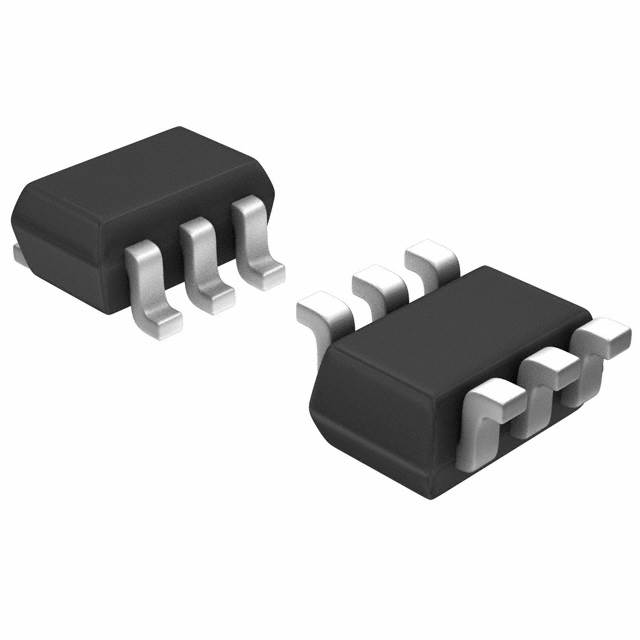
NX3008NBKS,115 vs SIL2324A-TP MOSFET Array Comparison
Quick verdict
For low-voltage, low-current switching tasks, especially in automotive or space-constrained designs, the NX3008NBKS,115 is the better choice due to its logic-level gate drive, AEC-Q101 automotive qualification, and very low gate charge. For applications requiring higher voltage and higher current capability—such as load switching or power management in industrial or consumer electronics—the SIL2324A-TP outperforms with its 100 V rating, 2 A continuous current, and significantly lower on-resistance.
Spec comparison table
| Spec | NX3008NBKS,115 | SIL2324A-TP | Notes |
|---|---|---|---|
| Configuration | 2 N-Channel (Dual) | 2 N-Channel (Dual) | Equivalent dual MOSFET arrays |
| Drain-Source Voltage Max | 30 V | 100 V | SIL2324A-TP supports over 3x higher voltage, enabling use in higher-voltage systems |
| Continuous Drain Current @ 25°C | 350 mA | 2 A | SIL2324A-TP supports nearly 6x higher current, better for higher load applications |
| Pulsed Drain Current Max | 1.4 A | 8 A | SIL2324A-TP handles higher transient currents |
| Drain-Source On-Resistance Typical @ 25°C | 1.5 Ω | 280 mΩ | SIL2324A-TP has significantly lower R_DS(on), reducing conduction losses substantially |
| Gate Threshold Voltage Typical | 1.75 V | 1.5 V | NX3008NBKS,115 has slightly higher threshold but both are logic-level compatible |
| Gate Charge Total Typical @ 4.5 V | 0.68 nC | 4.6 nC | NX3008NBKS,115 requires ~7x lower gate charge, easing gate driver requirements |
| Input Capacitance Typical @ 15 V | 50 pF | 445 pF | NX3008NBKS,115 has much lower input capacitance, enabling faster switching |
| Output Capacitance Typical | 6.5 pF | 23 pF | Lower output capacitance in NX3008NBKS,115 aids in faster switching |
| Reverse Transfer Capacitance Typical | 2.2 pF | 20 pF | NX3008NBKS,115 has lower reverse capacitance, reducing Miller effect |
| Forward Transconductance Typical | 310 mS | 7.1 S | SIL2324A-TP has orders of magnitude higher transconductance, indicating stronger drive |
| Maximum Power Dissipation | 445 mW | 1.5 W | SIL2324A-TP can dissipate over 3x more power, better suited for higher power applications |
| Thermal Resistance Junction to Ambient Typical | 300 K/W (per device) | 125 °C/W (usually °C/W = K/W) | SIL2324A-TP has better thermal resistance, easier thermal management |
| Junction Temperature Range | -55°C to +150°C | -55°C to +150°C | Equivalent operating temperature range |
| Package | 6-TSSOP (SC-88, SOT-363) | SOT-23-6L | Different package types; footprint not compatible |
| Gate-Source Voltage Max/Min | ±8 V | ±20 V | SIL2324A-TP tolerates wider gate drive voltage swings |
| Drain Leakage Current Typical @ 25°C | 1 µA | 1 µA | Comparable leakage at room temperature |
| ESD Rating | 2000 V | Not specified | NX3008NBKS,115 specifies 2 kV ESD rating; SIL2324A-TP datasheet does not specify |
| AEC-Q101 Qualification | Yes | No | NX3008NBKS,115 is automotive qualified; SIL2324A-TP is not |
| Turn-On Delay Time Typical | 15–30 ns | 8.2 ns | SIL2324A-TP switches faster, beneficial for high-speed switching |
| Turn-Off Delay Time Typical | 69–138 ns | 14.3 ns | SIL2324A-TP has significantly faster turn-off, reducing switching losses |
| Rise Time Typical | 11 ns | 6.3 ns | SIL2324A-TP faster switching speeds |
| Fall Time Typical | 19 ns | 4.5 ns | SIL2324A-TP faster switching speeds |
| Gate Leakage Current Typical @ 25°C | 0.2–1 µA | Not specified | NX3008NBKS,115 gate leakage specified, SIL2324A-TP not detailed |
| Storage Temperature Range | -65°C to +150°C | -55°C to +150°C | NX3008NBKS,115 supports slightly wider low-temp storage range |
Design trade-offs
The NX3008NBKS,115 and SIL2324A-TP serve quite different niches despite both being dual N-channel MOSFET arrays. The NX3008NBKS,115 is optimized for low-voltage, low-current applications with very low gate charge and input/output capacitances, which means it can switch faster with less gate drive power and generates less switching loss in low-power circuits. Its logic-level gate drive and AEC-Q101 qualification make it attractive for automotive and industrial environments where reliability and signal-level compatibility matter more than raw power handling.
Conversely, the SIL2324A-TP addresses higher power needs with a 100 V rating and 2 A continuous current capability. Its 280 mΩ R_DS(on) at 2 A significantly reduces conduction losses in higher current paths, while the higher gate charge (4.6 nC typical) and input capacitance (445 pF) require stronger gate drivers and potentially slower switching to avoid excessive switching losses. However, its much faster switching times and lower thermal resistance (125 °C/W vs 300 K/W) simplify thermal management under moderate power dissipation.
From a layout perspective, the NX3008NBKS,115’s smaller input capacitance and gate charge reduce EMI and cross-talk risks, enabling more compact, sensitive designs. The SOT-23-6 package of the SIL2324A-TP is smaller than the 6-TSSOP of the NX3008NBKS,115, which might save PCB area but complicate thermal dissipation due to the smaller thermal pad. The NX3008NBKS’s higher thermal resistance mandates careful thermal design even at its lower power rating.
Cost-wise, the NX3008NBKS,115 will generally be cheaper for low-power applications given its simpler die and lower power rating, but volume pricing depends on supplier and market. The SIL2324A-TP’s higher power capability may justify its higher unit cost in designs where current and voltage margins are critical.
Gate drive considerations are paramount: the NX3008NBKS,115 can be driven directly from low-voltage logic with minimal current, while the SIL2324A-TP demands a gate driver capable of sourcing/sinking several milliamps to charge/discharge its larger gate capacitance quickly, especially if switching at tens or hundreds of kHz.
Use-case fit
Choose NX3008NBKS,115 when…
- You need a dual MOSFET array for low-voltage (≤30 V), low-current (≤350 mA) switching in automotive or industrial environments requiring AEC-Q101 qualification.
- Gate drive power is limited, and you want minimal switching losses due to low gate charge and input capacitance.
- Circuit board space is limited but you prioritize easier thermal management over absolute package size.
- Your design involves sensitive analog or digital circuits where low input/output capacitance reduces EMI and cross-talk.
- Switching speed is moderate, and you want a logic-level gate threshold compatible with 3.3 or 5 V logic.
Choose SIL2324A-TP when…
- Your application requires switching voltages up to 100 V and continuous currents up to 2 A, such as in power management or load switching.
- You need low conduction losses at moderate currents, benefiting from the 280 mΩ R_DS(on).
- Fast switching times (turn-on/off delay and rise/fall times) are critical to minimize switching losses at higher frequencies.
- Thermal dissipation is a concern but you have sufficient PCB area or cooling to handle the 1.5 W power dissipation.
- Your gate drive circuit can supply higher peak currents to switch the larger input capacitance efficiently.
Drop-in compatibility
These two devices are not pin-compatible or footprint-compatible. The NX3008NBKS,115 comes in a 6-TSSOP (SC-88, SOT-363) package sized approximately 2.2 mm x 1.35 mm, while the SIL2324A-TP is packaged in a smaller SOT-23-6L format. The pin assignments and internal transistor arrangements differ, so substituting one for the other requires PCB redesign and verification of gate drive and thermal management. No direct drop-in substitution is possible without layout and possibly schematic changes.
Alternatives to consider
- Si2302DS (Vishay): A low-voltage (20 V), logic