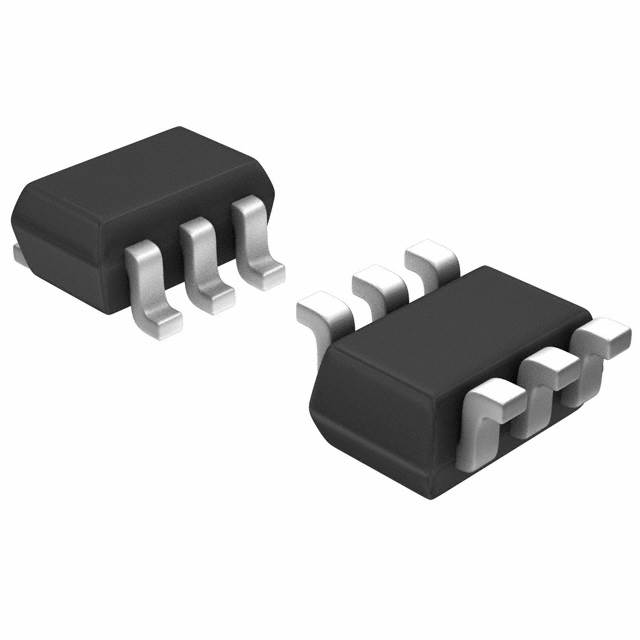
Comparison: NX3008NBKS,115 vs SI2302A MOSFETs
Quick verdict
For low-current, low-voltage switching applications where board space and dual MOSFET integration matter, the NX3008NBKS,115 offers a compact, automotive-grade solution with dual channels and logic-level gate drive. For higher current switching up to 3.6A at 20V, the SI2302A provides significantly lower R_DS(on) (85mΩ vs. ~1.4Ω) and higher continuous drain current, making it the better choice for power switching or load driving up to a few amps.
Spec comparison table
| Spec | NX3008NBKS,115 | SI2302A | Notes |
|---|---|---|---|
| Technology | MOSFET (Metal Oxide) | MOSFET (Metal Oxide) | Same technology |
| Configuration | 2 N-Channel (Dual) | Single N-Channel | NX3008NBKS,115 integrates two devices; SI2302A is single transistor |
| Drain-Source Voltage (V_DS max) | 30 V | 20 V | NX3008NBKS,115 supports higher voltage margin (30V vs 20V) |
| Continuous Drain Current (I_D) | 350 mA | 3.6 A | SI2302A supports 10x higher continuous current |
| Pulsed Drain Current (I_DM) | 1.4 A | 10 A | SI2302A supports much higher pulsed current |
| Gate Threshold Voltage (V_GS(th) typ) | 0.6–1.1 V (typ) | 0.95 V (typ) | Similar threshold voltages, NX3008NBKS,115 has a slightly wider range |
| R_DS(on) @ 4.5 V, I_D typ | 1.0–1.5 Ω | 85 mΩ | SI2302A offers roughly 15x lower on-resistance, critical for conduction losses |
| R_DS(on) max @ 2.5 V, I_D 3.1A | 1.4 Ω (max) | 115 mΩ (max) | SI2302A still much lower at logic-level voltages |
| Gate Charge Qg typ @ 4.5 V | 0.52–0.68 nC | 10 nC | NX3008NBKS,115 has extremely low gate charge, beneficial for switching speed and drive power |
| Input Capacitance C_iss typ | 34–50 pF | 300 pF | NX3008NBKS,115 has ~6x lower input capacitance, easier to drive at high speed |
| Output Capacitance C_oss typ | 6.5 pF | 120 pF | NX3008NBKS,115 has significantly lower output capacitance |
| Reverse Transfer Capacitance C_rss typ | 2.2 pF | 80 pF | NX3008NBKS,115 has much lower reverse transfer capacitance |
| Power Dissipation max | 445 mW | 1.25 W | SI2302A can dissipate nearly 3x more power, reflecting higher current capability |
| Package | 6-TSSOP dual (SOT-363) | SOT-23 (single) | Different packages; NX3008NBKS,115 smaller footprint but dual device |
| Operating Temperature Range | -55°C to +150°C | -55°C to +150°C | Both rated for automotive temperature range |
| ESD Rating | 2 kV (HBM) | 100 nA gate leakage max (low current) | NX3008NBKS,115 explicitly rated for 2 kV ESD; SI2302A gate leakage max is 100 nA |
| Gate-Source Voltage Max | ±8 V | ±8 V | Same gate voltage rating |
| Drain Leakage Current @ 25°C typ | 1 µA | 10 µA (IDSS) | NX3008NBKS,115 has lower leakage current |
| Transient Thermal Impedance (typ) | 0.01–1 K/W (varies by timescale) | 2 °C/W (typ) | SI2302A has much better thermal impedance, reflecting better heat dissipation |
| Switching Times (t_on, t_off typ) | t_on: 15–30 ns; t_off: 69–138 ns | t_on: 15 ns; t_off: 25 ns | SI2302A is faster switching, especially turn-off time |
| Total Power Dissipation typ | 280 mW | 0.8 W | SI2302A handles more power dissipation in practice |
| Forward Transconductance g_fs typ | 310 mS | 8 S | SI2302A’s g_fs is ~25x higher, indicating stronger drive capability |
| Package Dimensions (L x W) | 2.2 mm x 1.35 mm | 1.15 mm x 0.95 mm | SI2302A is smaller footprint, but single device vs dual for NX3008NBKS,115 |
Design trade-offs
The NX3008NBKS,115 targets low-current dual-MOSFET switching with a logic-level gate and very low input and output capacitances. With R_DS(on) around 1.4 Ω at 4.5 V gate drive, it is suitable for signal-level switching and low power loads, not for power switching. Its dual device in a compact 6-TSSOP (SOT-363) package saves board space when two low-current switches are needed, such as level shifting, load switching, or multiplexing in automotive environments. The AEC-Q101 qualification and wide operating temperature range (-55°C to +150°C) make it appropriate for harsh environments.
In contrast, the SI2302A is a single N-channel MOSFET designed for higher current switching up to 3.6A continuous and 10A pulsed, with R_DS(on) as low as 85 mΩ at 4.5 V gate drive — more than an order of magnitude lower than the NX3008NBKS,115. This difference drastically reduces conduction losses and heat generation at moderate currents. Its higher maximum power dissipation (1.25 W typical) and better thermal resistance (~2 °C/W) allow it to be used in power switching or load driving applications such as DC/DC converters, power path switching, or battery management where currents exceed 1A.
Gate charge is another critical difference. The NX3008NBKS,115 has an exceptionally low gate charge (~0.6 nC typical), which is beneficial for fast switching with minimal gate drive power, especially when switching low currents. The SI2302A’s 10 nC gate charge is typical for power MOSFETs and demands a stronger driver or slower switching speeds to avoid excessive losses or EMI.
From a layout perspective, the NX3008NBKS,115’s dual MOSFET in a single package simplifies routing for dual switches but requires attention to thermal dissipation due to its higher R_DS(on) and lower power handling. The SI2302A’s single-channel SOT-23 footprint is very common and compact, with better thermal characteristics, easing heat management.
Cost-wise, the NX3008NBKS,115’s automotive qualification and dual-device integration might raise unit cost but reduce overall system cost by minimizing component count. The SI2302A, being a more conventional single low-R_DS(on) MOSFET, is generally low cost in volume but may require additional components for dual-switch applications.
Use-case fit
Choose NX3008NBKS,115 when…
- You need two low-current (≤350 mA) N-channel MOSFETs in a single compact package to save PCB area.
- Operating voltage up to 30 V is required, offering more voltage headroom than typical 20 V MOSFETs.
- Automotive-grade qualification (AEC-Q101) and operation in harsh temperature environments (-55°C to +150°C) are mandatory.
- Very low gate charge and input capacitance matter to minimize gate drive losses and switching noise at low currents.
- Leakage current must be minimal to avoid parasitic drain currents in sensitive signal lines or battery-powered systems.
Choose SI2302A when…
- Continuous drain currents up to 3.6 A and pulsed currents up to 10 A are needed, e.g., for power switching or load driving.
- Low R_DS(on) at logic-level gate drive (85 mΩ @ 4.5 V) is critical to reduce conduction losses and thermal dissipation.
- Higher power dissipation capability (~1.25 W) is required to handle moderate power loads without additional cooling.
- Smaller single-channel SOT-23 footprint is preferred for compact power stages.
- Faster switching speeds with moderate gate charge are acceptable, and gate drivers can supply ~10 nC per switch transition.
Drop-in compatibility
The NX3008NBKS,115 and SI2302A are not pin-compatible nor footprint-compatible. The NX3008NBKS,115 is a dual MOSFET in a 6-TSSOP (SOT-363) package with six pins for two devices, while the SI2302A is a single