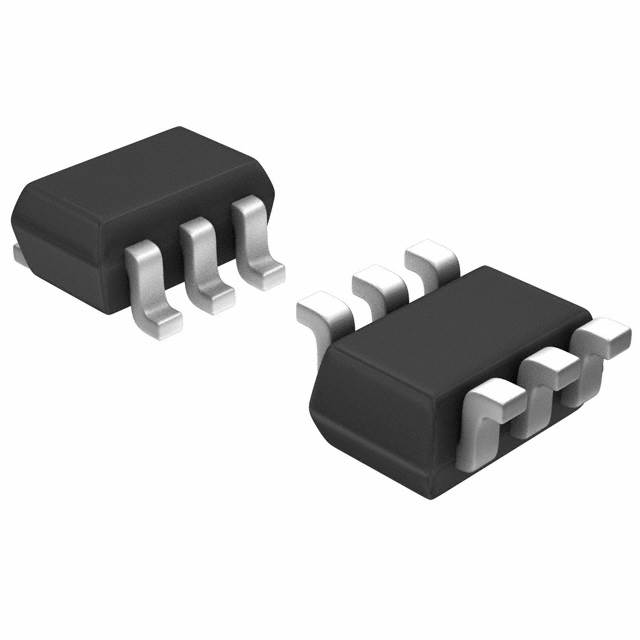
NX3008NBKS,115 vs RQ3E120ATTB: Component Comparison for Power Electronics Engineers
Quick verdict
For low-current, dual N-channel switching or load switching below 350mA at 30V, the NX3008NBKS,115’s integrated dual MOSFET array with logic-level gates and automotive qualification makes it the better choice. For high-current, single P-channel load switching or high-side switching up to 12A at 30V, the RQ3E120ATTB offers vastly superior conduction capability and much lower R_DS(on), though at the cost of significantly higher gate charge and different polarity.
Spec comparison table
| Spec | NX3008NBKS,115 | RQ3E120ATTB | Notes |
|---|---|---|---|
| MOSFET type | Dual N-Channel | Single P-Channel | Different polarity; affects drive and circuit topology. |
| Drain-Source Voltage (V_DS max) | 30 V | 30 V | Equal maximum voltage rating. |
| Continuous Drain Current @ 25°C (I_D max) | 350 mA | 12 A | RQ3E120ATTB supports much higher current. |
| Drain Current Spiking Max | 1.4 A | Not specified | NX3008NBKS supports limited spike current; RQ3E120ATTB not specified. |
| R_DS(on) Typ @ 25°C, V_GS=4.5V | 1.4 Ω @ 350mA | 8 mΩ @ 12 A, 10 V | RQ3E120ATTB offers orders of magnitude lower on-resistance, critical for efficiency at high current. |
| Gate Threshold Voltage V_GS(th) Typ | 1.75 V | 2.5 V @ 1mA | NX3008NBKS is logic-level with lower threshold voltage. |
| Gate Charge Q_g max @ V_GS | 0.68 nC @ 4.5 V | 62 nC @ 10 V | NX3008NBKS has much lower gate charge, enabling faster switching and lower gate drive losses. |
| Input Capacitance C_iss max @ 15 V | 50 pF | 3200 pF | NX3008NBKS has dramatically lower input capacitance, reducing switching losses and EMI. |
| Power Dissipation Max (P_D max) | 445 mW | 2 W (Ta) | RQ3E120ATTB can dissipate more power, suitable for higher load currents. |
| Package | 6-TSSOP (SC-88, SOT-363) | 8-HSMT (3.2x3) | Different package sizes and pin counts; affects PCB layout and thermal management. |
| Operating Temperature Range | -55°C to +150°C | up to 150°C (TJ) | Comparable maximum junction temp; NX3008NBKS specifies wider ambient temp range. |
| Electrostatic Discharge (ESD) Rating | 2000 V | Not specified | NX3008NBKS provides ESD rating; RQ3E120ATTB’s not stated. |
| Gate-Source Voltage Max | ±8 V | ±20 V | RQ3E120ATTB supports higher gate voltage swings, allowing robust gate drive margin. |
| Qualification | AEC-Q101 Automotive | Not specified | NX3008NBKS is automotive qualified; RQ3E120ATTB is not, important for automotive/high-reliability. |
| Total Power Dissipation Typical | 280 mW | Not specified | NX3008NBKS typical power dissipation is low; RQ3E120ATTB data not given for typical dissipation. |
| Transient Thermal Impedance (typical) | 0.01 K/W (10 ns) to 1 K/W (1 ns) | Not specified | NX3008NBKS datasheet provides detailed transient thermal impedance; none for RQ3E120ATTB. |
| Gate Leakage Current (typ) | 0.2 - 1 µA @ 25°C | Not specified | NX3008NBKS data shows low gate leakage; no data for RQ3E120ATTB. |
Design trade-offs
The NX3008NBKS,115 is a dual N-channel MOSFET array optimized for low-current switching applications, with a very low gate charge (0.68 nC at 4.5 V) and extremely low input capacitance (50 pF max). This means it can be driven with minimal gate driver current and can switch relatively fast with low power loss in the gate drive stage. The higher R_DS(on) (typical 1.4 Ω at 350 mA) makes it unsuitable for high-current applications but perfectly adequate for signal-level switching or low-side loads. The dual device integration saves board space and simplifies layout for dual-switch configurations, especially in automotive environments due to its AEC-Q101 qualification and broad temperature range (-55°C to 150°C ambient).
By contrast, the RQ3E120ATTB is a single P-channel MOSFET designed for high-current applications up to 12A continuous at 30V. Its R_DS(on) is extremely low (8 mΩ @ 12A, 10V), enabling efficient conduction with minimal voltage drop and power dissipation in high-current load switching or power path control. However, the gate charge is much higher (62 nC at 10V), requiring a stronger gate drive capability and potentially causing increased switching losses and EMI if switching at high frequency. The input capacitance is also much higher (3200 pF), which further increases gate drive requirements. The P-channel device simplifies high-side switching in some topologies but requires careful gate drive voltage design, given its ±20V max gate-source voltage rating.
Thermally, the RQ3E120ATTB’s 2W power dissipation rating and larger 8-HSMT package allow better heat spreading for high-current operation, whereas the NX3008NBKS,115’s 6-TSSOP package and 445 mW max power dissipation limit its use to lower power levels. The NX3008NBKS also provides detailed transient thermal impedance data, useful for transient thermal modeling and reliability analysis.
From a layout perspective, the NX3008NBKS’s dual device in a small 6-TSSOP footprint is ideal for compact applications requiring two switches close together, reducing parasitics and simplifying routing. The RQ3E120ATTB’s larger footprint accommodates its higher current rating and heat dissipation but occupies more board area and requires more copper for adequate thermal management.
Cost-wise, the NX3008NBKS,115 is likely lower cost per unit due to lower silicon area and simpler drive requirements, especially in automotive-qualified volumes. The RQ3E120ATTB, with its high current rating and larger die, will command a higher price but is necessary where conduction losses and thermal performance at high current are key.
Use-case fit
Choose NX3008NBKS,115 when…
- Designing low-voltage signal switching or level shifting circuits where currents do not exceed 350 mA.
- Implementing dual low-side switches in automotive or industrial environments requiring AEC-Q101 qualification.
- Minimizing gate drive power and complexity is critical due to low gate charge and input capacitance.
- Board space is constrained, and a dual MOSFET array reduces component count and simplifies layout.
- Operating temperature ranges from -55°C to 150°C ambient are required for reliable long-term operation.
Choose RQ3E120ATTB when…
- Switching or controlling loads drawing up to 12 A continuous at 30 V, such as motor drivers, power rails, or battery protection.
- High-side P-channel switching is preferred to simplify positive supply load switching without complex gate drivers.
- Low conduction losses are critical to maintain efficiency and reduce thermal stress at high currents.
- The design can accommodate a larger 8-HSMT package and the associated PCB area and thermal management.
- Gate drive circuitry can supply or handle large gate charge (62 nC) and higher voltage swings (±20V).
Drop-in compatibility
These parts are not pin-compatible or footprint-compatible. The NX3008NBKS,115 is a dual N-channel MOSFET array in a 6-TSSOP package with a small outline and 6 pins, while the RQ3E120ATTB is a single P-channel MOSFET in an 8-HSMT (3.2 mm x 3 mm) package. Substituting one for the other requires redesigning the PCB footprint, gate drive circuitry, and likely the control logic due to different polarity and device count. Electrical characteristics and drive requirements differ substantially, so a direct drop-in replacement is not possible without redesign.
Alternatives to consider
- BSS138 (NXP / ON Semiconductor): Single N-channel MOSFET with low gate charge and low current rating, suitable for signal-level switching.
- IRLZ44N (Infineon / Vishay): High-current N-channel MOSFET with low R_DS(on) and logic-level gate, good for medium-power switching.
- Si2302 (Vishay / Vishay Siliconix): P-channel MOSFET with moderate current rating and low gate charge, a possible alternative for low-to-mid current high-side switching.