Component Comparison: NX3008NBKS,115 vs NX3008PBKS,115
Quick verdict
For low-voltage, low-current switching where N-channel MOSFETs are required, the NX3008NBKS,115 outperforms the P-channel NX3008PBKS,115 due to its lower R_DS(on) (1.4 Ω vs. 4.1 Ω at 4.5 V gate drive) and higher continuous current rating (350 mA vs. 200 mA). Conversely, when a P-channel device is necessary for high-side switching with logic-level drive, the NX3008PBKS,115 is the go-to option despite its higher R_DS(on), as it simplifies the gate drive scheme.
Spec comparison table
| Spec | NX3008NBKS,115 (N-Channel) | NX3008PBKS,115 (P-Channel) | Notes |
|---|---|---|---|
| Configuration | 2 N-Channel (Dual) | 2 P-Channel (Dual) | Choice dictated by application topology; N-ch for low-side, P-ch for high-side switching. |
| Drain-Source Voltage, V_DS max | 30 V | 30 V | Equal voltage rating; no advantage. |
| Continuous Drain Current, I_D @ 25°C | 350 mA | 200 mA | NX3008NBKS supports 75% higher continuous current; better for higher load currents. |
| Drain Current Spiking Max | 1.4 A | Not specified | NX3008NBKS can handle short spikes up to 1.4 A; no data for NX3008PBKS. |
| Maximum Power Dissipation | 445 mW | 445 mW | Equal power rating; thermal dissipation capability similar. |
| R_DS(on) max @ I_D, V_GS | 1.4 Ω @ 350 mA, 4.5 V | 4.1 Ω @ 200 mA, 4.5 V | NX3008NBKS has significantly lower on-resistance, reducing conduction losses. |
| Gate Threshold Voltage V_GS(th) max | 1.1 V @ 250 µA | 1.1 V @ 250 µA | Identical gate threshold; logic-level compatible. |
| Gate Charge Q_G max @ V_GS | 0.68 nC @ 4.5 V | 0.75 nC @ 4.5 V | Slightly lower gate charge on NX3008NBKS; marginally easier to drive at high switching frequencies. |
| Input Capacitance C_iss max @ V_DS | 50 pF @ 15 V | 46 pF @ 15 V | Comparable input capacitance; negligible difference for gate driver design. |
| Output Capacitance C_oss (typ) | 6.5 pF | Not specified | NX3008NBKS data only; output capacitance affects switching losses and EMI. |
| Reverse Transfer Capacitance C_rss (typ) | 2.2 pF | Not specified | NX3008NBKS data only; lower C_rss reduces Miller effect in switching. |
| Gate Leakage Current (typ @ 25°C) | 0.2–1 µA | Not specified | NX3008NBKS low gate leakage improves gate stability; no data for NX3008PBKS. |
| ESD Rating | 2000 V | 2000 V | Equal ESD robustness. |
| Operating Temperature Range | -55°C to +150°C | -55°C to +150°C | Equivalent thermal operating range. |
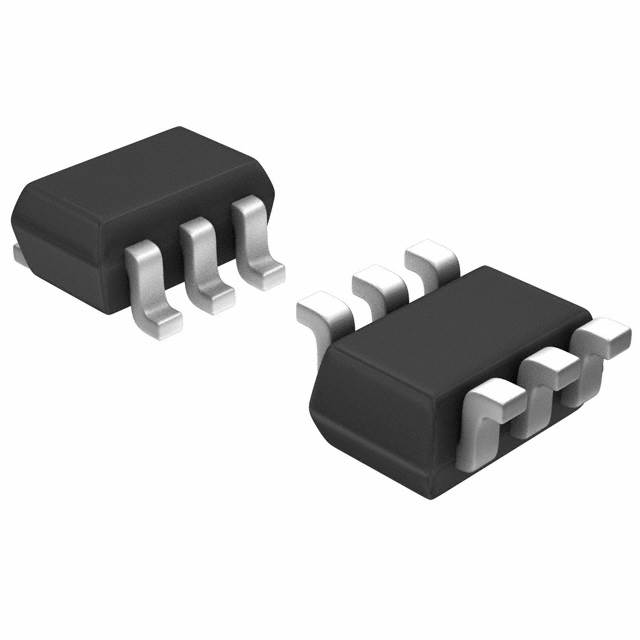
| Package Type | 6-TSSOP (SC-88, SOT-363) | 6-TSSOP (SC-88, SOT-363) | Identical package; footprint likely the same. |
| Total Power Dissipation Typ | 280 mW | Not specified | NX3008NBKS typical power dissipation given; unknown for NX3008PBKS. |
| Transient Thermal Impedance (typ) | 0.5 K/W @ 100 ms | Not specified | NX3008NBKS data only; affects transient thermal response. |
| Forward Transconductance g_fs (typ) | 310 mS | Not specified | NX3008NBKS data only; indicates gain and switching speed. |
Design trade-offs
The primary design trade-off between these two devices hinges on channel type and on-resistance. The NX3008NBKS,115 dual N-channel MOSFET has a lower R_DS(on) of 1.4 Ω at 350 mA and 4.5 V gate drive, compared to the NX3008PBKS,115 dual P-channel MOSFET’s 4.1 Ω at 200 mA and 4.5 V. This difference translates directly into conduction losses, making the N-channel device more efficient for equivalent current loads. For example, at 200 mA load current, the NX3008NBKS dissipates roughly 56 mW (I²R = 0.2² × 1.4), whereas the NX3008PBKS dissipates 164 mW (0.2² × 4.1), nearly three times more power loss.
Thermally, both devices share the same maximum power dissipation rating of 445 mW and similar operating temperature ranges (-55°C to +150°C), but the lower conduction losses of the N-channel device reduce heat generation and simplify thermal management. The NX3008NBKS also provides detailed transient thermal impedance data, enabling more precise thermal modeling, which is absent in the NX3008PBKS datasheet.
Gate drive requirements are similar because both devices are logic-level MOSFETs with comparable gate threshold voltages (max 1.1 V at 250 µA) and gate charge around 0.68–0.75 nC at 4.5 V. The slight difference in gate charge is negligible at typical switching frequencies. However, the P-channel device’s higher on-resistance and lower current rating mean that switching efficiency and thermal performance will be worse under equivalent loads.
From a layout perspective, both come in identical 6-TSSOP packages, which should simplify PCB design. The NX3008NBKS provides more detailed capacitance and switching time data, allowing for better optimization of switching speed and EMI mitigation. The NX3008PBKS lacks detailed switching and capacitance info, which may complicate design for high-frequency switching.
Cost-wise, P-channel MOSFETs generally cost more per die area due to fabrication complexities, and the lower current rating of the NX3008PBKS suggests smaller die size but potentially lower performance. Pricing at volume will depend on supplier and demand; typically, N-channel devices are more cost-effective for equivalent specs.
Use-case fit
Choose NX3008NBKS,115 when:
- Designing low-voltage, low-current load switches or level shifters requiring dual N-channel MOSFETs for low-side switching.
- Efficiency and thermal dissipation are critical, and the load current approaches or exceeds 200 mA.
- Fast switching with minimal gate charge and low input capacitance is needed for PWM or digital load control.
- Automotive applications needing AEC-Q101-qualified N-channel devices with robust ESD protection.
- Tight thermal budgets require minimizing conduction losses to stay within 445 mW power dissipation.
Choose NX3008PBKS,115 when:
- The design requires dual P-channel MOSFETs for high-side switching at voltages up to 30 V.
- Logic-level gate drive is needed without an additional high-side driver or bootstrap circuit.
- Load currents are low, not exceeding 200 mA, and higher conduction losses are acceptable.
- Automotive qualification (AEC-Q101) with P-channel MOSFETs is mandatory.
- PCB real estate constraints favor a compact dual MOSFET in a 6-TSSOP package with integrated P-ch devices.
Drop-in compatibility
Both parts share the same 6-TSSOP package and appear to be dual MOSFET arrays, but one is dual N-channel and the other dual P-channel. This fundamental difference means they are not pin-compatible for direct substitution without circuit modifications. The pin functions related to source, drain, and gate will differ in polarity and operating conditions. The datasheets do not explicitly confirm pin-to-pin compatibility. Substituting one for the other requires redesign of the gate drive circuitry and possibly changes to the PCB layout due to differing electrical behavior.
Alternatives to consider
- BSS138 (Nexperia): A single N-channel logic-level MOSFET with lower current capabilities but very low gate charge, suitable for ultra-low-power applications.
- Si2333CDS (Vishay): A dual P-channel MOSFET array with similar voltage rating but potentially lower R_DS(on), worth evaluating for high-side switching.
- FDN337N (Fairchild/ON Semiconductor): Single N-channel MOSFET with low R_DS(on) and logic-level gate drive, useful if a single transistor per channel is acceptable over dual arrays.
This comparison focuses on the practical implications of the electrical parameters and package details to guide engineers in selecting the appropriate MOSFET array for low-voltage, low-current automotive or industrial applications.