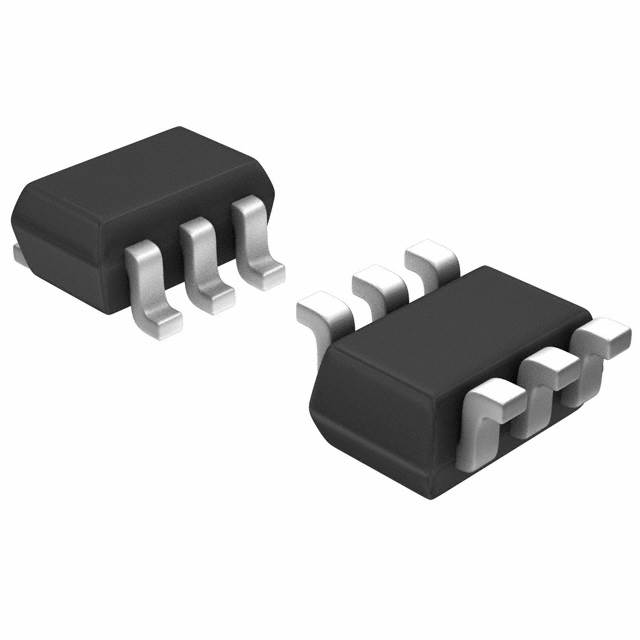
NX3008NBKS,115 vs MCM3400A-TP MOSFET Array Comparison
Quick verdict
For low-current, low-power switching applications where board space is tight and logic-level drive compatibility is critical, the NX3008NBKS,115 offers a compact, automotive-grade solution with modest current and power ratings. Conversely, for higher current loads (up to 5 A continuous) and higher power dissipation requirements, the MCM3400A-TP is the clear choice, delivering significantly lower on-resistance and higher current capacity at the cost of a larger package and higher gate drive voltage.
Spec comparison table
| Spec | NX3008NBKS,115 | MCM3400A-TP | Notes |
|---|---|---|---|
| Configuration | 2 N-Channel (Dual) | 2 N-Channel (Dual) | Equivalent configuration |
| Continuous Drain Current (typ) @ 25°C | 350 mA | 5 A | MCM3400A-TP supports >14x higher continuous current |
| Continuous Drain Current (min) | 350 mA | 4 A | MCM3400A-TP guaranteed higher minimum current |
| Drain Current Max (pulsed) | 1.4 A | 20 A | MCM3400A-TP supports much higher pulsed current |
| Drain-Source Voltage Max | 30 V | 30 V | Equivalent voltage rating |
| Drain-Source On Resistance (typ) @ 25°C | 1.4 Ω | 38 mΩ | MCM3400A-TP has ~37x lower R_DS(on), drastically reducing conduction losses |
| Drain-Source On Resistance (max) | 1.4 Ω | 45 mΩ | MCM3400A-TP better max R_DS(on) |
| Gate Threshold Voltage (typ) | 1.75 V | 0.9 V | MCM3400A-TP has lower threshold, easier to fully turn on at lower gate voltages |
| Gate Threshold Voltage (max) | 1.1 V | 1.5 V | NX3008NBKS,115 tighter max gate threshold spec |
| Gate-Source Voltage Max | ±8 V | ±12 V | MCM3400A-TP supports higher gate voltage swings |
| Gate Charge (Q_g) | 0.68 nC @ 4.5V | Not specified | NX3008NBKS,115 has very low gate charge, beneficial for fast switching |
| Input Capacitance (C_iss) @ 15 V | 50 pF | 1155 pF | NX3008NBKS,115 has far lower input capacitance, easier gate drive at high speeds |
| Reverse Transfer Capacitance (C_rss) | 2.2 pF | Not specified | Lower C_rss helps reduce Miller effect, NX3008NBKS,115 advantage |
| Power Dissipation Max | 445 mW | 1.4 W | MCM3400A-TP can dissipate >3x power |
| Package | 6-TSSOP (2.2 x 1.35 mm) | 6-VDFN Exposed Pad (2.0 x 2.0 mm) | NX3008NBKS,115 smaller footprint but no exposed pad for thermal dissipation |
| Thermal Resistance Junction-to-Ambient | 300 K/W | 89 °C/W (approx. 89 K/W) | MCM3400A-TP better thermal resistance, helps with heat dissipation |
| Junction Temperature Range | -55 °C to +150 °C | -55 °C to +150 °C | Equivalent |
| ESD Rating | 2000 V | Not specified | NX3008NBKS,115 ESD rating specified |
| Diode Forward Voltage Max | Not specified | 1 V | MCM3400A-TP body diode forward voltage specified, useful for synchronous rectification |
| Gate Leakage Current Typical @ 25°C | ~1 µA | Max 100 nA | MCM3400A-TP has lower max gate leakage, beneficial for low leakage designs |
| Switching Frequency (typ) | Not specified | 1 MHz | MCM3400A-TP rated for higher switching frequency |
| Pulsed Drain Current Max | Not specified | 20 A | MCM3400A-TP supports high transient currents |
| Total Power Dissipation (typ) | 280 mW | 1.4 W | MCM3400A-TP supports higher continuous power dissipation |
| Gate Resistance Min | Not specified | 1.7 Ω | MCM3400A-TP internal gate resistance could affect gate drive speed |
| Storage Temperature Range | -65 °C to +150 °C | -55 °C to +150 °C | NX3008NBKS,115 slightly wider storage temperature range |
| Supplier Device Package | 6-TSSOP | DFN2020-6L | Different package types, impacts layout and thermal management |
Design trade-offs
The NX3008NBKS,115 targets low-current, low-power applications where board space and gate drive simplicity are priorities. Its low input capacitance (~50 pF) and low gate charge (0.68 nC at 4.5 V) enable fast switching with minimal gate drive energy, which benefits battery-powered or low-noise designs. However, its high on-resistance (~1.4 Ω) and low continuous current rating (350 mA) limit its use to signal-level switching or load switching of small currents.
In contrast, the MCM3400A-TP is designed for significantly higher power applications with continuous currents up to 5 A and pulsed currents up to 20 A. Its on-resistance is an order of magnitude lower (~38 mΩ typical), drastically reducing conduction losses and heat generation. The larger exposed pad DFN package improves thermal dissipation, reflected in its lower thermal resistance (~89 K/W vs 300 K/W), which is critical for maintaining junction temperature under higher power loads.
From a gate drive standpoint, the NX3008NBKS,115 supports logic-level gates with thresholds around 1.75 V but requires lower gate voltages (±8 V max). The MCM3400A-TP has a wider gate voltage range (±12 V) and a lower typical threshold (0.9 V), but its higher input capacitance (1.2 nF) and internal gate resistance (1.7 Ω min) demand a stronger gate driver, especially for high-frequency switching. This also means switching losses will be higher at equivalent frequencies unless carefully designed.
Layout-wise, the MCM3400A-TP’s exposed pad and larger footprint facilitate better heat sinking but require careful PCB thermal design to fully leverage this advantage. The NX3008NBKS,115’s smaller TSSOP package is easier to place in dense layouts but will need derating for power dissipation and may require thermal vias or copper pours to manage heat.
Cost-wise, although pricing data is not provided here, the NX3008NBKS,115’s simpler, smaller package and lower current rating will generally translate to lower cost in volume. The MCM3400A-TP’s superior conduction and thermal performance come at a likely higher price point and increased BOM complexity due to more robust gate driving requirements.
Use-case fit
Choose NX3008NBKS,115 when…
- Switching or level shifting low-current signals (≤350 mA) in space-constrained automotive or industrial environments.
- Implementing logic-level MOSFET switches directly driven by microcontrollers with limited drive strength.
- Designing low power load switches or small solenoid drivers where conduction losses are minimal.
- Thermal dissipation must be managed within tight space without active cooling.
- AEC-Q101 qualification and automotive-grade reliability are required.
Choose MCM3400A-TP when…
- Switching loads up to 5 A continuous, such as higher current motor phases, LED drivers, or power rails.
- Operating at switching frequencies up to 1 MHz where low R_DS(on) reduces conduction losses substantially.
- Thermal management is feasible with exposed pad PCB layout and possibly heat sinking.
- Gate drivers capable of delivering higher peak currents and handling 12 V gate drive voltage are available.
- Applications require fast pulsed switching (up to 20 A) with minimal conduction and switching losses.
Drop-in compatibility
These two MOSFET arrays are not drop-in compatible in terms of footprint or pinout. The NX3008NBKS,115 comes in a 6-TSSOP package (2.2 x 1.35 mm) without an exposed pad, while the MCM3400A-TP is in a 6-pin DFN2020-6L package (2.0 x 2.0 mm) with an exposed thermal pad. Pin assignments and thermal pad connections will differ, requiring PCB redesign.
Gate drive voltage ranges differ as well (±8 V max vs ±12 V), so direct substitution without verifying gate drive circuitry is unsafe. Thermal dissipation and layout will also need reconsideration due to differing thermal resistances and package styles.
Alternatives to consider
- **Nexperia PSMN2