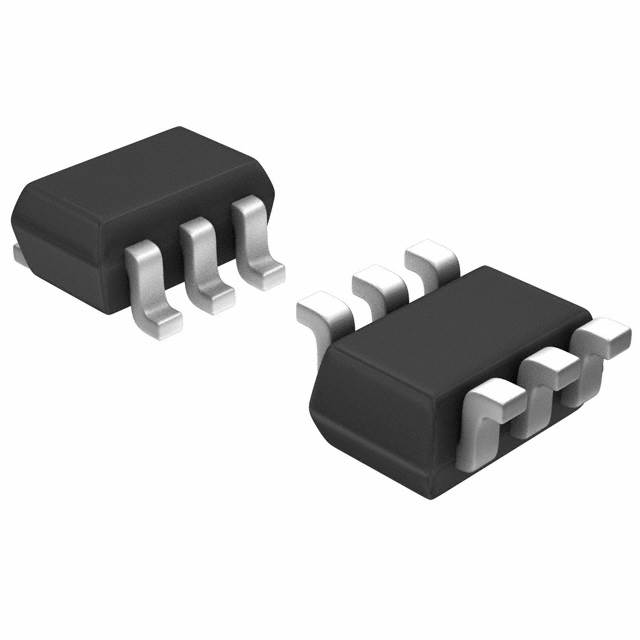
Component Comparison: NX3008NBKS,115 vs IMT40R011M2HXTMA1
1. Quick verdict
For low-voltage, low-current switching applications (under 30 V, sub-1 A), the NX3008NBKS,115 is the clear choice due to its logic-level gate drive and dual MOSFET array in a tiny 6-TSSOP package. Conversely, for high-voltage, high-current power switching (up to 400 V, tens of amps), the IMT40R011M2HXTMA1 stands out with its SiC technology, low R_DS(on) of 11.3 mΩ, and high avalanche energy, despite needing a higher gate drive voltage and larger footprint.
2. Spec comparison table
| Spec | NX3008NBKS,115 | IMT40R011M2HXTMA1 | Notes |
|---|---|---|---|
| Technology | MOSFET (Metal Oxide) | SiCFET (Silicon Carbide) | SiC offers higher voltage, temperature, and switching speed capability |
| Configuration | 2 N-Channel (Dual) | Single N-Channel | Dual MOSFET array vs single transistor; affects application flexibility |
| Drain-Source Voltage (max) | 30 V | 400 V | IMT40R011M2HXTMA1 supports >10× higher voltage |
| Continuous Drain Current (typ) | 350 mA | 13.4 A (Ta), 144 A (Tc) | IMT40R011M2HXTMA1 handles >30× higher current at ambient; junction Tc rating critical |
| Pulsed Drain Current (max) | 1.4 A | 432 A (typ) | IMT40R011M2HXTMA1 can handle large current surges |
| Drain-Source On-State Resistance (R_DS(on)) (typ @ 25°C) | 1 – 1.4 Ω @ 350 mA, 4.5 V | 11.3 mΩ @ 37.1 A, 18 V | IMT40R011M2HXTMA1 has drastically lower R_DS(on), suitable for high current and efficiency |
| Gate Threshold Voltage (V_GS(th)) (typ) | 0.6 – 1.1 V | 4.5 V | NX3008NBKS,115 has logic-level gate drive; IMT40R011M2HXTMA1 requires higher gate voltage |
| Gate Charge (Q_g) | 0.52 – 0.68 nC @ 4.5 V | 85 nC @ 18 V | NX3008NBKS,115 gate charge is ~100× smaller, easier to drive at low voltages |
| Input Capacitance (C_iss) (typ) | 34 – 50 pF | 3770 pF @ 200 V | NX3008NBKS,115 has very low gate capacitance, enabling faster switching |
| Power Dissipation (max) | 445 mW | 3.8 W (Ta), 429 W (Tc) | IMT40R011M2HXTMA1 dissipates much higher power, indicating suitability for high-power use |
| Operating Temperature Range (TJ) | -55°C to +150°C | -55°C to +175°C | IMT40R011M2HXTMA1 supports higher max TJ |
| Package | 6-TSSOP (2.2 x 1.35 mm) | PG-HSOF-8-2 (approx. 10.5 x 9.7 mm) | NX3008NBKS,115 is much smaller, suitable for compact designs |
| Thermal Resistance Junction-to-Ambient (typ) | 300 K/W (per device) | 40 °C/W | IMT40R011M2HXTMA1 package and construction allow better heat dissipation |
| Avalanche Energy (single pulse) | Not specified | 220 mJ (typ) | IMT40R011M2HXTMA1 can absorb significant energy spikes |
| ESD Rating | 2000 V (max) | Not specified | NX3008NBKS,115 has explicit ESD rating |
| Gate Voltage Max | ±8 V | +23 V / -7 V (static), +25 V / -10 V (transient) | IMT40R011M2HXTMA1 supports higher gate drive voltages but requires careful drive design |
| Switching Speeds (t_rise / t_fall typical) | t_rise: 11 ns, t_fall: 19 ns (typ) | Not explicitly specified | NX3008NBKS,115 suitable for fast switching at low voltage |
| Total Power Dissipation (typ) | 280 mW | Not specified | NX3008NBKS,115 limited power dissipation |
| Grade / Qualification | Automotive, AEC-Q101 | None specified | NX3008NBKS,115 qualified for automotive use |
3. Design trade-offs
The NX3008NBKS,115 targets low-voltage, low-current logic-level switching with a dual MOSFET array in a tiny 6-TSSOP package. Its low gate charge (under 1 nC) and low input capacitance (50 pF max) reduce gate driver complexity and switching losses at low voltages, making it ideal for signal-level switching or load switching in compact, space-constrained designs. However, its relatively high R_DS(on) (1–1.4 Ω at 350 mA) and low current rating limit it to low-power applications. Thermal management is minimal due to the low power dissipation capability (~445 mW max), and the high thermal resistance (300 K/W typical) means even modest currents can cause significant junction temperature rise without careful PCB thermal design.
In contrast, the IMT40R011M2HXTMA1 is a single SiC MOSFET optimized for high-voltage (400 V) and high-current (13.4 A ambient, 144 A case) power applications. Its R_DS(on) of 11.3 mΩ at 37 A and 18 V gate drive is orders of magnitude lower than the NX3008NBKS,115, significantly reducing conduction losses in high current scenarios. The trade-off is a much higher gate charge (~85 nC at 18 V), necessitating a robust gate driver capable of delivering higher peak currents and voltage swings. The IMT40R011M2HXTMA1’s larger package (PG-HSOF-8-2) supports better thermal dissipation, reflected in its low thermal resistance (~40 °C/W typical junction-to-ambient) and high power handling (up to 429 W at case temperature). This enables operation at high switching frequencies and fast switching speeds, critical for power conversion and motor drive applications.
The NX3008NBKS,115 logic-level gate threshold (typ. 0.6–1.1 V) contrasts sharply with the IMT40R011M2HXTMA1’s 4.5 V threshold, meaning the former can be driven directly from low-voltage logic or microcontroller pins. The IMT40R011M2HXTMA1 requires dedicated gate drivers supplying 18 V to fully enhance the channel and minimize R_DS(on). This demands additional board area and BOM cost, as well as careful layout to minimize gate ringing and voltage overshoot given the higher gate voltages and larger gate charge.
From a layout perspective, the NX3008NBKS,115’s 6-TSSOP footprint is small and suited for dense, space-limited designs, but thermal dissipation is a challenge and must be handled via PCB copper area and possibly thermal vias. The IMT40R011M2HXTMA1’s larger package includes a thermal pad designed for efficient heat sinking, which must be soldered to a PCB copper plane or a heat sink for optimal performance. The larger package also increases board space and may require additional mechanical considerations.
Cost at volume will typically be significantly higher for the IMT40R011M2HXTMA1 due to SiC technology, higher current rating, and larger package, making it impractical for low-power switching. The NX3008NBKS,115 is likely a low-cost option for low-voltage load switching or signal multiplexing.
4. Use-case fit
Choose NX3008NBKS,115 when…
- You need a dual N-channel MOSFET array for low-voltage (≤30 V), low-current (<0.5 A) switching in a compact 6-TSSOP package.
- Driving loads or signals directly from 3.3 V or 5 V logic without a dedicated gate driver.
- Automotive or harsh environment applications requiring AEC-Q101 qualification.
- Power dissipation is under 445 mW; for example, switching small indicator LEDs, signal routing, or low-current load switching.
- Minimizing PCB space and component count is a priority.
Choose IMT40R011M2HXTMA1 when…
- Operating at high voltage up to 400 V, such as in power factor correction, motor drives, or power supplies.
- Handling continuous currents from 10 A up to 144 A (case temperature) with low conduction losses due to 11.3 mΩ R_DS