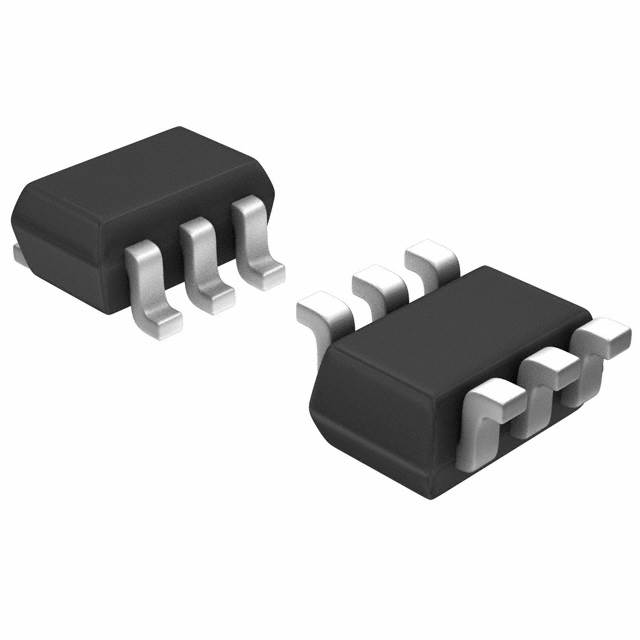
Component Comparison: NX3008NBKS,115 vs IMBG120R040M2HXTMA1
1. Quick verdict
For low-voltage, low-current switching and signal-level applications, the NX3008NBKS,115 is preferable due to its logic-level gate drive, ultra-low current rating (350mA), and dual MOSFET array format. For high-voltage, high-current power conversion tasks such as motor drives or power supplies, the IMBG120R040M2HXTMA1 dominates with its 1200 V rating, 52 A continuous drain current, and significantly lower on-resistance.
2. Spec comparison table
| Spec | NX3008NBKS,115 | IMBG120R040M2HXTMA1 | Notes |
|---|---|---|---|
| Technology | MOSFET (Metal Oxide) | SiCFET (Silicon Carbide) | SiC offers higher voltage and switching speed capabilities |
| Configuration | 2 N-Channel (Dual) | Single N-Channel | Dual MOSFET array vs. single transistor |
| Drain-Source Voltage Max (V) | 30 V | 1200 V | IMBG120R040M2HXTMA1 supports very high voltage applications |
| Continuous Drain Current (A) | 0.35 A | 52 A (Tc) | IMBG120R040M2HXTMA1 supports >100x higher current |
| Maximum Power Dissipation (W) | 0.445 W | 250 W (Tc) | IMBG120R040M2HXTMA1 can dissipate much more heat |
| R_DS(on) Typ @ 25°C | 1 to 1.4 Ω @ 350mA, 4.5V | 39.6 mΩ @ 17.5A, 18V | IMBG120R040M2HXTMA1 offers orders of magnitude lower on-resistance |
| Gate Threshold Voltage Typ (V) | 0.6–1.1 V | 4.2 V | NX3008NBKS,115 logic-level gate drive (low Vth) better for direct MCU drive |
| Gate Charge Qg Typ (nC) | 0.52–0.68 nC @ 4.5V | 39 nC @ 18 V | NX3008NBKS,115 gate charge is ~60x lower, easier/faster to drive |
| Input Capacitance Ciss Typ (pF) | 34–50 pF | 1310 pF @ 800 V | NX3008NBKS,115 has much lower gate input capacitance, reducing drive losses |
| Output Capacitance Coss Typ (pF) | 6.5 pF | 55 pF | Lower output capacitance reduces switching losses on NX3008NBKS,115 |
| Reverse Transfer Capacitance Crss Typ (pF) | 2.2 pF | 4.7 pF | NX3008NBKS,115 has lower Crss, beneficial for switching speed |
| Avalanche Energy Single (mJ) | Not specified | 220 mJ | IMBG120R040M2HXTMA1 can handle avalanche energy, suitable for inductive loads |
| Avalanche Energy Repetitive Typ (mJ) | Not specified | 1.1 mJ | Relevant for robustness in hard switching environments |
| Max Junction Temperature (°C) | 150 °C | 200 °C | IMBG120R040M2HXTMA1 supports higher TJ, better for harsh thermal environments |
| Ambient Operating Temperature Range (°C) | -55 to +150 °C | -55 to +175 °C | IMBG120R040M2HXTMA1 has wider operating range |
| Package Type | 6-TSSOP (Dual MOSFET array) | PG-TO263-7-12 (TO-263 style) | NX3008NBKS,115 is small SMT; IMBG120R040M2HXTMA1 is larger power package |
| Package Dimensions (L×W×H mm) | 2.2 × 1.35 × (height not specified) | 4.2–5.2 × 2.3 × 1.27–1.37 | NX3008NBKS,115 smaller footprint |
| Power Dissipation Typ (W) | 0.28 W | 250 W | IMBG120R040M2HXTMA1 supports much higher power dissipation |
| Thermal Resistance Junction-to-Ambient (K/W) | 300 K/W (typ, device) | 0.6 K/W (typ) | IMBG120R040M2HXTMA1 package designed for heat sinking and high power |
| Gate Leakage Current Typ (nA) | 1–10 nA | 120 nA | NX3008NBKS,115 has lower gate leakage, important for low-power control circuits |
| Turn-On Delay Time Typ (ns) | 15–30 ns | Not specified | NX3008NBKS,115 switching times provided; IMBG120R040M2HXTMA1 datasheet omits typical |
| Turn-Off Delay Time Typ (ns) | 69–138 ns | Not specified | Same as above |
| Peak Drain Current Typ (A) | 1.4 A | 180 A | IMBG120R040M2HXTMA1 supports much higher transient current |
| ESD Rating (V) | 2000 V | Not specified | NX3008NBKS,115 has specified ESD rating |
| Grade / Qualification | Automotive AEC-Q101 | None specified | NX3008NBKS,115 is automotive qualified |
| Gate Drive Voltage Max/Min (V) | ±8 V | +23 V / -10 V | IMBG120R040M2HXTMA1 requires higher gate voltage drive |
| Forward Transconductance Typ (S) | 310 mS | 11.8 S | IMBG120R040M2HXTMA1 has much higher transconductance, reflecting larger current capacity |
3. Design trade-offs
The NX3008NBKS,115 is a low-voltage dual MOSFET array optimized for signal-level and switching tasks below 30 V and around 350 mA continuous current. Its logic-level gate threshold (typ 0.6–1.1 V) and very low gate charge (~0.6 nC) make it ideal for direct drive from low-voltage logic or microcontrollers with limited drive strength. The small 6-TSSOP package supports high-density PCB layouts in space-constrained applications but comes with limited power dissipation (~0.445 W max) and relatively high on-resistance (~1.2 Ω typical at 350 mA). Thermal management is minimal, and the high thermal resistance (~300 K/W) means power dissipation must be kept low to avoid excessive junction temperature rise.
In contrast, the IMBG120R040M2HXTMA1 targets high-voltage (1200 V) power applications with continuous current capability up to 52 A and power dissipation up to 250 W (Tc). The SiC technology enables very low R_DS(on) (~39.6 mΩ at 17.5 A), which translates into significantly lower conduction losses at high currents, improving efficiency in power converters or motor drives. However, the gate threshold voltage is high (typ 4.2 V), and gate charge is substantial (39 nC @ 18 V), requiring a dedicated gate driver capable of 15–18 V drive voltage and sufficient current capability for fast switching. The larger PG-TO263 package supports thermal conduction via heat sinks or PCB copper layers, with a thermal resistance around 0.6 K/W typical, suitable for high-power dissipation.
From a layout perspective, the NX3008NBKS,115’s low input capacitance and quick switching times simplify gate driver design and reduce EMI concerns in low-power switching. The IMBG120R040M2HXTMA1’s significantly larger input capacitance (1310 pF at 800 V) and gate charge require careful gate driver optimization and PCB layout to minimize parasitic inductances that can cause voltage overshoot or switching losses. The IMBG120R040M2HXTMA1 also supports avalanche energy absorption, which is critical in inductive load switching and rugged power applications.
Cost-wise, the NX3008NBKS,115 is likely cheaper per unit, given its simpler technology, smaller package, and lower voltage/current ratings. The IMBG120R040M2HXTMA1, being a SiC MOSFET with high voltage and current specs, commands a significantly higher price point but is necessary for high-power, high-voltage systems.
4. Use-case fit
Choose NX3008NBKS,115 when…
- Designing low-voltage (≤30 V) load switches or level shifters with ≤350 mA current.
- Implementing dual low-side or high-side switches in compact space, leveraging the dual MOSFET array.
- Driving directly from low-voltage logic or microcontrollers without a