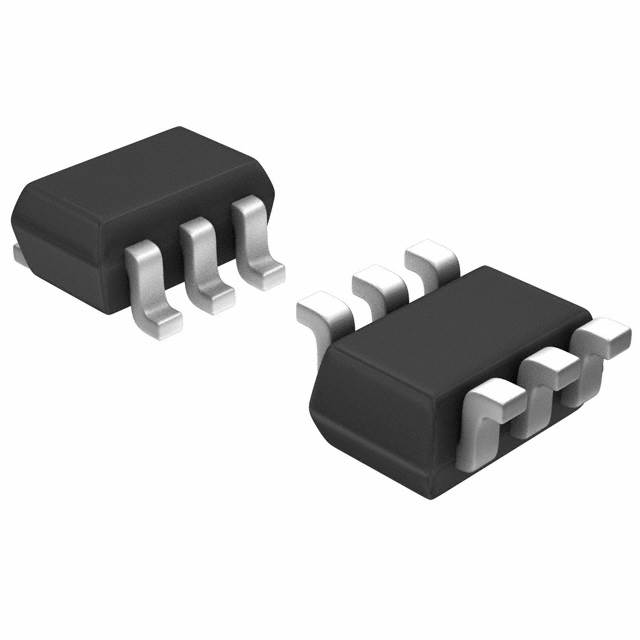
Component Comparison: NX3008NBKS,115 vs IMBG120R022M2HXTMA1
1. Quick verdict
For low-voltage, low-current signal switching or level shifting where space and gate charge matter, the NX3008NBKS,115 is the clear choice due to its low gate charge, small package, and logic-level drive. For high-voltage, high-current power conversion — especially in industrial or automotive traction inverters — the IMBG120R022M2HXTMA1 is the only viable option, offering 1200 V blocking, 87 A continuous current, and SiC technology for efficiency and thermal robustness.
2. Spec comparison table
| Spec | NX3008NBKS,115 | IMBG120R022M2HXTMA1 | Notes |
|---|---|---|---|
| Technology | MOSFET (Metal Oxide) | SiCFET (Silicon Carbide) | SiC enables higher voltage, temperature, and efficiency at cost of complexity |
| Fet type | 2 N-Channel (Dual) | N-Channel | NX3008NBKS has dual devices; IMBG120R022M2HXTMA1 is single but high power |
| Drain-Source Voltage (Vds) max | 30 V | 1200 V | IMBG120R022M2HXTMA1 supports 40x higher voltage, essential for high-voltage systems |
| Continuous Drain Current (Id) @ 25°C | 350 mA | 87 A (Tc) | IMBG120R022M2HXTMA1 supports ~250x higher current, suitable for power applications |
| Drain Current Spiking Max | 1.4 A | 310 A (typ peak) | IMBG120R022M2HXTMA1 handles large surge currents |
| Rds(on) Typ @ 25°C | 1.0 – 1.4 Ω @ 350 mA, 4.5 V | 21.6 mΩ @ 32.1 A, 18 V | IMBG120R022M2HXTMA1 has orders of magnitude lower Rds(on), critical for high current |
| Gate Threshold Voltage (Vgs_th) Typ | 0.6 – 1.1 V | 4.2 V | NX3008NBKS is logic-level (lower gate drive voltage) |
| Gate Charge (Qg) Typical | 0.52 – 0.68 nC @ 4.5 V | 71 nC @ 18 V | NX3008NBKS has extremely low gate charge, reducing gate drive losses |
| Input Capacitance (Ciss) Typ | 34 – 50 pF @ 15 V | 100 pF – 2330 pF @ 800 V | NX3008NBKS input capacitance is much lower, easier to drive at logic level |
| Output Capacitance (Coss) Typ | 6.5 pF | 131.3 pF | NX3008NBKS has lower output capacitance, beneficial in fast switching at low power |
| Reverse Transfer Capacitance (Crss) Typ | 2.2 pF | 9 pF | Lower Crss in NX3008NBKS reduces Miller effect and switching losses |
| Max Power Dissipation | 445 mW | 385 W (Tc) | IMBG120R022M2HXTMA1 can handle ~860x more power dissipation |
| Operating Temperature Range | -55 to +150 °C | -55 to +175 °C | IMBG120R022M2HXTMA1 supports higher max TJ, useful for harsh environments |
| Package | 6-TSSOP (2.2 × 1.35 mm) | PG-TO263-7-12 (5.2 × 4.5 mm) | NX3008NBKS is much smaller, suitable for dense PCB layouts |
| Thermal Resistance (RθJA) Typ | 300 K/W per device | 0.39 K/W | IMBG120R022M2HXTMA1 requires heavy heatsinking, NX3008NBKS dissipates less power |
| ESD Rating | 2000 V | Not specified | NX3008NBKS is qualified for 2 kV ESD, IMBG120R022M2HXTMA1 data missing |
| Qualification | AEC-Q101 (Automotive Grade) | Not specified | NX3008NBKS suitable for automotive reliability programs |
| Gate Voltage Max/Min | ±8 V | +23 V / -10 V | IMBG120R022M2HXTMA1 needs higher gate drive voltages, increasing gate driver complexity |
| Turn-On Delay / Rise Time (Typ) | 15–30 ns / 11 ns | 6 ns / 16.9 ns | IMBG120R022M2HXTMA1 switches faster, but with higher gate voltage and charge |
| Turn-Off Delay / Fall Time (Typ) | 69–138 ns / 19 ns | 11.3 ns / 7.4 ns | IMBG120R022M2HXTMA1 is faster, beneficial in high-frequency switching |
| Drain Leakage Current Typ @ 25°C | 1 µA | 4.7 µA | NX3008NBKS has lower leakage, but both low enough for most applications |
| Gate Leakage Current Typ | 0.2 – 1 µA (varies with Vgs) | 120 nA | IMBG120R022M2HXTMA1 has significantly lower gate leakage current |
| Package Footprint Dimensions | 2.2 × 1.35 mm | 5.2 × 4.5 mm | NX3008NBKS footprint is ~1/10th area of IMBG120R022M2HXTMA1 |
| Power Dissipation (typ) | 280 mW | 385 W | IMBG120R022M2HXTMA1 designed for high power dissipation |
| Avalanche Energy (typ) | Not specified | 403 mJ | IMBG120R022M2HXTMA1 supports avalanche capability, important for rugged power stages |
| Short Circuit Withstand Time (typ) | Not specified | 2 µs | IMBG120R022M2HXTMA1 can survive short circuit pulses |
3. Design trade-offs
The NX3008NBKS,115 and IMBG120R022M2HXTMA1 are fundamentally different devices targeting vastly different applications. The NX3008NBKS,115 is a low-voltage dual MOSFET in a small 6-TSSOP package, optimized for signal-level switching and low current loads. Its extremely low gate charge (~0.6 nC), low input capacitance, and logic-level gate threshold voltage (~0.6–1.1 V) make it easy to drive directly from low-voltage CMOS or MCU GPIOs without dedicated gate drivers or charge pumps. This simplifies the driver circuitry and reduces PCB complexity. However, its Rds(on) is high (~1 Ω at 350 mA), and it cannot handle currents beyond a few hundred milliamps.
In contrast, the IMBG120R022M2HXTMA1 is a high-voltage (1200 V), high-current (87 A continuous) SiC MOSFET designed for power conversion in industrial, automotive, or renewable energy systems. Its extremely low Rds(on) of 21.6 mΩ at 32.1 A drastically reduces conduction losses at tens of amps. However, it requires a high gate drive voltage (15–18 V recommended) and has a large total gate charge (~71 nC), necessitating a dedicated gate driver IC and careful gate drive design to minimize switching losses and avoid gate voltage overshoot. Its switching times are much faster than NX3008NBKS (6–11 ns turn-on/off delay), but this requires careful layout to avoid EMI and voltage ringing.
Thermally, NX3008NBKS dissipates less than 0.5 W max and can rely on PCB copper for heat sinking, whereas IMBG120R022M2HXTMA1 dissipates hundreds of watts and needs a large copper area and heatsink or active cooling. The TO-263 package of the IMBG supports thermal conduction to a heat sink, but increases PCB area and complicates mechanical design.
Regarding efficiency, the SiC device is designed for high-efficiency power stages where switching losses and conduction losses dominate. The NX3008NBKS,115 is not intended for power switching but for low-level signals or load switching under 1 A.
Cost-wise, the NX3008NBKS,115 is a low-cost, high-volume automotive-grade device with AEC-Q101 qualification, suitable for mass-market products. The IMBG120R022M2HXTMA1 is a specialized, more expensive SiC MOSFET with a niche in high-voltage power electronics.
4. Use-case fit
Choose NX3008NBKS,115 when…
- You need a compact dual N-channel MOSFET for level shifting or low-current load switching (≤350 mA).
- The