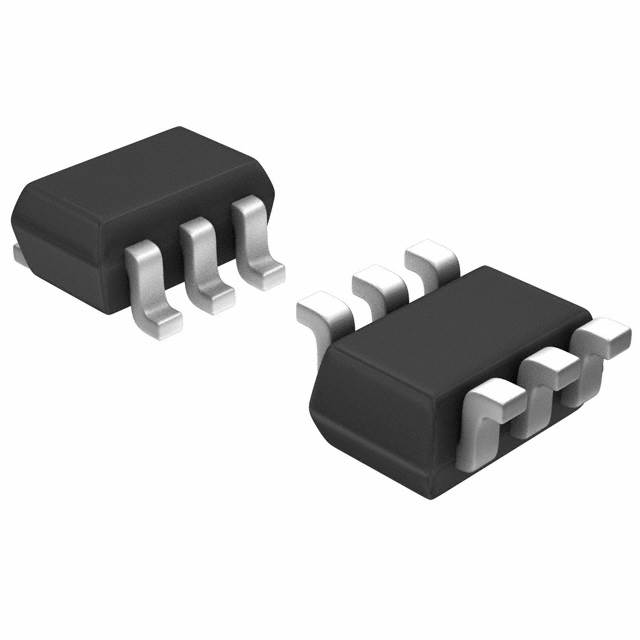
NX3008NBKS,115 vs IMBF170R450M1XTMA1 MOSFET Comparison
Quick verdict
For low-voltage, low-current switching or signal-level applications requiring dual-channel functionality and automotive-grade qualification, the NX3008NBKS,115 is the clear choice due to its logic-level gate drive and compact 6-TSSOP package. Conversely, for high-voltage, high-current power conversion tasks—especially where ruggedness and high blocking voltage (1700 V) are mandatory—the IMBF170R450M1XTMA1 stands out with its SiC technology and significantly higher current and power ratings.
Spec comparison table
| Spec | NX3008NBKS,115 | IMBF170R450M1XTMA1 | Notes |
|---|---|---|---|
| Technology | MOSFET (Metal Oxide) | SiCFET (Silicon Carbide) | SiC enables higher voltage, temperature, and switching speed for IMBF part |
| Configuration | 2 N-Channel (Dual) | Single N-Channel | Dual for NX3008NBKS useful in half-bridge or complementary switches |
| Drain-Source Voltage (V) max | 30 V | 1700 V | IMBF170R450M1XTMA1 supports very high voltage applications |
| Continuous Drain Current (A) @ 25°C | 0.35 A | 9.8 A (Tc) | IMBF part handles 28x more current, suitable for power stages |
| Drain Current Spiking Max | 1.4 A | 24.8 A (peak) | IMBF supports much higher peak currents |
| On-State Resistance (Rds(on)) typical @25°C | 1.5 Ω | 450 mΩ @ 12 V | IMBF has far lower on-resistance at its rated current and voltage |
| On-State Resistance (Rds(on)) max @ Id/Vgs | 1.4 Ω @ 350mA, 4.5V | 638 mΩ @ 2A, 15V | IMBF optimized for higher voltage and current, lower conduction losses |
| Gate Threshold Voltage (Vgs_th) typical | 1.75 V | 4.5 V | NX3008NBKS logic-level gate drive; IMBF needs higher gate voltage |
| Gate Charge (Qg) typical | 0.68 nC @ 4.5 V | 11 nC @ 12 V | NX3008NBKS requires significantly less gate charge, easier for low-power drivers |
| Max Power Dissipation (W) | 0.445 W | 107 W (Tc) | IMBF can dissipate orders of magnitude more power |
| Junction Temperature Range (°C) | -55 to +150 | -55 to +175 | IMBF supports higher max junction temperature |
| Package | 6-TSSOP (SC-88, SOT-363) | PG-TO263-7-13 (D2PAK variant) | NX3008NBKS is compact, IMBF is large, better for heatsinking |
| Input Capacitance (Ciss) typical @ Vds | 34–50 pF | 610 pF @ 1000 V | NX3008NBKS has lower input capacitance, beneficial for high-speed low-current switching |
| Output Capacitance (Coss) typical | 6.5 pF | 16 pF | NX3008NBKS lower output capacitance reduces switching losses |
| Reverse Transfer Capacitance (Crss) typical | 2.2 pF | 1.7 pF | IMBF slightly better here, reduces Miller effect |
| ESD Rating (V) max | 2000 V | Not specified | NX3008NBKS explicitly rated for 2 kV ESD |
| Storage Temperature Range (°C) | -65 to +150 | -55 to +150 | NX3008NBKS has wider storage temp range |
| Operating Temperature Range (TJ) (°C) | -55 to +150 | -55 to +175 | IMBF supports higher max operating temp |
| Thermal Resistance Junction-to-Ambient (RθJA) | 300 K/W (typ) | 62 K/W (typ) | IMBF’s larger package offers better thermal dissipation |
| Thermal Resistance Junction-to-Solder (RθJS) | 130 K/W (typ) | Not specified | NX3008NBKS has data; IMBF likely better but not specified |
| Gate Leakage Current typical @ 25°C | 0.2 - 1 µA | 100 nA (min) | IMBF gate leakage is lower, reducing gate drive leakage |
| Gate Voltage Max | ±8 V | +20 V / -10 V | IMBF supports higher gate voltage limits |
| Turn-On Delay Time typical | 15–30 ns | 27 ns (min) | Similar switching speed range |
| Fall Time typical | 19 ns | 50 ns (typ) | NX3008NBKS has faster fall time, beneficial for very fast switching |
| Total Power Dissipation Typical | 280 mW | 107 W | IMBF designed for power applications, NX3008NBKS for signal-level or low power |
| Qualification | AEC-Q101 (Automotive) | None specified | NX3008NBKS suited for automotive reliability requirements |
| Mounting Type | Surface Mount | Surface Mount | Both surface mount but very different package sizes |
| Package Dimensions (L x W mm) | 2.2 x 1.35 | ~15 x 4.4 | IMBF is physically much larger, impacts PCB size and thermal management |
Design trade-offs
The NX3008NBKS,115 and IMBF170R450M1XTMA1 target fundamentally different application spaces, reflected in their specifications and packaging. The NX3008NBKS is a low-voltage dual N-channel MOSFET array optimized for signal-level switching, load switching, or level translation in automotive or industrial systems. Its logic-level gate threshold (~1.75 V typ) and extremely low gate charge (<1 nC) mean it can be driven directly by low-power microcontrollers or logic circuits without complex gate drivers, reducing BOM and control complexity.
In contrast, the IMBF170R450M1XTMA1 is a single-channel SiC MOSFET designed for high-voltage power conversion, such as PFC stages, DC-DC converters, or motor drives requiring voltage blocking up to 1700 V and continuous currents near 10 A. Its higher gate threshold (~4.5 V) and gate charge (~11 nC @ 12 V) dictate a dedicated gate driver capable of providing 12–15 V drive with sufficient current to achieve fast switching. The SiC technology also enables operation at elevated junction temperatures (up to 175 °C) and reduces switching losses in high-frequency hard-switching applications.
Thermally, the NX3008NBKS’s tiny 6-TSSOP package and modest power dissipation (under 0.5 W) limit it to low-power circuits or signal-level switching. Its thermal resistance (~300 K/W) means careful PCB layout with thermal relief is required if operating near max power. The IMBF’s D2PAK-style PG-TO263 package, with a thermal resistance around 62 K/W, supports much higher power levels (up to 107 W at the case), making it suitable for direct mounting on heatsinks or thermally enhanced PCB areas.
From a layout perspective, the NX3008NBKS’s small footprint is ideal for compact, space-constrained designs but requires attention to ESD protection given its rated 2 kV ESD robustness. The IMBF’s large package demands more PCB area but simplifies thermal management and power routing, critical for high-current applications.
Cost-wise, the NX3008NBKS is likely less expensive in volume, given its low-voltage, lower-power nature and smaller die size. The IMBF170R450M1XTMA1’s SiC technology and rugged package generally command a premium, justified only where high voltage and power density justify the complexity.
Use-case fit
Choose NX3008NBKS,115 when…
- You need dual N-channel MOSFETs in a single compact package for load switching or level shifting under 30 V and 350 mA continuous current.
- Designing automotive or industrial signal-level switching circuits requiring AEC-Q101 qualification and ambient temperature operation up to 150 °C.
- Minimizing gate drive complexity and power consumption is critical, as its low gate charge (<1 nC) allows direct MCU or logic-level drive.
- PCB space is limited, and a small 6-TSSOP footprint is required.
- Fast switching speed with low input/output capacitances is needed for low-power, high-speed digital switching.
Choose IMBF170R450M1XTMA1 when…
- The application requires blocking voltages up to 1700 V and continuous currents near 10 A, e.g., in power factor correction (PFC), motor drives, or high-voltage DC-DC converters.
- High temperature operation up to 175 °C junction temperature is necessary.
- Efficiency