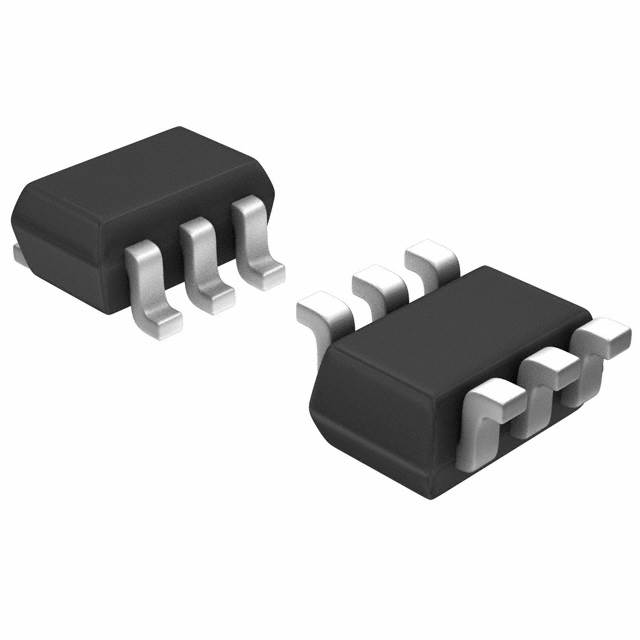
NX3008NBKS,115 vs FDC6401N MOSFET Arrays: Technical Comparison for Hardware Engineers
Quick verdict
For low-current, low-voltage logic-level switching applications—such as signal-level analog switches or low-power load switching—the NX3008NBKS,115’s 30 V rating and very low gate charge make it the better fit. Conversely, for higher current switching up to 3 A at 20 V, where conduction losses dominate and package thermal resistance matters, the FDC6401N outperforms due to its much lower R_DS(on) and higher continuous current rating.
Spec comparison table
| Spec | NX3008NBKS,115 | FDC6401N | Notes |
|---|---|---|---|
| Configuration | Dual N-Channel | Dual N-Channel | Equal |
| Drain-Source Voltage (Max) | 30 V | 20 V | NX3008NBKS,115 allows higher voltage margin |
| Continuous Drain Current @ 25°C | 350 mA | 3 A | FDC6401N supports nearly 10x higher current |
| Drain Current Spiking Max | 1.4 A | Not specified | NX3008NBKS,115 supports limited pulsed current |
| Power Dissipation Max | 445 mW | 700 mW | FDC6401N can dissipate more power |
| Gate Charge Qg @ 4.5 V (Max) | 0.68 nC | 4.6 nC | NX3008NBKS,115 requires ~7x less gate drive energy |
| Input Capacitance C_iss @ typical V_ds | 34–50 pF | 324 pF | NX3008NBKS,115 has significantly lower input capacitance, reducing switching losses |
| Output Capacitance C_oss (typ) | 6.5 pF | Not specified | NX3008NBKS,115 likely better for high-speed switching |
| Reverse Transfer Capacitance C_rss (typ) | 2.2 pF | Not specified | NX3008NBKS,115 likely better for low Miller effect |
| R_DS(on) @ 25°C, 4.5 V Gate | 1.4 Ω | 70 mΩ | FDC6401N has ~20x lower conduction losses at rated current |
| R_DS(on) @ 150°C (typical) | 1.8–2.5 Ω | Not specified | NX3008NBKS,115 resistance increases considerably with temperature |
| Gate Threshold Voltage V_GS(th) (max) | 1.1 V @ 250 µA | 1.5 V @ 250 µA | NX3008NBKS,115 has lower threshold, better for logic-level drive |
| Gate-Source Voltage Max/Min | ±8 V | Not specified | NX3008NBKS,115 rated for ±8 V gate drive voltage |
| Operating Temperature Range | -55 °C to +150 °C | -55 °C to +150 °C | Equal |
| Package | 6-TSSOP (SC-88, SOT-363) | SuperSOT-6 (TSOT-23-6) | FDC6401N smaller footprint, better for space-constrained designs |
| Thermal Resistance Junction-to-Ambient (typ) | 300 K/W per device | Not specified | NX3008NBKS,115 has very high thermal resistance, limiting power dissipation |
| Electrostatic Discharge (ESD) Rating | 2000 V | Not specified | NX3008NBKS,115 ESD rating provided; none listed for FDC6401N |
| Total Power Dissipation (typ) | 280 mW | Not specified | NX3008NBKS,115 typical power dissipation is lower |
| Drain Leakage Current @ 25°C | 1 µA | Not specified | NX3008NBKS,115 leakage current is low |
| Gate Leakage Current @ 25°C | 0.2–1 µA | Not specified | NX3008NBKS,115 has low gate leakage |
| Transient Thermal Impedance (typ 100ms) | 0.5 K/W | Not specified | NX3008NBKS,115 provides transient thermal data |
| Gate Charge Breakdown: Q_gs, Q_gd, Q_g total | 0.17 nC, 0.08 nC, 0.52–0.68 nC | 4.6 nC total | NX3008NBKS,115 significantly lower gate charge components |
Design trade-offs
The NX3008NBKS,115 and FDC6401N serve different niches despite both being dual N-channel MOSFET arrays. The biggest design trade-off is between current handling and switching losses versus gate drive requirements and voltage rating.
The NX3008NBKS,115’s low gate charge (max 0.68 nC at 4.5 V) and low input capacitance (34–50 pF) make it highly suitable for switching at low currents (sub-500 mA) and higher voltages (up to 30 V). This reduces gate driver power consumption and EMI issues associated with rapid switching, which is critical in battery-powered and noise-sensitive systems. However, its drain-source on-resistance of around 1.4 Ω at 350 mA is high, limiting its use to low-current loads where conduction losses are minimal. The high thermal resistance (300 K/W junction-to-ambient) further restricts continuous power dissipation to under 0.5 W, so proper thermal management or intermittent operation is necessary.
In contrast, the FDC6401N is designed for higher current (3 A continuous) and lower voltage (20 V max) applications, with an extremely low R_DS(on) of 70 mΩ at 3 A, 4.5 V gate drive. This translates to significantly lower conduction losses, enabling efficient power switching in load drivers, power rails, or DC-DC converters. The trade-off is a much higher gate charge (4.6 nC), which demands a stronger gate driver and increases switching losses and EMI at high switching frequencies. The smaller SuperSOT-6 package reduces board space but may complicate thermal management due to limited copper area and less heat dissipation capability.
From a layout perspective, the NX3008NBKS,115’s larger TSSOP package eases handling and thermal spreading, while the FDC6401N’s smaller footprint suits dense PCB real estate but requires careful thermal relief and possibly additional heatsinking or copper pours. The NX3008NBKS,115’s gate voltage rating of ±8 V allows some margin in gate drive circuits, whereas the FDC6401N does not specify this, so caution is advised to avoid gate oxide stress.
Cost-wise, the NX3008NBKS,115 may be less expensive due to lower current ratings and older package style, but this depends on volume and supplier pricing. The FDC6401N’s superior current capability and lower R_DS(on) often justify higher cost in power-sensitive designs.
Use-case fit
Choose NX3008NBKS,115 when…
- Switching low current loads (<350 mA) at voltages up to 30 V, such as sensor multiplexing, signal routing, or analog switch arrays.
- Gate drive power and EMI must be minimized, thanks to very low gate charge and input capacitance.
- Automotive or industrial applications requiring AEC-Q101 qualification and operation up to 150 °C junction temperature.
- Designs where space is less constrained and slightly larger 6-TSSOP packages are acceptable.
- Applications needing a logic-level gate MOSFET with a low threshold voltage (~0.6–1.1 V).
Choose FDC6401N when…
- Switching higher currents up to 3 A at voltages up to 20 V, such as load switches, DC-DC converters, or motor driver low-side switches.
- Minimizing conduction losses is critical, with R_DS(on) of 70 mΩ enabling power efficiency and thermal headroom.
- Board space is limited, requiring a compact SuperSOT-6 footprint.
- Gate drivers can supply higher gate charge (4.6 nC) without compromising switching speed or EMI.
- Applications where logic-level gate drive threshold (1.5 V max) is acceptable and gate voltage ratings are within driver limits.
Drop-in compatibility
Pin and footprint compatibility between the NX3008NBKS,115 and FDC6401N is unlikely. The NX3008NBKS,115 is in a 6-TSSOP package (also referenced as SC-88, SOT-363), typically 2.2 mm × 1.35 mm, while the FDC6401N uses a SuperSOT-6 (TSOT-23-6) package, which has a different pinout and physical footprint.
Substituting one for the other would require a PCB redesign due to package and pin differences. Additionally, the voltage and current ratings differ significantly, so circuit conditions must be reevaluated to avoid overstressing the device.
Alternatives to consider
- Si2302DS (Vishay): Dual N-channel MOSFET with low R_DS(on) around 0.1 Ω at 20 V and 1.