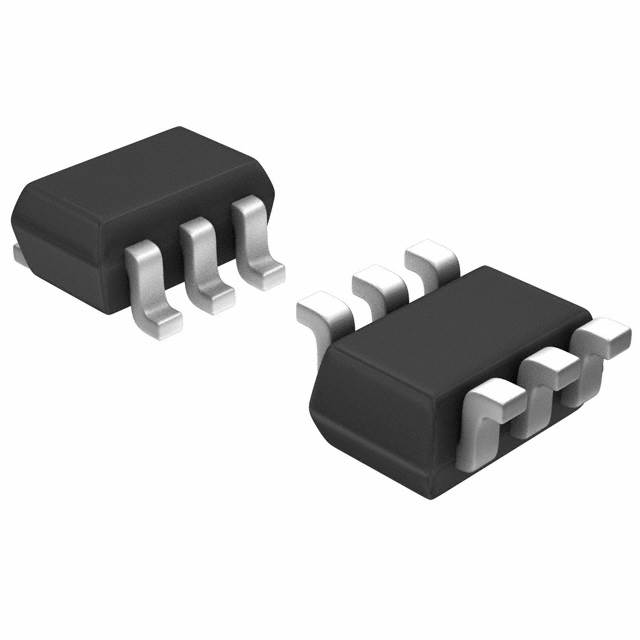
NX3008NBKS,115 vs FDC6321C MOSFET Array Comparison
Quick verdict
For low-voltage, low-current dual N-channel switching or load switching in automotive or industrial environments where AEC-Q101 qualification is required, the NX3008NBKS,115 is the better choice due to its automotive grade rating and stable operation up to 30 V and 350 mA per transistor. For mixed-signal applications requiring both N- and P-channel MOSFETs in a very compact footprint with higher current capability (up to 680 mA) and slightly better on-resistance at 25 V rating, the FDC6321C is preferable, especially in battery-powered or handheld devices where package size and gate charge are critical.
Spec comparison table
| Spec | NX3008NBKS,115 | FDC6321C | Notes |
|---|---|---|---|
| Configuration | 2 × N-Channel (Dual) | 1 × N-Channel + 1 × P-Channel | NX3008NBKS,115 is dual N, FDC6321C offers complementary pairs for high/low side switching |
| Drain-Source Voltage Max (V) | 30 V | 25 V | NX3008NBKS,115 supports higher voltage margin |
| Continuous Drain Current @ 25°C | 350 mA | 680 mA (N), 460 mA (P) | FDC6321C offers higher current capability |
| Drain Current Spiking Max | 1.4 A | Not specified | NX3008NBKS,115 specifies transient spike current |
| Drain-Source On-Resistance (Rds(on)) Max @ Vgs | 1.4 Ω @ 350 mA, 4.5 V | 0.45 Ω @ 500 mA, 4.5 V | FDC6321C has significantly lower Rds(on) at comparable voltages and currents |
| Total Power Dissipation Max | 990 mW | 700 mW | NX3008NBKS,115 can dissipate more power, better for continuous operation |
| Package | 6-TSSOP, SC-88, SOT-363 | SuperSOT™-6 (TSOT-23-6) | FDC6321C package is smaller, better for space-constrained designs |
| Ambient Operating Temperature Range | -55°C to +150°C | -55°C to +150°C | Both suitable for automotive/industrial temperature ranges |
| Gate Threshold Voltage (Vgs_th max @ 250µA) | 1.1 V | 1.5 V | NX3008NBKS,115 has lower threshold, easier to drive at low gate voltages |
| Gate Charge (Qg max) @ Vgs | 0.68 nC @ 4.5 V | 2.3 nC @ 5 V | NX3008NBKS,115 requires significantly less gate charge, improving switching efficiency |
| Input Capacitance (Ciss) Max | 50 pF @ 15 V | 50 pF @ 10 V | Comparable input capacitance |
| Output Capacitance (Coss) Typ | 6.5 pF | Not specified | NX3008NBKS,115 data available, could influence switching losses |
| Reverse Transfer Capacitance (Crss) Typ | 2.2 pF | Not specified | NX3008NBKS,115 data available |
| Gate-Source Voltage Max/Min | ±8 V | Not explicitly specified | NX3008NBKS,115 explicitly rated ±8 V gate voltage |
| Electrostatic Discharge (ESD) Max | 2000 V | Not specified | NX3008NBKS,115 specifies ESD rating |
| Power Max | 445 mW | 700 mW | Conflicting with total power dissipation (see above); FDC6321C can handle higher power |
| Transient Thermal Impedance (typical 100ms) | 0.5 K/W | Not specified | NX3008NBKS,115 provides detailed thermal impedance, useful for transient thermal design |
| Thermal Resistance Junction-to-Ambient (typ) | 300 K/W (per device) | Not specified | NX3008NBKS,115 provides thermal data |
| Technology | MOSFET (Metal Oxide) | MOSFET (Metal Oxide) | Equivalent technology |
| Qualification | AEC-Q101 Automotive | Not specified | NX3008NBKS,115 is automotive qualified, critical for automotive/harsh environments |
Design trade-offs
The NX3008NBKS,115 and FDC6321C target somewhat different application spaces despite both being low-voltage MOSFET arrays in small packages. The NX3008NBKS,115’s dual N-channel configuration and AEC-Q101 qualification make it a natural fit for automotive or industrial control circuits where device reliability and extended temperature range are mandatory. The 30 V rating provides a wider voltage margin for 12 V automotive systems, and the low gate threshold voltage (1.1 V max) ensures reliable logic-level operation with minimal gate drive voltage, reducing complexity in gate driver design.
In contrast, the FDC6321C’s complementary N- and P-channel pair supports half-bridge or push-pull configurations in a single package, simplifying layout and BOM for small DC-DC converters or load switches. Its lower Rds(on) (0.45 Ω vs 1.4 Ω) at similar gate drive voltages allows for better conduction efficiency and less heat generation at currents up to 680 mA (N-channel). However, it has a lower absolute maximum voltage rating of 25 V, which may limit its use in circuits with higher voltage spikes or transients. Additionally, the higher gate charge (2.3 nC vs 0.68 nC) will increase switching losses and gate drive current requirements, potentially impacting efficiency and battery life in switching applications.
From a thermal management perspective, the NX3008NBKS,115’s detailed transient thermal impedance data and higher power dissipation rating (up to 990 mW) allow for more confident thermal design and continuous power handling. The FDC6321C’s smaller SuperSOT-6 package reduces PCB real estate but may present challenges in heat dissipation, requiring careful layout and possibly thermal vias or copper pours.
Gate drive requirements differ notably. NX3008NBKS,115’s lower gate charge and threshold voltage allow for simpler, lower power gate drive circuits and faster switching times, reducing EMI concerns. The FDC6321C’s higher gate charge means gate drivers must be sized accordingly to maintain efficient switching, and switching speed may be slower or require more careful gate resistor tuning.
Cost-wise, volume pricing for both parts is typically comparable given their similar integration level and packaging, but the NX3008NBKS,115’s automotive qualification may add a premium. The FDC6321C’s smaller package and higher current rating might justify a higher price in compact, power-sensitive designs.
Use-case fit
Choose NX3008NBKS,115 when…
- Designing automotive load switches or control logic where AEC-Q101 qualification is mandatory.
- Operating circuits with voltages up to 30 V and currents up to 350 mA per channel.
- Low gate drive voltage and minimal gate charge are critical to reduce driver complexity and power consumption.
- You require dual N-channel MOSFETs for simple high-side or low-side switching in a small footprint.
- Thermal dissipation margin and transient thermal impedance data are important for reliable operation under varying load conditions.
Choose FDC6321C when…
- Implementing complementary MOSFET half-bridge or push-pull stages requiring both N- and P-channel devices in a single package.
- Higher continuous current capability (up to 680 mA N-channel) is needed.
- PCB space is at a premium and a smaller SuperSOT-6 footprint is advantageous.
- Your design can operate within a 25 V maximum voltage limit without risk of damage.
- You can accommodate higher gate charge drive requirements for improved conduction losses.
Drop-in compatibility
These two devices are not pin-compatible or footprint-compatible. The NX3008NBKS,115 comes in a 6-TSSOP (SOT-363) package with two N-channel MOSFETs, while the FDC6321C uses a SuperSOT-6 (TSOT-23-6) package with an N- and a P-channel MOSFET. The pin functions and internal transistor arrangements differ, so substituting one for the other would require PCB layout changes and likely circuit redesign. No direct drop-in substitution is possible.
Alternatives to consider
- BSS138 (dual N-channel MOSFET): Widely available, low-voltage logic-level MOSFET for general switching with modest current capability.
- Si2302 (N-channel MOSFET): Low Rds(on) and low gate charge in small SOT-23 package for low-power switching.
- FDG6333 (N- and P-channel MOSFET pair): Similar complementary pair in small package for half-bridge applications, with different voltage/current ratings to evaluate.