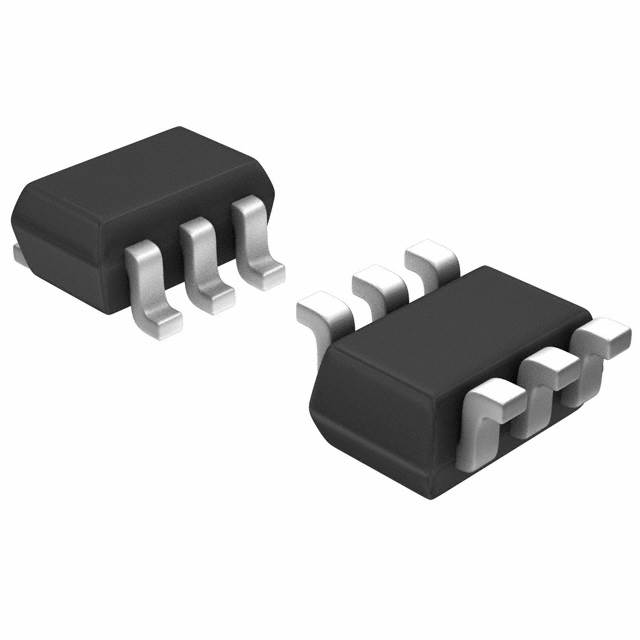
NX3008NBKS,115 vs FDC6305N MOSFET Array Comparison
Quick verdict
For low-current, low-voltage switching applications requiring automotive-grade qualification and very low gate charge, the NX3008NBKS,115 is the superior choice. Conversely, for higher current switching up to 2.7 A with low R_DS(on) and higher power dissipation in compact space, the FDC6305N excels despite a higher gate charge and lower voltage rating.
Spec comparison table
| Spec | NX3008NBKS,115 | FDC6305N | Notes |
|---|---|---|---|
| Configuration | 2 N-Channel (Dual) | 2 N-Channel (Dual) | Equivalent |
| Drain-source voltage max (V) | 30 V | 20 V | NX3008NBKS,115 supports 50% higher voltage margin, important for 24V automotive or industrial rails |
| Continuous drain current @ 25°C (A) | 0.35 A | 2.7 A | FDC6305N supports nearly 8× higher current |
| Drain current spiking max | 1.4 A | Not specified | NX3008NBKS,115 allows short pulses up to 1.4A |
| Power dissipation max (mW) | 445 mW (device), 990 mW (total) | 700 mW | FDC6305N can handle ~50% more power dissipation |
| Package | 6-TSSOP (SC-88, SOT-363) | SuperSOT™-6 (SOT-23-6 Thin) | Different packages; FDC6305N smaller footprint but less power dissipation capability |
| Package dimensions (L × W) (mm) | 2.2 × 1.35 | Not explicitly specified | NX3008NBKS,115 is slightly larger |
| R_DS(on) @ 4.5V, 25°C (Ω) | Typ: 1 to 1.4 Ω (at 350 mA) | Max: 0.08 Ω (at 2.7 A) | FDC6305N has dramatically lower R_DS(on) suited for higher current applications |
| Gate charge Q_g @ 4.5 V (nC) | 0.68 nC | 5 nC | NX3008NBKS,115 gate charge is ~7× lower, easing gate drive requirements and switching losses |
| Input capacitance C_iss (pF) | 34–50 pF (typ/max @ 25°C, 15 V) | 310 pF @ 10 V | NX3008NBKS,115 has significantly lower input capacitance, beneficial for high-speed switching |
| Gate-source threshold voltage V_GS(th) | Typ 0.6–1.1 V, max 1.1 V @ 250 µA | Max 1.5 V @ 250 µA | NX3008NBKS,115 turns on at lower gate voltage, better for logic-level inputs |
| Operating temperature range (°C) | -55 to +150 | -55 to +150 | Equivalent |
| ESD voltage rating (V) | 2000 V | Not specified | NX3008NBKS,115 offers ESD robustness |
| Gate voltage max (V) | ±8 V | Not specified | NX3008NBKS,115 gate voltage limits clearly stated; FDC6305N datasheet does not specify |
| Input leakage current (µA/nA) | 0.2–1 µA typ, 1–10 nA (various V_GS) | Not specified | NX3008NBKS,115 has quantified low gate leakage |
| Drain leakage current (µA) | 1 µA typ @ 25°C, 10 µA typ @ 150°C | Not specified | NX3008NBKS,115 has low leakage current data |
| Rise/fall times (ns) | Rise: 11 ns, Fall: 19 ns | Not specified | NX3008NBKS,115 switching times specified; FDC6305N data missing |
| Transient thermal impedance (K/W) | 0.01–1 (various time scales) | Not specified | NX3008NBKS,115 datasheet provides detailed thermal transient data |
| Total power dissipation typical | 280 mW | Not specified | NX3008NBKS,115 typical power dissipation data provided |
| Qualification | AEC-Q101 (Automotive grade) | Not specified | NX3008NBKS,115 is automotive qualified, suitable for harsh environments |
Design trade-offs
The most salient difference between the NX3008NBKS,115 and FDC6305N is in their current and voltage ratings, which dictate their typical application envelopes. The NX3008NBKS,115 is rated for 30 V and 350 mA continuous current, making it suitable for low-power, low-voltage logic-level switching circuits, such as signal multiplexing or power gating in automotive or industrial control systems. Its AEC-Q101 qualification and 150°C operating temperature range further support deployment in harsh environments.
In contrast, the FDC6305N supports a much higher continuous current of 2.7 A but with a lower voltage rating of 20 V. This makes it more appropriate for higher-current loads, such as small motor drives, load switches, or low-voltage DC-DC converters. Its R_DS(on) max of 80 mΩ at 2.7 A is orders of magnitude lower than the NX3008NBKS,115’s 1–1.4 Ω at 350 mA, translating to significantly lower conduction losses in high-current scenarios.
Gate charge and input capacitance impact switching efficiency and gate driver requirements. The NX3008NBKS,115’s gate charge of ~0.68 nC is substantially lower than the FDC6305N’s 5 nC, reducing gate drive power and switching losses in high-frequency applications. Similarly, the NX3008NBKS,115’s input capacitance is about one-sixth that of the FDC6305N, which eases gate driver design and allows faster switching transitions. However, the FDC6305N’s higher gate charge is a trade-off for lower R_DS(on) and higher current capability.
Thermally, the NX3008NBKS,115’s maximum power dissipation per device is 445 mW (990 mW total), which is lower than the FDC6305N’s 700 mW. Combined with the lower current rating, this limits NX3008NBKS,115 to low-power applications or those with robust cooling. The FDC6305N’s higher power dissipation rating supports more demanding loads but requires careful layout to handle higher heat dissipation, especially given its smaller SuperSOT-6 package.
The NX3008NBKS,115’s 6-TSSOP package is larger and more standardized for automated assembly in automotive-grade products; the FDC6305N’s SuperSOT-6 package is more compact but may pose more challenges in thermal management and PCB layout due to smaller thermal pad area and pin pitch.
Cost at volume is not specified here but generally, smaller packages and higher current ratings tend to increase unit cost. The automotive qualification of NX3008NBKS,115 also adds to cost but is necessary for safety-critical applications.
Use-case fit
Choose NX3008NBKS,115 when…
- You need a dual MOSFET array with automotive-grade AEC-Q101 qualification for under-1 A load switching in harsh environments.
- Operating voltage up to 30 V is required, providing margin over 24 V or 28 V rails common in automotive/industrial systems.
- Low gate charge and input capacitance are critical to minimize gate drive losses and EMI in high-speed logic-level switching.
- Your application involves sensitive analog or low-level digital switching where leakage currents and threshold voltages under 1.1 V matter.
- You require a package compatible with automated assembly and thermal management typical for automotive-grade 6-TSSOP components.
Choose FDC6305N when…
- The load current exceeds 1 A and can reach up to 2.7 A continuous, requiring very low R_DS(on) to reduce conduction losses.
- Your supply voltage is 20 V or less, and you prioritize conduction efficiency over voltage margin.
- You can handle higher gate drive power consumption and switching losses due to the larger gate charge.
- The board space is constrained, and you prefer the smaller SuperSOT-6 package footprint.
- The application is non-automotive or does not require AEC-Q101 qualification but demands compact, high-current dual MOSFET arrays.
Drop-in compatibility
These two devices are not pin- or footprint-compatible. NX3008NBKS,115 uses a 6-TSSOP package (2.2 × 1.35 mm) with a pinout defined for automotive-grade applications, while the FDC6305N comes in a SuperSOT-6 (TSOT-23-6 Thin) package with a different pin arrangement and smaller footprint.
Replacing one with the other would require PCB redesign for footprint and thermal management. Also, gate drive requirements differ due to varying gate charge and threshold voltages, so