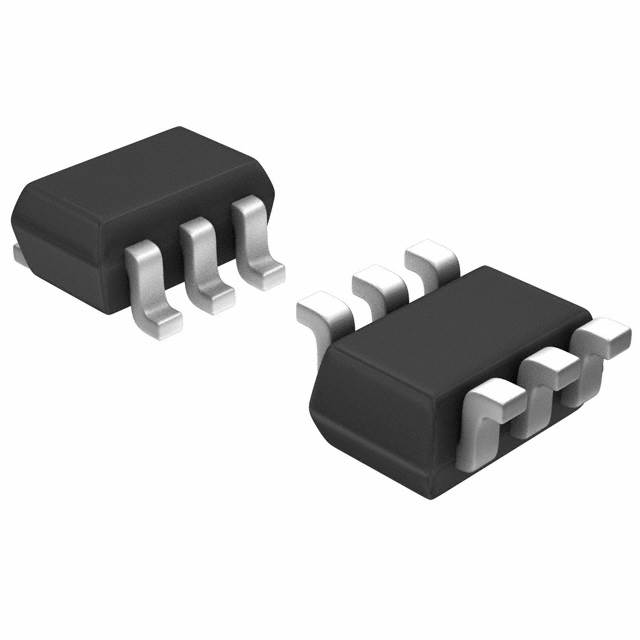
NX3008NBKS,115 vs FDC606P MOSFET Comparison
Quick verdict
For low-voltage, high-current power switching and load control—especially where a P-channel MOSFET is required—the FDC606P outperforms the NX3008NBKS,115 by a wide margin, offering 6A continuous current capability and a very low R_DS(on) of 26mΩ at 4.5V gate drive. Conversely, the NX3008NBKS,115 is a dual N-channel MOSFET array optimized for low-current signal-level switching (350mA max), with automotive qualification and logic-level gate drive, making it better suited for integrated control and signal multiplexing in harsh environments.
Spec comparison table
| Spec | NX3008NBKS,115 | FDC606P | Notes |
|---|---|---|---|
| MOSFET Type | Dual N-Channel | P-Channel | Different polarity; impacts circuit topology and drive requirements |
| Drain-Source Voltage (V_DS max) | 30 V | 12 V | NX3008NBKS,115 supports higher voltage margin |
| Continuous Drain Current (I_D) @ 25°C | 350 mA | 6 A | FDC606P supports ~17x higher load current |
| Drain Current Spiking Max | 1.4 A | Not specified | NX3008NBKS,115 limited to low transient currents |
| Drain-Source On Resistance (R_DS(on)) | 1.4 Ω @ 350mA, 4.5 V (max) | 26 mΩ @ 6A, 4.5 V | FDC606P has orders of magnitude lower R_DS(on), critical for conduction losses |
| Gate Charge (Q_g) @ 4.5V | 0.68 nC | 25 nC | NX3008NBKS,115 requires significantly less gate drive charge, easing gate driver load |
| Input Capacitance (C_iss) | 50 pF @ 15 V | 1699 pF @ 6 V | NX3008NBKS,115 has much lower input capacitance, allowing faster switching at low current |
| Output Capacitance (C_oss) | 6.5 pF (typ) | Not specified | NX3008NBKS,115 likely lower output capacitance, beneficial for high-speed switching |
| Reverse Transfer Capacitance (C_rss) | 2.2 pF (typ) | Not specified | NX3008NBKS,115 lower feedback capacitance, reducing Miller effect |
| Gate-Source Threshold Voltage (V_GS(th)) | 0.6–1.1 V (typ), 1.1V max @ 250µA | 1.5 V max @ 250µA | NX3008NBKS,115 has lower threshold voltage, easier to fully turn on at lower voltages |
| Gate-Source Voltage Max | ±8 V | ±8 V | Equal |
| Power Dissipation (P_D max) | 445 mW | 1.6 W | FDC606P supports ~3.6x higher dissipation, suitable for higher power applications |
| Junction Temperature Range (T_J) | -55°C to +150°C | -55°C to +150°C | Equal |
| Ambient Temperature Range | -55°C to +150°C | -55°C to +150°C | Equal |
| Electrostatic Discharge (ESD) | 2000 V | Not specified | NX3008NBKS,115 has specified ESD rating, useful for handling precautions |
| Package | 6-TSSOP (SC-88, SOT-363) | SuperSOT™-6 (TSOT-23-6) | Different packages; affects PCB footprint and thermal performance |
| Package Dimensions (L x W) | 2.2 mm x 1.35 mm | Not specified | NX3008NBKS,115 smaller footprint than typical SOT-23-6 but specific FDC606P dims unknown |
| Qualification | AEC-Q101 Automotive | None | NX3008NBKS,115 suitable for automotive and high-reliability applications |
| Configuration | Dual MOSFET (2 x N-channel) | Single MOSFET (P-channel) | NX3008NBKS,115 integrates two devices, saving board space for dual-switch applications |
| Thermal Resistance Junction-to-Ambient (typ) | 300 K/W per device | Not specified | NX3008NBKS,115 high thermal resistance; limits power dissipation without heatsinking |
| Transient Thermal Impedance (typ, 100ms) | 0.5 K/W | Not specified | NX3008NBKS,115 data available; FDC606P not specified |
| Gate Leakage Current (typ, 25°C) | 0.2–1 µA | Not specified | NX3008NBKS,115 very low leakage; important for low-power or sensitive gate drive circuits |
| Drain Leakage Current (typ) @ 25°C | 1 µA | Not specified | NX3008NBKS,115 low leakage fits low standby power designs |
Design trade-offs
The NX3008NBKS,115 and FDC606P target fundamentally different applications despite both being MOSFETs. The NX3008NBKS,115 is a dual N-channel MOSFET array optimized for low-current switching with a logic-level gate drive threshold and automotive qualification. Its maximum continuous current is limited to 350mA, with an on-resistance in the range of 1 to 1.4 Ω at 4.5V gate drive, and very low input capacitance (~50pF). This makes it suited for signal switching, level shifting, or low-power load switching where board space savings from the dual-device package and high reliability are priorities.
In contrast, the FDC606P is a single P-channel MOSFET designed for substantially higher currents (6A continuous) at a lower voltage rating (12V max). Its R_DS(on) is an extremely low 26mΩ at 4.5V gate drive, which drastically reduces conduction losses in power switching applications. However, this comes with a significantly higher gate charge of 25nC, implying that gate drivers must supply more current and switching losses will be higher at fast switching frequencies. The FDC606P’s input capacitance (C_iss) is about 1700pF, more than an order of magnitude higher than the NX3008NBKS,115, which also impacts switching speed and driver requirements.
Thermally, the NX3008NBKS,115’s maximum power dissipation is 445mW, with thermal resistance junction-to-ambient around 300 K/W, indicating it is not intended for high power dissipation without additional heatsinking or thermal management. The FDC606P supports up to 1.6W power dissipation at ambient temperature, making it more robust in thermal terms for power switching. The NX3008NBKS,115’s automotive-grade qualification (AEC-Q101) and specified ESD rating (2000 V) make it preferable in automotive or industrial environments where reliability and ruggedness are critical.
From a layout perspective, the NX3008NBKS,115’s smaller input capacitance and gate charge allow for simpler, lower-power gate drive circuitry and potentially higher switching speeds at low current levels. The dual MOSFET array in one package can save PCB area and reduce component count in multiplexing or signal switching circuits. The FDC606P’s SuperSOT-6 package is common for power MOSFETs and offers low R_DS(on) in a small footprint, but its larger input capacitance necessitates careful gate driver design to avoid switching losses and EMI.
Cost considerations at volume are not provided here, but typically, dual MOSFET arrays with automotive qualification like the NX3008NBKS,115 carry a premium compared to single discrete MOSFETs like the FDC606P. Engineers must weigh the benefits of integration and qualification versus raw performance and cost.
Use-case fit
Choose NX3008NBKS,115 when…
- You need a dual N-channel MOSFET array for low-current switching or multiplexing signals under 350mA.
- Operating in automotive or harsh environments requiring AEC-Q101 qualification and robust ESD protection.
- Your design demands logic-level gate drive with very low gate charge and input capacitance to minimize driver complexity.
- Board space is limited and integrating two MOSFETs in a single 6-TSSOP footprint reduces component count.
- Switching speeds require minimal input capacitance and output capacitance to reduce switching losses at low currents.
Choose FDC606P when…
- You require a P-channel MOSFET capable of handling continuous currents up to 6A at voltages up to 12V.
- Low conduction losses are critical, especially in power switch or load switch applications where R_DS(on) of 26mΩ reduces heat dissipation.
- Your application can accommodate the higher gate charge and input capacitance, with suitable gate driver capability.
- Thermal dissipation up to 1.6W is necessary without extensive heatsinking.
- You need a small footprint P-channel device for power switching in consumer, industrial, or general-purpose circuits.
Drop-in compatibility
These parts are not pin-compatible or