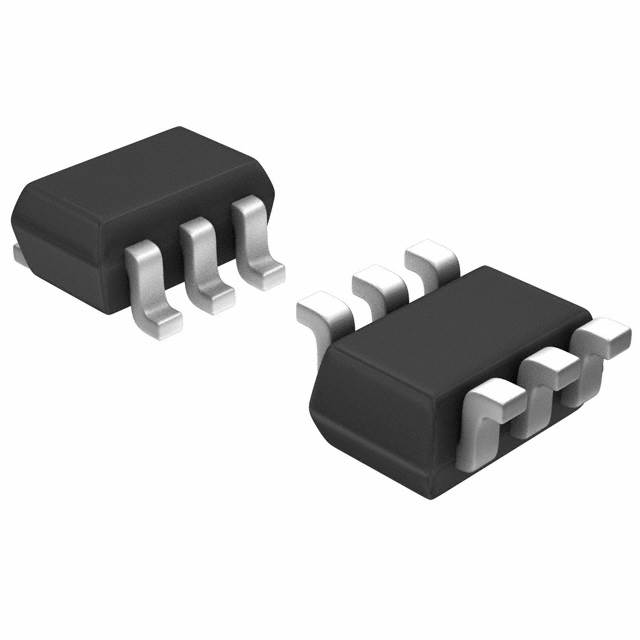
Component Comparison: NX3008NBKS,115 vs EPC2001C
Quick verdict
For low-voltage, low-current applications requiring dual MOSFETs in a compact automotive-grade package, the NX3008NBKS,115 offers a suitable solution with its 30 V rating and 350 mA current capability. Conversely, for high-current, high-voltage, and high-efficiency switching applications demanding cutting-edge performance and very low R_DS(on), the EPC2001C GaN FET die is the clear choice, especially where 100 V and up to 36 A continuous current are needed.
Spec comparison table
| Spec | NX3008NBKS,115 | EPC2001C | Notes |
|---|---|---|---|
| Technology | MOSFET (Metal Oxide) | GaNFET (Gallium Nitride) | GaN offers lower losses at high frequencies and currents but requires specialized drive. |
| Configuration | 2 N-Channel (Dual) | Single N-Channel | NX3008NBKS,115 integrates two devices, useful for half-bridge or complementary stages. |
| Drain-Source Voltage (V_DS max) | 30 V | 100 V | EPC2001C supports over 3x higher voltage, enabling higher voltage rails or margin. |
| Continuous Drain Current (I_D max @ 25°C) | 350 mA | 36 A | EPC2001C supports two orders of magnitude higher current; NX3008NBKS is for low-current. |
| Drain Current Spiking Max | 1.4 A | Not specified | NX3008NBKS max spike is limited; EPC2001C die likely supports high transient currents. |
| R_DS(on) (typ @ 25°C) | 1.0 – 1.4 Ω @ 350 mA, 4.5 V | 7 mΩ @ 25 A, 5 V | EPC2001C has dramatically lower R_DS(on), critical for efficiency at high current. |
| Gate Threshold Voltage (V_GS(th)) (typ) | 0.6 – 1.1 V (typ) | 2.5 V @ 5 mA | NX3008NBKS is lower threshold logic-level MOSFET; EPC2001C needs higher gate drive voltage. |
| Gate Charge (Q_g max @ V_GS) | 0.68 nC @ 4.5 V | 9 nC @ 5 V | NX3008NBKS requires much lower gate charge, easing gate drive power and switching speed. |
| Input Capacitance (C_iss max) | 50 pF @ 15 V | 900 pF @ 50 V | NX3008NBKS has much lower input capacitance, reducing gate drive losses at low voltages. |
| Output Capacitance (C_oss typ) | 6.5 pF | Not specified | NX3008NBKS output capacitance is low, but EPC data lacks this spec for direct comparison. |
| Reverse Transfer Capacitance (C_rss typ) | 2.2 pF | Not specified | Lower C_rss benefits switching speed and reduces Miller effect; EPC spec not given. |
| Power Dissipation Max | 445 mW | Not specified | NX3008NBKS power dissipation is limited; EPC2001C die thermal limits depend on PCB design. |
| Package | 6-TSSOP (Surface Mount) | Bare die | NX3008NBKS has a standard SMT package; EPC2001C requires custom mounting and handling. |
| Operating Temperature Range (TJ) | -55°C to +150°C | -40°C to +150°C | NX3008NBKS supports wider low-temperature range, relevant for automotive-grade designs. |
| ESD Rating | 2000 V (HBM) | Not specified | NX3008NBKS rated for moderate ESD robustness; EPC2001C die likely requires handling precautions. |
| Thermal Resistance (R_θJA typ) per transistor | 390 – 445 K/W | Not specified | NX3008NBKS thermal resistance is high due to small package and low power rating. |
| Gate-Source Voltage (max) | ±8 V | +6 V / -4 V | NX3008NBKS supports wider gate voltage range; EPC2001C limited to lower max gate voltages. |
| Grade (Qualification) | Automotive (AEC-Q101) | None stated | NX3008NBKS is qualified for automotive; EPC2001C is a die without stated qualification. |
| Mounting Type | Surface Mount | Die | NX3008NBKS is ready for standard SMT assembly; EPC2001C requires die attach and wirebond. |
Design trade-offs
The NX3008NBKS,115 is a dual N-channel MOSFET array designed primarily for low-voltage (30 V), low-current (350 mA) applications. Its low input capacitance (50 pF) and low gate charge (<1 nC) facilitate simple gate drive circuits, making it suitable for logic-level switching with minimal driver complexity. The device’s relatively high R_DS(on) (~1.0–1.4 Ω) limits efficiency at higher currents but is acceptable for signal switching, level shifting, or load switching in automotive or industrial environments. The package (6-TSSOP) and AEC-Q101 qualification make it straightforward to use in automotive-grade PCBs with standard SMT processes.
In contrast, the EPC2001C is a bare GaN FET die designed for high-voltage (100 V), high-current (36 A) operation with ultralow R_DS(on) of 7 mΩ at 25 A. The GaN technology offers much higher switching speed and efficiency but at the cost of significantly higher input capacitance (900 pF) and gate charge (9 nC). This means gate drivers must be more robust to deliver fast switching transitions, and layout must minimize parasitic inductances to avoid ringing and potential device failure. The die package requires custom assembly (die attach, wirebonding), increasing manufacturing complexity and cost.
Thermally, the NX3008NBKS,115 dissipates under 0.5 W max, with thermal resistance exceeding 300 K/W per device, making it suitable only for low power applications or where thermal management is minimal. The EPC2001C, while not specifying thermal resistance, can handle much higher currents and power dissipation but demands careful PCB thermal design (e.g., thick copper, thermal vias) and likely active cooling in high-power scenarios.
From a firmware and driver perspective, the NX3008NBKS’s low gate charge and logic-level gate threshold simplify direct MCU or simple driver interfacing. The EPC2001C’s higher threshold voltage (2.5 V at 5 mA) and gate voltage limits (+6 V max) require dedicated GaN drivers with controlled gate voltage to avoid overstress and to achieve optimal switching performance.
Cost-wise, the NX3008NBKS,115 is a mature, automotive-qualified MOSFET array with well-understood supply chains and low unit cost at volume. The EPC2001C, being a GaN die, is significantly more expensive per unit and requires specialized handling and assembly, justifiable only where performance gains outweigh these costs.
Use-case fit
Choose NX3008NBKS,115 when…
- You need a dual N-channel MOSFET array for low-voltage (≤30 V), low-current (≤350 mA) switching in automotive or industrial environments.
- Your design requires AEC-Q101 qualification for automotive reliability.
- Board space is limited and you prefer a standard 6-TSSOP package for straightforward SMT assembly.
- Gate drive circuitry must be simple, with logic-level compatible thresholds and minimal drive current.
- Power dissipation and thermal budgets are low, and you can tolerate higher R_DS(on) for cost and integration benefits.
Choose EPC2001C when…
- Your application demands high-voltage operation (up to 100 V) with continuous currents above 10 A, such as DC-DC converters or motor drives.
- Efficiency is critical, and the ultralow R_DS(on) of 7 mΩ at 25 A can reduce conduction losses significantly.
- You have access to specialized GaN gate drivers and can control gate voltage precisely within ±6 V max.
- Your manufacturing process can handle die attach and wirebonding required for bare die components.
- Thermal management is robust, including heavy copper planes or active cooling to handle high power dissipation.
Drop-in compatibility
These parts are not pin- or footprint-compatible. The NX3008NBKS,115 is a 6-TSSOP packaged dual MOSFET array with a defined pinout for dual transistors, while the EPC2001C is a bare die with no standard package or pins. Substituting one for the other would require significant PCB redesign, including layout changes to accommodate the die and its bonding pads, different gate drive circuitry, and thermal management solutions. Additionally, the gate drive voltage and threshold requirements differ substantially, demanding firmware and driver adjustments.
Alternatives to consider
- Si2302DS (Vishay): Low-voltage dual N-channel MOSFET array in small SOT-23 package, similar to NX3008NBKS but with slightly different R_DS(on) and voltage ratings—good for low power automotive