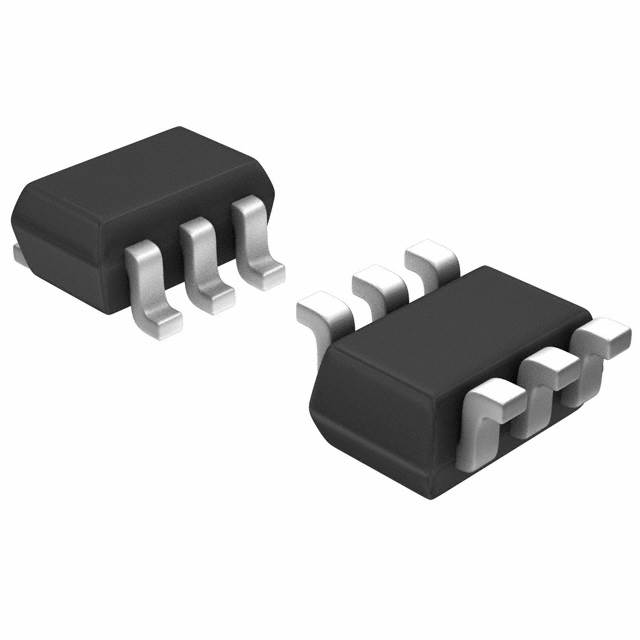
NX3008NBKS,115 vs DMN3200U-7: Component Comparison for Low-Voltage MOSFETs
Quick verdict
For low-current, dual-channel switching or level-shifting in automotive or industrial logic-level applications, the NX3008NBKS,115 excels due to its automotive grade, dual MOSFET array, and ultra-low gate charge. For single-channel, higher-current switching at up to 2.2A, the DMN3200U-7 is the clear choice, offering significantly lower R_DS(on) and higher continuous current capability in a very compact SOT-23 package.
Spec comparison table
| Spec | NX3008NBKS,115 | DMN3200U-7 | Notes |
|---|---|---|---|
| Configuration | 2 N-Channel (Dual) | 1 N-Channel | NX3008NBKS offers dual MOSFETs, useful for half-bridge or level shifting applications. |
| Drain-Source Voltage (V_DS max) | 30 V | 30 V | Equal voltage rating, suitable for similar low-voltage circuits. |
| Continuous Drain Current (I_D @ 25°C) | 350 mA | 2.2 A | DMN3200U-7 supports over 6x current, suitable for higher power switching. |
| Drain Current Spiking Max | 1.4 A | Not specified | NX3008NBKS handles transient spikes up to 1.4 A; no data for DMN3200U-7. |
| R_DS(on) @ I_D, V_GS | 1.4 Ω @ 350mA, 4.5 V | 90 mΩ @ 2.2A, 4.5 V | DMN3200U-7 has dramatically lower R_DS(on), reducing conduction losses at higher currents. |
| Gate Threshold Voltage (V_GS(th)) | 0.6 – 1.1 V (typical 0.9 V) | 1.0 V @ 250µA | NX3008NBKS has slightly lower threshold, easier to drive at low gate voltages. |
| Gate Charge (Q_g) | 0.52 – 0.68 nC @ 4.5 V | Not specified | NX3008NBKS has very low gate charge, beneficial for switching speed and gate drive losses. |
| Input Capacitance (C_iss) | 34 – 50 pF @ 25°C, 15 V | 290 pF @ 10 V | NX3008NBKS has an order of magnitude lower input capacitance, easing gate drive requirements. |
| Output Capacitance (C_oss) | 6.5 pF (typ) | Not specified | Lower output capacitance on NX3008NBKS improves switching performance. |
| Reverse Transfer Capacitance (C_rss) | 2.2 pF (typ) | Not specified | Lower C_rss on NX3008NBKS reduces Miller effect, improving switching speed and stability. |
| Power Dissipation (P_D max) | 445 mW (typ), 990 mW (max) | 650 mW (Ta) max | DMN3200U-7 can dissipate more power, supporting higher currents and loads. |
| Operating Temperature Range | -55°C to +150°C (TJ) | -55°C to +150°C (TJ) | Equivalent temperature range for harsh environment applications. |
| Package | 6-TSSOP (SC-88, SOT-363) | SOT-23-3 (TO-236-3, SC-59) | NX3008NBKS is a dual transistor array in a slightly larger package; DMN3200U-7 is single. |
| ESD Rating | 2000 V | Not specified | NX3008NBKS provides known ESD robustness; DMN3200U-7 lacks published rating. |
| Thermal Resistance Junction-to-Ambient | 300 K/W (typ per device) | Not specified | NX3008NBKS data available; DMN3200U-7 thermal data not provided, usually better in SOT-23. |
| Transient Thermal Impedance | 0.01 – 1 K/W (typ, time dependent) | Not specified | NX3008NBKS has detailed transient thermal data, useful for transient power design. |
| Gate-Source Voltage Max | ±8 V | ±8 V | Equivalent gate voltage limits. |
| Leakage Currents | Drain leakage: 1 µA @ 25°C, 10 µA @ 150°C | Not specified | NX3008NBKS provides leakage current data; DMN3200U-7 data not given. |
| Gate Leakage Current | 0.2 – 1 µA (typ) | Not specified | NX3008NBKS low gate leakage current aids in stable logic-level switching. |
Design trade-offs
The NX3008NBKS,115 is a dual N-channel MOSFET array optimized for low-current logic-level switching with a very low gate charge (0.52–0.68 nC) and extremely low input capacitance (~50 pF max). This translates into minimal gate drive losses and faster switching times, which is critical when driving multiple MOSFETs in parallel or cascaded configurations from weak logic-level drivers or microcontrollers. Its very high R_DS(on) (~1.4 Ω at 350 mA) limits it to low current applications, but the automotive qualification (AEC-Q101) and ESD rating (2000 V) make it a strong candidate for harsh environments requiring dual-channel configurations.
In contrast, the DMN3200U-7 targets significantly higher current applications with a continuous drain current rating of 2.2 A and a low R_DS(on) of 90 mΩ at 2.2 A and 4.5 V gate drive. While gate charge and capacitance data are not published, the much higher input capacitance (290 pF vs 50 pF) suggests greater gate drive requirements and slower switching speeds compared to the NX3008NBKS. Thermal dissipation capability is higher (650 mW vs 445 mW typical), supporting higher power loads. This device suits single-switch power stages where size and conduction losses matter more than gate drive complexity.
From a layout perspective, the NX3008NBKS’s 6-TSSOP package is larger, but integrates two MOSFETs, potentially reducing BOM and board space in dual-switch applications. The DMN3200U-7’s SOT-23-3 package is smaller footprint-wise but only offers one transistor, requiring parallel or multiple devices for dual-switch use cases. The smaller package also typically has better thermal performance per unit area, but requires careful PCB layout to handle higher current densities.
Gate drive requirements favor the NX3008NBKS for scenarios where low drive current and fast switching are priorities, such as signal-level muxing or analog switching. The DMN3200U-7 needs a stronger gate driver due to higher gate charge and capacitance, impacting microcontroller GPIO loading and switching losses.
Cost at volume will depend on packaging and qualification. The NX3008NBKS’s AEC-Q101 automotive grade and dual MOSFET array packaging may increase unit cost but reduce overall system complexity in automotive and industrial designs. The DMN3200U-7, a simpler, higher-current single MOSFET, may be cheaper per unit but require more components or larger gate drivers.
Use-case fit
Choose NX3008NBKS,115 when…
- You need a dual MOSFET array for low-current switching or level shifting in automotive or industrial environments.
- The application requires AEC-Q101 qualification and high ESD robustness.
- Gate drive current is limited and low gate charge is critical, e.g., battery management systems or sensor interfaces.
- Switching speed and minimal gate drive losses impact system efficiency or EMI.
- You want to simplify BOM by integrating two MOSFETs in one package for small-signal control.
Choose DMN3200U-7 when…
- You require single-channel switching at currents up to 2.2 A with low conduction losses.
- Power dissipation capability up to 650 mW is necessary for medium power loads.
- Board space is at a premium, and a small SOT-23-3 package is preferred.
- Gate drive capability is adequate to handle higher input capacitance and gate charge.
- The application does not require automotive-grade qualification or integrated dual MOSFETs.
Drop-in compatibility
These two devices are not pin-compatible or footprint-compatible. The NX3008NBKS,115 is a dual MOSFET array in a 6-TSSOP package (2.2 mm x 1.35 mm footprint), while the DMN3200U-7 is a single N-channel MOSFET in a smaller SOT-23-3 package. Substituting one for the other requires board redesign for pin layout and size.
Additionally, the NX3008NBKS has two transistors internally, so substituting the DMN3200U-7 requires adding a second discrete MOSFET to replicate the function. Gate drive requirements and thermal management considerations differ and must be reevaluated upon substitution.
Alternatives to consider
- **BSS138 (Nexperia