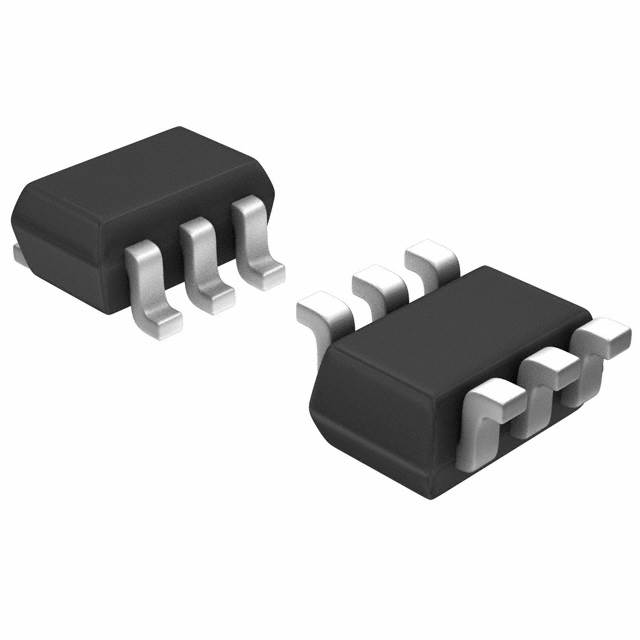
Comparison: NX3008NBKS,115 vs CSD17585F5 MOSFETs
Quick verdict
For low-current, dual-channel switching or level-shifting in automotive or industrial signal-level applications, the NX3008NBKS,115 is the clear choice due to its integrated dual N-channel array, AEC-Q101 qualification, and low voltage rating. For higher current, single-channel power switching up to ~6A, the CSD17585F5 is superior, offering an order of magnitude higher continuous current rating and significantly lower R_DS(on), suitable for power stages and load switching.
Spec comparison table
| Spec | NX3008NBKS,115 | CSD17585F5 | Notes |
|---|---|---|---|
| Configuration | 2 N-Channel (Dual) | 1 N-Channel | NX3008NBKS,115 provides dual devices in one package, useful for complementary or dual loads. |
| Drain-Source Voltage (V_DS max) | 30 V | 30 V | Equal voltage rating, suitable for similar voltage domains. |
| Continuous Drain Current (I_D @ 25°C) | 350 mA | 5.9 A | CSD17585F5 supports 17x higher current, critical for power applications. |
| Drain Current Spiking Max | 1.4 A | Not specified | NX3008NBKS,115 limited to 1.4A spike; CSD17585F5 data unavailable but likely much higher. |
| Drain-Source On-State Resistance (R_DS(on)) @ 25°C | 1 – 1.4 Ω @ 350 mA, 4.5 V | 27 mΩ @ 900 mA, 10 V | CSD17585F5 has ~50x lower R_DS(on), drastically reducing conduction losses at higher currents. |
| Gate Threshold Voltage (V_GS(th)) | 0.5 – 1.75 V (typ 1.75 V) | 1.7 V @ 250 µA | NX3008NBKS,115 has lower threshold, easier to drive at logic level. |
| Gate Charge (Q_g) | 0.52 – 0.68 nC @ 4.5 V | 5.1 nC @ 10 V | NX3008NBKS,115 requires ~10x less gate charge, lowering gate drive power and switching losses at low voltage. |
| Input Capacitance (C_iss typ) | 34 – 50 pF | 380 pF @ 15 V | NX3008NBKS,115 has significantly lower input capacitance, beneficial for high-speed switching and low gate drive current. |
| Output Capacitance (C_oss typ) | 6.5 pF | Not specified | NX3008NBKS,115 output capacitance is low, aiding switching speed. |
| Reverse Transfer Capacitance (C_rss typ) | 2.2 pF | Not specified | Lower C_rss reduces Miller effect; NX3008NBKS,115 advantage here. |
| Power Dissipation (P_D max) | 445 mW | 500 mW (Ta) | Comparable power dissipation under typical conditions; actual thermal design will differ. |
| Operating Temperature Range | -55°C to +150°C | -55°C to +150°C | Both suitable for automotive and industrial environments. |
| Package | 6-TSSOP, SC-88, SOT-363 | 3-PICOSTAR (1.49x0.73 mm) | Different package styles; CSD17585F5 is smaller footprint but single channel. |
| Electrostatic Discharge (ESD) Rating | 2 kV | Not specified | NX3008NBKS,115 has specified ESD rating, important for handling robustness. |
| Junction-to-Ambient Thermal Resistance (R_θJA) | 300 K/W (typ) per device | Not specified | NX3008NBKS,115 has high thermal resistance due to small package and low power rating. |
| Transient Thermal Impedance | 0.5 K/W @ 100 ms (typ) | Not specified | NX3008NBKS,115 data available; CSD17585F5 thermal transient data not provided. |
| Gate-Source Voltage Max | ±8 V | 20 V | CSD17585F5 supports higher gate voltage, allowing more drive flexibility. |
| Gate Leakage Current (typ) | 0.2 – 1 µA @ 25°C | Not specified | NX3008NBKS,115 gate leakage current is low but measurable; no data for CSD17585F5. |
| Qualification | AEC-Q101 | None specified | NX3008NBKS,115 is automotive qualified, relevant for safety-critical automotive applications. |
Design trade-offs
The NX3008NBKS,115 is a dual N-channel MOSFET array designed for low-current switching and level-shifting applications, particularly in automotive environments, as evidenced by its AEC-Q101 qualification and wide operating temperature range. Its relatively high R_DS(on) (1–1.4 Ω at 350 mA) and low continuous current rating (350 mA) limit its use to signal-level loads or as a low-side switch for small loads. Its low gate charge (~0.6 nC) and low input capacitance (~50 pF) make it easy to drive directly from logic-level signals with minimal gate drive power, enabling high switching frequencies without substantial gate drive losses.
Conversely, the CSD17585F5 targets power switching applications with a continuous drain current rating of 5.9 A and an extremely low R_DS(on) of 27 mΩ at 900 mA and 10 V gate drive. This translates to substantially lower conduction losses at moderate currents, critical for efficiency and thermal management in power stages. However, the gate charge is about 5.1 nC at 10 V, roughly 8–10 times higher than the NX3008NBKS,115, which must be considered when designing gate drivers and estimating switching losses, especially at high frequencies. The higher max gate voltage (20 V) offers more flexibility in gate drive schemes, but the device also requires a stronger gate driver to switch efficiently.
Thermally, the NX3008NBKS,115’s small package (6-TSSOP) and high thermal resistance (~300 K/W junction-to-ambient) confine it to low-power applications or require careful PCB thermal design. The CSD17585F5’s smaller 3-PICOSTAR package suggests an emphasis on compact, high-efficiency power switching; however, specific thermal resistance data is not provided, so PCB thermal design should be validated carefully. The dual channel of the NX3008NBKS,115 can simplify designs that require two matched switches, reducing BOM and layout complexity, whereas the CSD17585F5 is single channel.
From a layout perspective, the lower input capacitance and gate charge of the NX3008NBKS,115 reduce EMI and switching noise, which is advantageous in sensitive analog or RF circuits. The CSD17585F5, by contrast, demands a low-inductance gate drive loop and careful layout to minimize switching losses and voltage overshoot. Volume cost will depend on supplier and quantity, but typically dual MOSFET arrays like the NX3008NBKS,115 command a slight premium over single discrete MOSFETs like the CSD17585F5.
Use-case fit
Choose NX3008NBKS,115 when…
- You need two low-voltage N-channel MOSFET switches in a compact, single package for signal-level switching or level shifting in automotive or industrial environments.
- The application requires AEC-Q101 qualification for automotive safety and reliability.
- Your load current is under 350 mA continuous, such as LED indicators, sensor power switching, or low-side load control.
- Gate drive power and EMI must be minimized, benefiting from the low gate charge and input capacitance.
- You want to reduce BOM and PCB space by integrating two MOSFETs instead of two discrete devices.
Choose CSD17585F5 when…
- Your design requires a single MOSFET capable of switching up to ~6 A continuous current, such as battery management, DC-DC converters, or motor driver low-side switches.
- Low conduction losses are critical, as the device offers an R_DS(on) of 27 mΩ at 900 mA and 10 V gate drive.
- The gate driver can supply the higher gate charge (5.1 nC) efficiently without compromising switching speed or thermal performance.
- You require a very compact footprint (3-PICOSTAR) for dense power stages.
- The design tolerates non-AEC-Q101 qualification or operates in non-automotive environments.
Drop-in compatibility
These parts are not pin-compatible or footprint-compatible. The NX3008NBKS,115 is a dual MOSFET array in a 6-TSSOP package with multiple pins for two devices, while the CSD17585F5 is a single MOSFET in a 3-PICOSTAR no-lead package with a different pin count and footprint. Substituting one for the other would require PCB redesign, including re-routing and possibly changes to gate drive circuitry and thermal management. No direct drop-in interchangeability is possible.