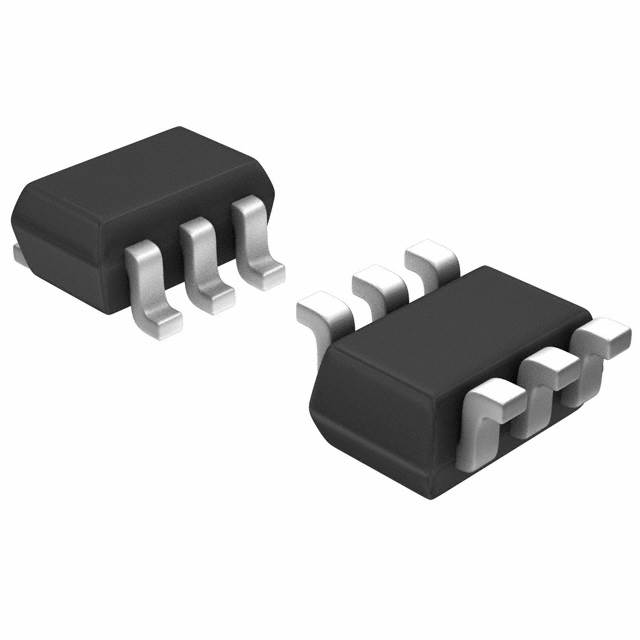
NX3008NBKS,115 vs AO7400 MOSFET Comparison
Quick verdict
For low-current dual-channel switching or level-shifting in compact automotive or industrial applications, the NX3008NBKS,115 is the better fit due to its dual MOSFET array, automotive qualification (AEC-Q101), and wide operating temperature range. For single-channel, higher-current loads up to 1.7A with lower on-resistance and better efficiency at moderate gate drive voltages, the AO7400 is the superior choice, especially in space-constrained designs requiring a tiny SC-70-3 package.
Spec comparison table
| Spec | NX3008NBKS,115 | AO7400 | Notes |
|---|---|---|---|
| Configuration | 2 N-Channel (Dual) | 1 N-Channel | NX3008NBKS,115 offers dual MOSFETs, enabling half-bridge or dual switch applications. |
| Drain-Source Voltage Max (V) | 30 V | 30 V | Equal voltage rating, suitable for low-voltage switching. |
| Continuous Drain Current @ 25°C | 350 mA | 1.7 A | AO7400 supports nearly 5x higher continuous current, better for higher power loads. |
| Drain Current Spiking Max | 1.4 A | Not specified | NX3008NBKS,115 can handle short spikes up to 1.4A; AO7400 datasheet doesn’t specify spike. |
| On-Resistance Rds(on) @ Id, Vgs | 1.4 Ω @ 350 mA, 4.5 V | 85 mΩ @ 1.5 A, 10 V | AO7400 has dramatically lower Rds(on), enabling higher efficiency for moderate currents. |
| Gate Threshold Voltage Vgs_th | 0.6–1.1 V (typ) | 1.4 V @ 250 µA | NX3008NBKS,115 has a lower and broader gate threshold voltage range, easier to drive at logic levels. |
| Gate Charge Qg @ 4.5 V | 0.68 nC (typ) | 4.82 nC | NX3008NBKS,115 requires significantly less gate charge, reducing gate drive losses. |
| Input Capacitance Ciss @ 15 V | 50 pF | 390 pF | NX3008NBKS,115 has much lower input capacitance, beneficial for fast switching and low gate drive current. |
| Output Capacitance Coss | 6.5 pF (typ) | Not specified | Lower output capacitance in NX3008NBKS,115 reduces switching losses. |
| Reverse Transfer Capacitance Crss | 2.2 pF (typ) | Not specified | Lower Crss in NX3008NBKS,115 improves switching speed and reduces Miller effect. |
| Power Dissipation Max (Ta) | 445 mW | 350 mW | NX3008NBKS,115 can dissipate more power, helpful in thermally constrained designs. |
| Package | 6-TSSOP (dual) | SC-70-3 (single) | AO7400’s smaller SC-70-3 is suitable for compact layouts; NX3008NBKS,115 is larger dual. |
| Operating Temperature Range | -55°C to +150°C | -55°C to +150°C | Both suitable for automotive and industrial temperature ranges. |
| Electrostatic Discharge (ESD) Rating | 2000 V | Not specified | NX3008NBKS,115 offers defined ESD robustness, important for automotive applications. |
| Gate-Source Voltage Max | ±8 V | ±12 V | AO7400 tolerates higher gate voltages, useful in some gate driver architectures. |
| Drain Leakage Current @ 150°C | 10 µA (typ) | Not specified | NX3008NBKS,115 datasheet quantifies leakage, indicating low leakage at high temp. |
| Transient Thermal Impedance (typ 100ms) | 0.5 K/W | Not specified | NX3008NBKS,115 provides detailed thermal data for better thermal design. |
| Gate Leakage Current @ 25°C | 0.2–1 µA (typ) | Not specified | NX3008NBKS,115 has low and well-documented gate leakage, beneficial for low-power designs. |
Design trade-offs
The biggest practical difference between the NX3008NBKS,115 and AO7400 lies in current handling and switching losses driven by on-resistance and gate charge. The AO7400’s Rds(on) of 85 mΩ at 1.5 A and 10 V gate drive voltage is orders of magnitude lower than the NX3008NBKS,115’s 1.4 Ω at 350 mA and 4.5 V. This means the AO7400 can conduct significantly more current with lower conduction losses, making it suitable for switching loads in the ampere range, such as power rails, low-side switches, or load switches in battery-powered or portable devices.
However, the AO7400 trades off higher gate charge (4.82 nC vs. 0.68 nC) and much higher input capacitance (390 pF vs. 50 pF). This increases gate drive losses and requires stronger or more power-hungry gate drivers, especially in high-frequency switching applications. The NX3008NBKS,115’s low gate charge and input capacitance make it easier to drive with simple logic-level signals or low-current drivers, reducing complexity in gate drive circuitry.
Thermally, the NX3008NBKS,115 supports a higher maximum power dissipation (445 mW vs. 350 mW) and provides detailed transient thermal impedance data, which is helpful when tightly budgeting thermal performance in automotive or industrial environments. Its dual MOSFET configuration and AEC-Q101 qualification make it well-suited for harsh environments and applications requiring redundancy or half-bridge topologies in a single package.
In layout terms, the AO7400’s SC-70-3 package is significantly smaller than the NX3008NBKS,115’s 6-TSSOP dual package, enabling higher density designs but limiting current handling and heat dissipation capability. The NX3008NBKS,115’s package is larger but provides two matched MOSFETs, which can simplify board layout for dual switch applications and reduce component count.
Cost at volume is not directly provided, but generally, single discrete MOSFETs like the AO7400 in smaller packages tend to be cheaper than dual arrays with automotive qualification. The NX3008NBKS,115’s AEC-Q101 qualification and dual MOSFET integration add cost but simplify design in automotive and industrial contexts.
Use-case fit
Choose NX3008NBKS,115 when…
- You need two matched low-current N-channel MOSFETs in a single package for half-bridge or dual-switch applications.
- Operating in automotive or industrial environments requiring AEC-Q101 qualification and wide temperature range up to +150°C.
- Your design emphasizes low gate drive power and fast switching due to low input capacitance and gate charge.
- Power dissipation and thermal management are critical, and you need detailed thermal impedance data.
- Your gate drive voltage is limited to logic-level ranges (around 4.5 V), and you want a logic-level MOSFET with low gate threshold voltage.
Choose AO7400 when…
- You require a single MOSFET capable of continuous currents up to 1.7 A with low conduction losses.
- Board space is limited and you prefer a very small SC-70-3 package.
- Your gate driver can supply the higher gate charge current and operate at 10 V or higher gate drive voltages to minimize Rds(on).
- You are designing low-voltage DC-DC converters, load switches, or power rails with moderate switching frequencies.
- ESD robustness or automotive qualification is not a primary concern.
Drop-in compatibility
These parts are not pin-compatible or footprint-compatible. The NX3008NBKS,115 is a dual MOSFET array in a 6-TSSOP package, while the AO7400 is a single MOSFET in a SC-70-3 package. Substituting one for the other requires redesigning the PCB footprint and possibly the gate drive and load configuration due to the differing number of channels and electrical characteristics. No direct drop-in substitution is possible.
Alternatives to consider
- Si2302DS (N-Channel, 20 V, ~2.3 A, SC-70-3): Slightly higher current rating than AO7400 in small package, suitable for compact low-voltage loads.
- BSS138 (N-Channel, 50 V, 200 mA, SOT-23): Low current logic-level MOSFET alternative with similar gate charge to NX3008NBKS,115 but single channel.
- SI2301 (N-Channel, 30 V, 3.7 A, SOT-23): Higher current and lower Rds(on) than AO7400, useful for higher power load switching in compact packages.