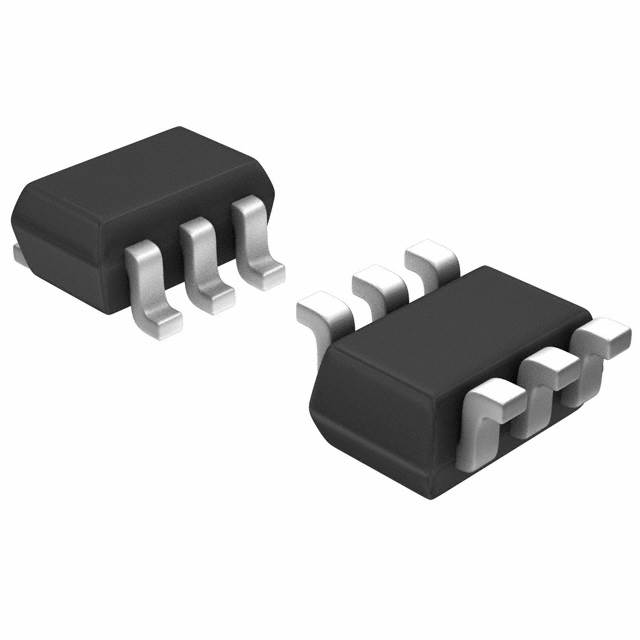
Component Comparison: NX3008NBKS,115 vs AO6604
Quick verdict
For low-current, low-voltage switching or level-shifting applications where board space is tight and gate charge must be minimal, the NX3008NBKS,115 is the better choice due to its very low gate charge and dual N-channel configuration. For power switching or complementary push-pull stages at moderate voltages with significantly higher current demands, the AO6604 outperforms with its higher continuous current rating, complementary N/P channel pair, and much lower R_DS(on), making it better suited for power stages and motor drivers.
Spec comparison table
| Spec | NX3008NBKS,115 | AO6604 | Notes |
|---|---|---|---|
| Configuration | Dual N-Channel | Complementary N- and P-Channel | AO6604 offers complementary pair, enabling push-pull or half-bridge designs without extra parts. |
| Drain-Source Voltage (V_DS max) | 30 V | 20 V | NX3008NBKS provides 50% higher voltage rating, useful for 24V rails or transient margin. |
| Continuous Drain Current @ 25°C | 350 mA | 3.4 A (N), 2.5 A (P) | AO6604 supports ~10x higher current, suitable for power applications. |
| Drain Current Spiking Max | 1.4 A | Not specified | NX3008NBKS can handle short spikes beyond continuous rating; AO6604 datasheet does not specify. |
| On-Resistance R_DS(on) @ I_D, V_GS | 1.4 Ω @ 350mA, 4.5V | 65 mΩ @ 3.4A, 4.5V | AO6604’s R_DS(on) is ~20x lower, reducing conduction losses drastically at high current. |
| Gate Charge Q_g max @ V_GS | 0.68 nC @ 4.5V | 3.8 nC @ 4.5V | NX3008NBKS has much lower gate charge, lowering gate drive power and switching losses. |
| Input Capacitance (C_iss) | 50 pF @ 15 V | 320 pF @ 10 V | NX3008NBKS has ~6x lower input capacitance, easing gate driver requirements and improving speed. |
| Power Dissipation Max | 445 mW | 1.1 W | AO6604 can dissipate more than twice the power, enabling higher current and thermal margin. |
| Package | 6-TSSOP | 6-TSOP (SC-74, SOT-457) | Both are 6-pin surface mount, but different footprints and sizes (NX3008NBKS 2.2x1.35 mm). |
| Operating Temperature Range | -55°C to +150°C | -55°C to +150°C | Identical, suitable for automotive/industrial temperature ranges. |
| ESD Rating | 2 kV | Not specified | NX3008NBKS specifies ESD rating, helpful for robust designs. |
| Gate Threshold Voltage (V_GS(th)) | 0.5 V (min), typical 1.75 V | 1 V @ 250µA (max) | NX3008NBKS has slightly higher threshold; AO6604 threshold is low and consistent. |
| Transient Thermal Impedance (typical) | 0.01–1 K/W (various timescales) | Not specified | NX3008NBKS datasheet provides detailed thermal impedance, AO6604 does not. |
| Gate Leakage Current (typical) | 0.2–1 µA at 25°C | Not specified | NX3008NBKS gate leakage is low and specified; AO6604 data not provided. |
| Drain Leakage Current (typical) | 1 µA @ 25°C, 10 µA @ 150°C | Not specified | NX3008NBKS leakage current is low and characterized. |
| Transistor Technology | MOSFET (Metal Oxide) | MOSFET (Metal Oxide) | Both use standard MOSFET technology. |
Design trade-offs
The most significant design trade-off between these parts lies in current capability and switching characteristics. The AO6604 supports continuous currents an order of magnitude higher than the NX3008NBKS,115, with R_DS(on) values approximately 20 times lower. This makes the AO6604 more suitable for power switching applications such as load switches, motor drivers, or DC-DC converters where conduction losses directly impact efficiency and thermal management.
However, the AO6604’s much larger input capacitance (320 pF vs. 50 pF) and higher gate charge (3.8 nC vs. 0.68 nC) impose greater demands on the gate driver. This can increase switching losses and require more robust gate drive circuitry, particularly at higher switching frequencies. The NX3008NBKS,115 excels in low gate charge and low input capacitance, making it more efficient in low-current switching or level-shifting applications where gate drive power and speed are critical.
Thermally, the AO6604’s power dissipation rating of 1.1W versus the NX3008NBKS’s 445mW reflects its ability to handle higher continuous power and thus higher junction temperatures under load. The NX3008NBKS’s high thermal resistance (~300 K/W per device) means that at its low current rating, careful thermal design is necessary to avoid hot spots. The AO6604’s thermal specs are not detailed, but its higher power rating suggests better thermal performance, especially in more robust packages.
The package difference is relevant for PCB layout. NX3008NBKS uses a 6-TSSOP package (2.2x1.35 mm), smaller and thinner than the AO6604’s 6-TSOP (SC-74/SOT-457), which is slightly larger and likely better for heat dissipation given the higher power. The AO6604’s complementary N/P configuration simplifies driver design for half-bridge or push-pull circuits, reducing component count and improving switching symmetry, whereas NX3008NBKS only provides dual N-channels, requiring external P-channel or discrete solutions for complementary stages.
From a cost perspective, the NX3008NBKS is likely cheaper given its simpler dual N-channel design and lower current rating, but the AO6604’s integration of complementary pairs and higher performance justifies its higher price in power applications. Volume pricing and availability should be confirmed with suppliers.
Use-case fit
Choose NX3008NBKS,115 when…
- You need a low-voltage (up to 30V) dual N-channel MOSFET array for signal-level switching or level shifting at currents below 350mA.
- Minimizing gate drive power and switching losses is critical, such as in low-frequency, low-current PWM or digital isolator outputs.
- Board space is limited and a very small 6-TSSOP package is required.
- Operating in automotive or industrial environments requiring AEC-Q101 qualification and wide temperature range (-55°C to +150°C).
- The application involves low power analog switches or load switches where leakage current and gate leakage must be minimal.
Choose AO6604 when…
- The application requires handling continuous drain currents in the 2.5–3.4A range at 20V, such as DC motor drivers, high-current load switches, or power rails.
- Complementary N/P channel switching is needed for half-bridge or push-pull topologies without adding discrete parts.
- Low on-resistance is critical to reduce conduction losses and improve efficiency at high currents.
- The design can accommodate a slightly larger package and more robust gate drivers to handle higher gate charge and input capacitance.
- Power dissipation up to 1.1W per device is expected, requiring better thermal management and package heat sinking.
Drop-in compatibility
The NX3008NBKS,115 and AO6604 are not pin-compatible nor footprint-compatible. The NX3008NBKS uses a 6-TSSOP package (2.2 mm x 1.35 mm), while the AO6604 is in a 6-TSOP (SC-74, SOT-457) package with a different pinout and physical size. Additionally, their configurations differ: NX3008NBKS is dual N-channel only, AO6604 is complementary N and P. Substituting one for the other requires a PCB redesign and possibly changes in gate drive circuitry and application topology. No direct drop-in replacement is possible.
Alternatives to consider
- BSS138 (NXP Semiconductors) — A low-voltage (50V), low-current N-channel MOSFET in a tiny SOT-23 package, useful for signal-level switching and level shifting.
- Si2302 (Vishay) — Logic-level N-channel MOSFET with low R_DS(on) for small load switching up to ~2A, in SOT-23 package.
- FDS6910 (ON Semiconductor) — Dual N-Channel MOSFET array with low gate charge and R_DS(on), suitable for low-voltage load switches and level shifting.