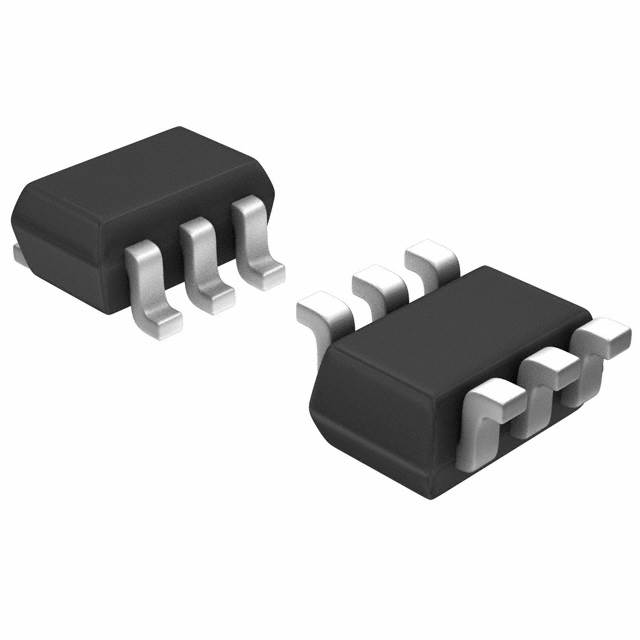
NX3008NBKS,115 vs AO3402 MOSFET Comparison
Quick verdict
For low-current, dual-channel switching or level-shifting applications with stringent space and automotive-grade requirements, the NX3008NBKS,115 is the preferred choice due to its dual MOSFET array and AEC-Q101 qualification. For single-channel, higher-current loads (up to 4A continuous) demanding low R_DS(on) and better thermal performance in a tiny SOT-23 package, the AO3402 is clearly superior.
Spec comparison table
| Spec | NX3008NBKS,115 | AO3402 | Notes |
|---|---|---|---|
| Type | Dual N-Channel MOSFET Array | Single N-Channel MOSFET | NX3008NBKS is dual channel; AO3402 is single channel |
| Drain-Source Voltage (V_DS max) | 30 V | 30 V | Equal rating |
| Continuous Drain Current (I_D @ 25°C) | 350 mA | 4 A | AO3402 supports >10x higher continuous current |
| Pulsed Drain Current (I_D,pulse max) | 1.4 A | 15 A | AO3402 supports much higher pulse currents |
| On-Resistance (R_DS(on) @ 4.5V) | 1.4 Ω (typ) @ 350mA | 55 mΩ (max) @ 4A, 10V | AO3402 has significantly lower R_DS(on), drastically reducing conduction losses |
| Power Dissipation (P_D max) | 445 mW | 1.4 W (Ta) | AO3402 can dissipate >3x the power, easing thermal design |
| Gate Threshold Voltage (V_GS(th)) | 0.5 - 1.1 V (typ 0.6-0.9-1.1 V) | 0.5 - 1.5 V (typ 1 V) | Comparable; AO3402 has slightly wider max range |
| Gate Charge (Q_g @ 4.5V) | 0.52 - 0.68 nC | 4.34 nC | NX3008NBKS requires significantly less gate charge, reducing gate drive power |
| Input Capacitance (C_iss @ 15V) | 50 pF | 390 pF | NX3008NBKS has much lower input capacitance, better for high-speed switching |
| Output Capacitance (C_oss typ) | 6.5 pF | Not specified | NX3008NBKS output capacitance is low, beneficial for switching losses |
| Reverse Transfer Capacitance (C_rss typ) | 2.2 pF | Not specified | NX3008NBKS has low feedback capacitance, improving switching performance |
| Gate-Source Voltage Max | ±8 V | ±12 V | AO3402 supports higher gate voltage, adding margin for gate drive voltage spikes |
| Drain Leakage Current (I_DSS @ 25°C) | 1 µA (typ) | Not specified | NX3008NBKS has low leakage current |
| Gate Leakage Current (I_GSS typ) | 0.2 - 1 µA | 100 nA | AO3402 gate leakage is lower (100 nA vs up to 1 µA) |
| Package | 6-TSSOP (SC-88, SOT-363) | SOT-23-3 | NX3008NBKS is a dual MOSFET array in 6-pin TSSOP; AO3402 is single MOSFET in 3-pin SOT-23 |
| Ambient Operating Temperature | -55°C to +150°C | -55°C to +150°C | Equal rating |
| Thermal Resistance Junction-to-Ambient | ~300 K/W per device | 125 °C/W max | AO3402 has better thermal resistance (lower °C/W), easier heat sinking |
| ESD Rating | 2000 V | Not specified | NX3008NBKS offers explicit ESD robustness |
| Qualification | AEC-Q101 Automotive Grade | Not qualified | NX3008NBKS is automotive qualified, AO3402 is not |
| Switching Times (Turn-on/off delay) | 15-30 ns (turn-on), 69-138 ns (turn-off) | 3.5 ns (turn-on), 17.5 ns (turn-off) | AO3402 has faster switching, beneficial for high-frequency applications |
| Total Power Dissipation (typ) | 280 mW | Not specified | NX3008NBKS documented typical power dissipation |
Design trade-offs
The most fundamental difference is current capability: the AO3402 supports up to 4A continuous drain current with a very low R_DS(on) of 55 mΩ at 4A and 10V gate drive, compared to the NX3008NBKS,115’s 350mA max current and 1.4 Ω R_DS(on) at 350mA and 4.5V. This means conduction losses on the AO3402 are orders of magnitude lower for moderate to high current loads, enabling more efficient power switching and less heat generation.
The NX3008NBKS,115 is a dual MOSFET array with two N-channel devices in a compact 6-TSSOP package, which is useful for load switching or level shifting where two low-current switches are needed in a single footprint. It is also qualified to AEC-Q101 automotive standards, making it suitable for harsh environments and high-reliability applications. The AO3402, by contrast, is a single device in a smaller SOT-23-3 package without automotive qualification, limiting its use in automotive or similarly demanding fields.
From a gate drive perspective, the NX3008NBKS requires significantly less gate charge (~0.6 nC vs 4.3 nC at 4.5V), which reduces gate driver power dissipation and simplifies driving at high switching frequencies. Combined with its very low input capacitance (50 pF vs 390 pF), the NX3008NBKS is better suited for switching at higher speed with minimal gate power, but only for very low currents. The AO3402’s higher gate charge and capacitance require a stronger gate driver but enable much higher load currents.
Thermal management is a major consideration: the AO3402’s power dissipation rating of 1.4W and thermal resistance junction-to-ambient of 125 °C/W mean it can handle higher power in less aggressive cooling conditions. The NX3008NBKS dissipates under 0.5W and has a much higher thermal resistance (~300 K/W), which restricts it to low-power, low-current applications. This also affects PCB layout, as the AO3402 benefits from a thermal pad and copper area to dissipate heat, whereas the NX3008NBKS’s thermal limits are more constrained.
The NX3008NBKS’s dual MOSFET configuration and automotive qualification come at the cost of higher R_DS(on), lower current rating, and slower switching times, making it unsuitable for power stages or high load currents. The AO3402, optimized for single high-current switching, is better for power switching, DC-DC converters, and load switches where efficiency and thermal performance are critical.
Cost-wise, the AO3402 is likely cheaper due to simpler package and single channel, but automotive qualification and dual MOSFET integration in NX3008NBKS may justify its price premium for automotive or multi-switch use-cases.
Use-case fit
Choose NX3008NBKS,115 when:
- You need two low-current (≤350mA) N-channel MOSFET switches in a single 6-pin TSSOP footprint for space-constrained designs.
- The application requires AEC-Q101 automotive qualification for reliability in harsh environments.
- Gate drive power is limited and you require minimal gate charge and input capacitance to reduce switching losses.
- Switching frequencies are moderate to high but load currents remain low (sub-0.5A).
- You want integrated ESD robustness (2000V) for sensitive signal path switching.
Choose AO3402 when:
- Your load current requirements exceed 1A and can go up to 4A continuous or 15A pulsed.
- You need low conduction losses and high efficiency in power switching or load switching.
- Thermal dissipation capability and ease of heat sinking are important, with power dissipation up to 1.4W.
- You require fast switching times for high-frequency DC-DC converters or PWM applications.
- The design is non-automotive or qualification grade is not a critical factor.
Drop-in compatibility
These two MOSFETs are not pin-compatible. The NX3008NBKS,115 is a dual MOSFET in a 6-TSSOP package (6 leads), while the AO3402 is a single MOSFET in a 3-pin SOT-23-3 package. Their pinouts, package dimensions, and number of channels differ substantially. Substituting one for the other will require a PCB redesign and circuit reevaluation.