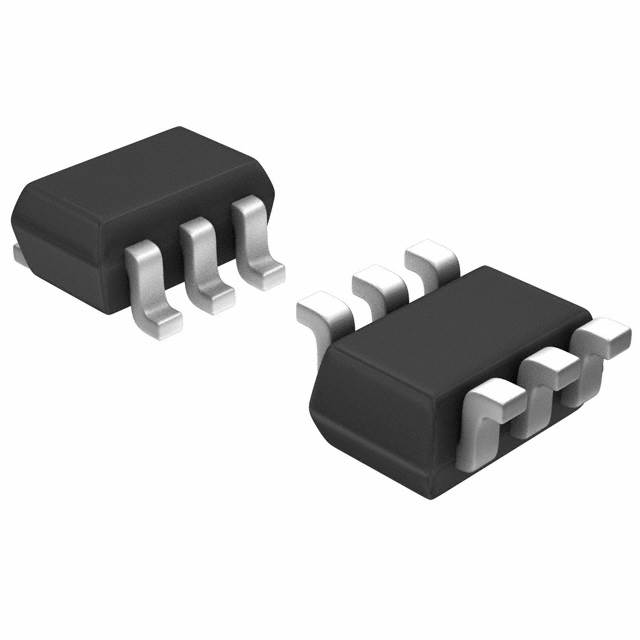
Component Comparison: NX3008NBKS,115 vs AIMBG120R160M1XTMA1
1. Quick verdict
For low-voltage, low-current switching and load switching applications (e.g., signal-level switching, level shifting, or small load control), the NX3008NBKS,115 is the better choice due to its dual MOSFET array configuration, low gate charge, and logic-level drive. Conversely, for high-voltage, high-current power conversion (e.g., industrial motor drives, power factor correction, or automotive traction inverters), the AIMBG120R160M1XTMA1 is the clear winner, offering a 1200 V rating, 17 A continuous current, and substantially higher power dissipation capability.
2. Spec comparison table
| Spec | NX3008NBKS,115 | AIMBG120R160M1XTMA1 | Notes |
|---|---|---|---|
| Technology | MOSFET (Metal Oxide) | SiCFET (Silicon Carbide) | SiC device supports higher voltage and temperature, but requires different gate drive. |
| Configuration | 2 N-Channel (Dual) | Single N-Channel | Dual MOSFET array useful for bidirectional or half-bridge configurations in NX3008NBKS. |
| Drain-Source Voltage Max | 30 V | 1200 V | AIMBG120R160M1XTMA1 supports high-voltage applications. |
| Continuous Drain Current @ 25°C | 350 mA | 17 A (Tc) | AIMBG120R160M1XTMA1 supports ~50x higher current. |
| Power Dissipation Max | 445 mW | 106 W (Tc) | AIMBG120R160M1XTMA1 can dissipate orders of magnitude more power. |
| Package Type | 6-TSSOP (SC-88, SOT-363) | PG-TO263-7-12 (D2PAK) | Different packages; TO-263 is larger with better thermal capability. |
| Gate Charge (Qg) Typ | 0.52–0.68 nC @ 4.5 V | 14 nC @ 20 V | NX3008NBKS requires much lower gate charge, easier to drive with logic-level signals. |
| Gate-Source Threshold Voltage Typ | 1.75 V | 5.1 V @ 1.6 mA | NX3008NBKS is logic-level (lower threshold), AIMBG120R160M1XTMA1 requires higher gate voltage. |
| Gate-Source Voltage Max | ±8 V | +23 V / -5 V | AIMBG120R160M1XTMA1 supports higher gate drive voltages, typical for SiC MOSFETs. |
| Input Capacitance (Ciss) | 34–50 pF @ 25°C, 15 V | 350 pF @ 800 V | NX3008NBKS has significantly lower input capacitance, reducing switching losses at low Vgs. |
| Drain-Source On-State Resistance (Rds(on)) Typ @ 25°C | 1–1.4 Ω @ 350 mA, 4.5 V | 0.2 Ω @ 5 A, 20 V | AIMBG120R160M1XTMA1 has much lower Rds(on) at its rated current, suitable for high-power use. |
| Drain Current Spiking Max | 1.4 A | Not specified | NX3008NBKS can handle short surges up to ~4x nominal current. |
| Ambient Temperature Range | -55°C to +150°C | -55°C to +175°C | AIMBG120R160M1XTMA1 supports higher operating temperature. |
| Junction Temperature Range | -55°C to +150°C | -55°C to +175°C | Higher TJ max on AIMBG120R160M1XTMA1 allows more thermal headroom. |
| ESD Rating | 2000 V | Not specified | NX3008NBKS offers modest ESD robustness; no data for AIMBG120R160M1XTMA1. |
| Forward Transconductance gfs Typ @ 25°C | 310 mS | Not specified | NX3008NBKS provides data; AIMBG120R160M1XTMA1 datasheet does not specify. |
| Switching Times (t_rise / t_fall / delays) Typ @ 25°C | Rise: 11 ns, Fall: 19 ns, Delay: 15–138 ns | Not specified, but “more precise values in datasheet” | NX3008NBKS has known switching speed; AIMBG120R160M1XTMA1 likely faster but data unclear here. |
| Thermal Resistance Junction-to-Ambient Typ | 300 K/W (device), 390–445 K/W (per transistor) | Not specified, but package (TO-263) implies lower RθJA | NX3008NBKS limited by small package; AIMBG120R160M1XTMA1 package better for heat dissipation. |
| Total Power Dissipation Typ | 280 mW | Not specified, max 106 W | AIMBG120R160M1XTMA1 far superior for power dissipation. |
| Creepage Distance | Not specified | 5.85 mm (min) | AIMBG120R160M1XTMA1 suitable for high-voltage safety requirements. |
| Qualification | AEC-Q101 (Automotive) | AEC-Q101 (Automotive) | Both qualified for automotive applications. |
| Mounting Type | Surface Mount | Surface Mount | Both surface mount but with different package footprints. |
3. Design trade-offs
The fundamental trade-off between the NX3008NBKS,115 and AIMBG120R160M1XTMA1 lies in their intended application domains: low-voltage, low-current signal-level switching versus high-voltage, high-current power switching. The NX3008NBKS,115 is a dual logic-level MOSFET array with a 30 V rating and a maximum continuous current of 350 mA, optimized for control and signal switching functions. Its extremely low gate charge (~0.6 nC) and low input capacitance (<50 pF) allow it to be driven directly from low-power logic without additional gate drivers, which simplifies board layout and reduces BOM cost and complexity.
In contrast, the AIMBG120R160M1XTMA1 is a single SiC MOSFET designed for high-voltage (1200 V) and high-current (17 A continuous) applications. Its significantly higher gate charge (14 nC at 20 V) and gate threshold voltage (~5.1 V) necessitate a dedicated gate driver with sufficient drive strength and voltage swing, increasing system complexity. However, this device’s low Rds(on) of 0.2 Ω at 5 A (20 V gate drive) translates to much lower conduction losses in high-current scenarios, and its package (PG-TO263-7) supports much better thermal dissipation (up to 106 W Tc rating) compared to the tiny 6-TSSOP package of the NX3008NBKS.
Thermally, the NX3008NBKS’s small package leads to high thermal resistance (300 K/W junction-to-ambient), limiting its power dissipation and requiring careful derating or heat sinking for continuous operation near its limits. The AIMBG120R160M1XTMA1’s TO-263 D2PAK package offers better heat spreading and can be mounted directly to a heatsink or PCB copper plane to manage up to 106 W, a necessary feature for power conversion applications.
From a switching perspective, the NX3008NBKS has well-documented switching times on the order of tens of nanoseconds, suitable for moderate-frequency switching in signal-level applications. While the AIMBG120R160M1XTMA1’s switching characteristics are not detailed here, SiC MOSFETs generally support faster switching speeds and lower switching losses at high voltages, enabling higher-frequency power conversion with improved efficiency.
Cost and PCB footprint are also critical considerations. The NX3008NBKS’s small 6-TSSOP dual MOSFET footprint is compact and low-cost, suitable for dense control boards. The AIMBG120R160M1XTMA1’s larger TO-263 package and SiC technology generally come at higher cost and require more PCB real estate and thermal design effort.
4. Use-case fit
Choose NX3008NBKS,115 when…
- You need a dual MOSFET array to switch or level-shift low-voltage signals or small loads up to 350 mA.
- Logic-level gate drive capability is required to interface directly with low-voltage microcontrollers or FPGAs without a separate gate driver.
- Board space is limited, and a small 6-TSSOP package is preferred.
- The application operates at voltages under 30 V and requires operation up to +150°C ambient.
- Low gate charge and input capacitance are critical to minimize switching losses and EMI in signal-level or low-frequency switching.
Choose AIMBG120R160M1XTMA1 when…
- Your application requires blocking voltages up to 1200 V, such as motor drives, high-voltage DC-DC converters, or inverter stages.
- Continuous