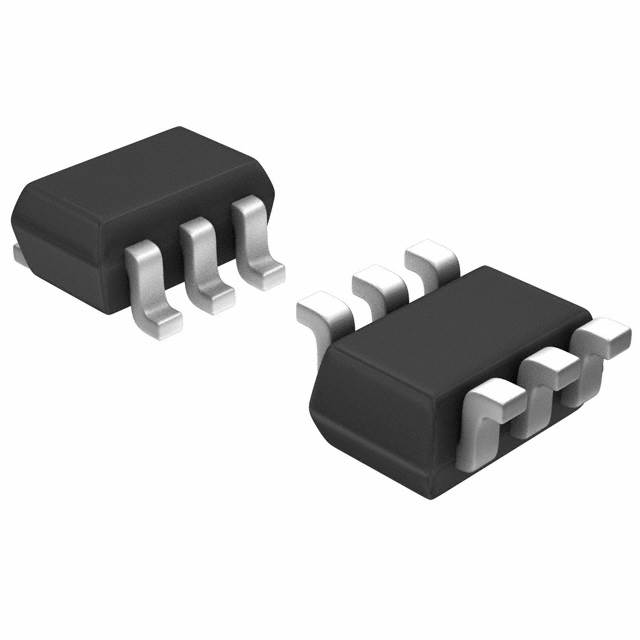
NX3008NBKS,115 vs 2N7002PS,115 MOSFET Arrays: Detailed Component Comparison
Quick verdict
For low-voltage switching applications with limited current requirements (under 350mA) and tight thermal margins, the NX3008NBKS,115 offers lower gate charge and slightly better on-resistance, making it preferable for efficient, thermally constrained circuits. In contrast, the 2N7002PS,115 supports higher voltage (60V) and thus suits designs requiring wider voltage headroom or higher voltage transients at similar current levels, despite its higher gate threshold and slightly higher R_DS(on).
Spec comparison table
| Spec | NX3008NBKS,115 | 2N7002PS,115 | Notes |
|---|---|---|---|
| Configuration | 2 N-Channel (Dual) | 2 N-Channel (Dual) | Identical. |
| Drain-Source Voltage, V_DS max | 30 V | 60 V | 2N7002PS doubles voltage rating, better for higher voltage margins. |
| Continuous Drain Current, I_D @ 25°C | 350 mA | 320 mA | NX3008NBKS has slightly higher continuous current rating. |
| Drain Current Spiking Max | 1.4 A | Not specified | NX3008NBKS specifies 1.4 A spike capability, useful for transient loads. |
| R_DS(on) Typ @ 25°C | 1.0 – 1.4 Ω @ 350mA, 4.5V | 1.6 Ω @ 500mA, 10V | NX3008NBKS has lower R_DS(on) at lower V_GS; 2N7002PS tested at higher current & gate voltage. Lower R_DS(on) at relevant gate drive is better. |
| Gate Threshold Voltage, V_GS(th) Typ | 0.6 – 1.1 V (typ) @ 250µA | 2.4 V @ 250µA | NX3008NBKS has significantly lower V_GS(th), easier to fully turn on with logic-level signals. |
| Gate Charge Q_g @ 4.5V max | 0.68 nC | 0.8 nC | NX3008NBKS slightly lower gate charge, reducing gate drive losses. |
| Input Capacitance C_ISS typ @ 25°C | 34 – 50 pF (max @ 15V) | 50 pF (max @ 10V) | Comparable input capacitance; NX3008NBKS rated at higher V_DS test condition. |
| Output Capacitance C_OSS typ | 6.5 pF | Not specified | NX3008NBKS provides output capacitance data, useful for switching loss calculations. |
| Reverse Transfer Capacitance C_RSS typ | 2.2 pF | Not specified | NX3008NBKS data available; lower C_RSS reduces Miller effect in switching. |
| Power Dissipation max | 445 mW | 420 mW | NX3008NBKS has slightly higher max power dissipation. |
| Package | 6-TSSOP (SOT-363) | 6-TSSOP (SOT-363) | Identical package and footprint. |
| Operating Temperature Range | -55°C to +150°C | -55°C to +150°C | Same temperature range, suitable for automotive grade applications. |
| ESD Rating | 2000 V | Not specified | NX3008NBKS rated for 2kV ESD, better for robust handling. |
| Thermal Resistance Junction-to-Ambient per Device (typ) | 300 K/W | Not specified | NX3008NBKS provides detailed thermal data; 300 K/W is fairly high, suggesting limited power dissipation in open air. |
| Gate Leakage Current typ @ 25°C | 0.2 – 1 µA | Not specified | NX3008NBKS specs gate leakage, useful for low-power designs. |
| Grade / Qualification | Automotive, AEC-Q101 | Automotive, AEC-Q100 | Both qualified for automotive, though slightly different standards (Q101 vs Q100). |
| Gate Source Voltage Max/Min | ±8 V | Not specified | NX3008NBKS specifies ±8 V limits, useful for gate drive design. |
| Rise / Fall / Turn-on / Turn-off times | Rise: 11 ns, Fall: 19 ns, Turn-on delay: 15-30 ns, Turn-off delay: 69-138 ns | Not specified | NX3008NBKS datasheet provides switching speed data, useful for timing-critical designs. |
| Transient Thermal Impedance | 0.01 – 1 K/W (various times) | Not specified | NX3008NBKS transient thermal data enables better transient thermal modeling. |
Design trade-offs
The NX3008NBKS,115 and 2N7002PS,115 share the same form factor and basic dual N-channel MOSFET configuration, but differ primarily in voltage rating, gate threshold voltage, on-resistance, and switching characteristics.
The 2N7002PS doubles the voltage rating to 60 V, which is significant if your design encounters voltage spikes, inductive kickback, or higher supply voltages. However, this comes at the cost of a higher gate threshold voltage (2.4 V typical vs ~1 V for NX3008NBKS), which means the MOSFET requires a stronger gate drive to fully turn on. This can complicate interfacing with low-voltage logic or microcontrollers running at 3.3 V or below, possibly requiring a dedicated driver or level shifter.
On-resistance is a key factor in conduction losses and, therefore, efficiency and thermal dissipation. The NX3008NBKS shows a typical R_DS(on) of 1.0–1.4 Ω at 4.5 V gate drive and 350 mA drain current, whereas the 2N7002PS is specified at 1.6 Ω at a higher 10 V gate drive and 500 mA current. Since the 2N7002PS requires a higher gate voltage to achieve low R_DS(on), it is less efficient in low-voltage gate drive environments. For switching applications under logic-level drive, the NX3008NBKS will generally be more energy efficient.
Switching speeds and gate charge also favor the NX3008NBKS, which has a slightly lower gate charge (0.68 nC vs 0.8 nC at 4.5 V). While the difference is modest, it can translate into lower switching losses and reduced EMI in high-frequency circuits.
Thermally, both devices have similar power ratings (~420–445 mW max) and operate over the same temperature range (-55°C to +150°C). The NX3008NBKS provides more detailed thermal resistance and transient thermal impedance data, supporting better thermal design and reliability assessment. However, the high junction-to-ambient thermal resistance (~300 K/W) indicates that these devices must rely on PCB copper and airflow for heat dissipation; they are not suitable for high-current or high-power dissipation without additional thermal management.
From a layout perspective, both parts share the 6-TSSOP package and footprint, so board-level changes are minimal if substituting, but the higher gate threshold and voltage rating of the 2N7002PS may require different gate drive considerations.
Cost at volume often aligns with the technology and qualification. Both are automotive grade with similar packaging; however, the 2N7002PS’s higher voltage rating might carry a small premium. Pricing should be reviewed case-by-case.
Use-case fit
Choose NX3008NBKS,115 when…
- Driving low-voltage logic-level signals (3.3 V or 5 V) where a low gate threshold and low R_DS(on) improve efficiency.
- Operating in thermally constrained environments with limited power dissipation, benefiting from the device’s slightly higher power rating and detailed thermal specs.
- Designing circuits with transient currents up to 1.4 A spikes, where the NX3008NBKS’s specified spike current rating improves reliability.
- Requiring precise switching timing and low gate charge for high-frequency switching (tens of kHz or more).
- Using automotive or industrial applications needing AEC-Q101 qualification with detailed reliability data.
Choose 2N7002PS,115 when…
- The application requires a higher voltage margin up to 60 V for handling voltage spikes, inductive loads, or higher supply rails.
- Gate drive voltage can reliably reach 10 V or higher to fully enhance the device and minimize conduction losses.
- Slightly lower continuous current (320 mA vs 350 mA) is acceptable in exchange for higher voltage rating.
- Simpler switching speed and transient thermal data are not critical for the design.
- The system uses automotive-grade AEC-Q100 components and can accommodate the higher gate threshold voltage.
Drop-in compatibility
Both devices share the 6-TSSOP (SOT-363) package and dual N-channel configuration, suggesting footprint and pin compatibility. The datasheets do not explicitly confirm pin-to-pin