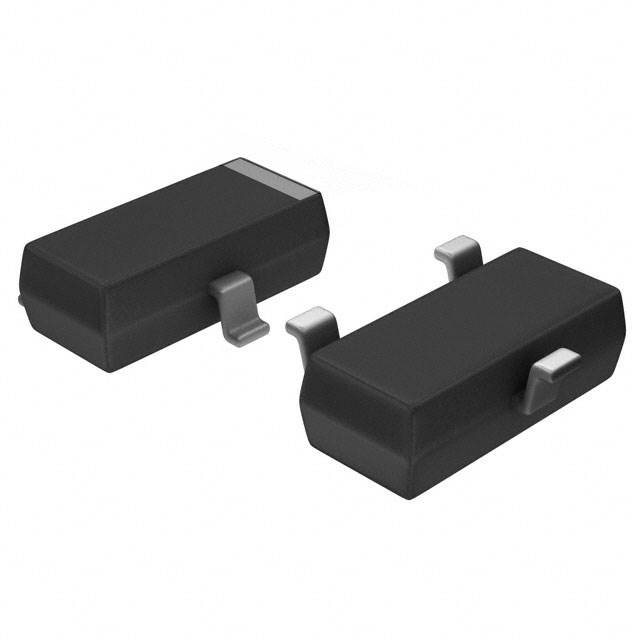
MMBF5485 vs TB67B008FTG,EL: Component Comparison for Power Electronics Engineers
Quick verdict
For low-current, high-frequency RF switching or amplification up to 400 MHz, the MMBF5485 is the clear choice due to its JFET technology, low noise figure, and SOT-23-3 footprint. Conversely, for motor control applications requiring integrated power stages and PWM input handling with up to 3 A output current, the TB67B008FTG,EL significantly outperforms as a fully integrated driver with robust thermal and control features.
Spec comparison table
| Spec | MMBF5485 | TB67B008FTG,EL | Notes |
|---|---|---|---|
| Configuration | N-Channel JFET | Power MOSFET (Half Bridge) | Different device types; JFET suited for RF, MOSFET optimized for power switching. |
| Current rating (max) | 10 mA | 3 A | TB67B008FTG handles 300x higher output current, critical for motor drivers. |
| Frequency | 400 MHz | Not specified | MMBF5485 supports RF applications up to 400 MHz; TB67B008FTG not designed for RF. |
| Gain | - | - | No gain data for MMBF5485; TB67B008FTG is a power stage, gain not applicable. |
| Mounting type | Surface Mount (SOT-23-3) | Surface Mount (24-WQFN 4x4 mm) | MMBF5485 is smaller and easier for compact RF circuits; TB67B008FTG requires larger PCB area. |
| Noise figure | 4 dB | Not specified | MMBF5485’s low noise figure benefits sensitive analog/RF front ends; TB67B008FTG not targeted here. |
| Output power max | Not specified | Not specified | TB67B008FTG’s power capability implied by current rating, but no explicit output power given. |
| Package case | TO-236-3 (SOT-23-3) | 24-WQFN (4x4 mm) | TB67B008FTG’s exposed pad aids thermal dissipation; MMBF5485’s small package limits thermal handling. |
| Technology | JFET | Power MOSFET | JFET for RF linearity and low noise; MOSFET for high efficiency switching and power delivery. |
| Voltage rated | 25 V | 5.5 V – 22 V | MMBF5485 can handle marginally higher voltage; TB67B008FTG optimized for typical motor voltages. |
| Voltage test | 15 V | Not specified | MMBF5485 tested at 15 V; TB67B008FTG supports operating voltage range 5.5 V to 22 V. |
| Function | Discrete transistor | Fully integrated driver with control and power stage | TB67B008FTG integrates gate driver and MOSFETs for half-bridge motor control. |
| Interface | None | PWM | TB67B008FTG designed for PWM input control; MMBF5485 is a passive component. |
| Motor type support | None | Brushless DC (BLDC) | TB67B008FTG supports BLDC motors; MMBF5485 not intended for motor control. |
| Operating temperature range | Not specified | -40°C to 105°C | TB67B008FTG specified for industrial temperature range; MMBF5485 datasheet does not specify. |
| Output configuration | Single transistor | Half bridge | TB67B008FTG integrates half-bridge output stage; MMBF5485 is a standalone transistor. |
Design trade-offs
The MMBF5485 is essentially a discrete JFET transistor optimized for RF applications, with a maximum frequency of 400 MHz and low noise figure (4 dB). Its maximum current rating is only 10 mA, which severely limits its use to small-signal amplification or switching tasks at RF frequencies. The SOT-23-3 package allows for compact PCB layouts where minimal parasitics are critical, but thermal dissipation capacity is limited due to the small size and low power handling.
In contrast, the TB67B008FTG,EL is a fully integrated motor driver IC combining power MOSFETs and gate drivers in a 24-WQFN package with an exposed pad for efficient thermal management. It handles continuous output currents up to 3 A, supports operating voltages from 5.5 V to 22 V, and accepts PWM inputs for motor control. This integration simplifies board layout and firmware complexity by abstracting MOSFET drive and protection functions, but comes at the cost of a larger PCB footprint and the need to manage switching losses and thermal dissipation carefully at higher currents.
From a thermal standpoint, the TB67B008FTG’s exposed pad and package size allow for heat sinking and more aggressive power cycling, whereas the MMBF5485’s small package and low current rating make it unsuitable for power stages or high dissipation scenarios. Efficiency curves are not provided for MMBF5485 due to its low power and frequency-specific application, but the TB67B008FTG’s MOSFETs will have conduction and switching losses dependent on gate drive voltage and switching frequency; firmware and hardware must be designed to optimize PWM duty cycles and minimize thermal stress.
The gate drive requirements differ fundamentally: MMBF5485 is a JFET transistor that requires biasing as a discrete device, generally simpler but less suited for integration; TB67B008FTG includes internal gate drivers and requires a PWM control interface, adding system complexity but enabling precise control of motor phases. Designers must consider firmware overhead, PCB layout for high-current loops, and EMI mitigation with the TB67B008FTG, while MMBF5485 demands careful RF layout and small-signal impedance matching.
Cost-wise, the MMBF5485 is likely cheaper per unit given its discrete nature and simple package, but the TB67B008FTG’s integration may reduce overall BOM and assembly costs by consolidating multiple components into one IC and simplifying control circuitry.
Use-case fit
Choose MMBF5485 when…
- Designing low-noise RF front-end amplifiers or switches operating up to 400 MHz.
- Implementing small-signal, low-current analog switching or mixing in communication circuits.
- Space-constrained PCB designs require a small SOT-23-3 package with minimal parasitic capacitance.
- Noise figure is critical, e.g., in sensitive receiver front ends or instrumentation.
- Voltage margins up to 25 V are necessary but power dissipation is minimal.
Choose TB67B008FTG,EL when…
- Building brushless DC motor drivers requiring integrated half-bridge stages and PWM control.
- Managing output currents up to 3 A with robust thermal handling and protection.
- Simplifying firmware by offloading MOSFET gate drive and protection to an integrated IC.
- Operating in industrial temperature ranges (-40°C to 105°C).
- Designing compact motor driver boards where exposed pad thermal dissipation improves reliability.
Drop-in compatibility
The MMBF5485 and TB67B008FTG,EL are not pin-compatible or footprint-compatible. The MMBF5485 is a 3-pin SOT-23-3 transistor package, whereas the TB67B008FTG is a 24-pin WQFN with integrated driver and power MOSFET half-bridge. Substituting one for the other requires complete redesign of PCB layout, power supply, control firmware, and application architecture. There is no functional interchangeability.
Alternatives to consider
- BSS138 (N-Channel MOSFET, SOT-23): A low-voltage MOSFET with higher current rating (~200 mA) suitable for low-power switching, an alternative to MMBF5485 in low-current digital switching.
- DRV8833 (TI): A dual H-bridge motor driver IC with integrated MOSFETs and PWM control, similar application space as TB67B008FTG but with different current ratings and features.
- IRLZ44N (N-Channel Power MOSFET): A discrete power MOSFET alternative for custom half-bridge implementation where integrated drivers like TB67B008FTG are not suitable.