Component Comparison: MMBF5485 vs TB6612FNG,C,8,EL
Quick verdict
For low-current, high-frequency RF switching or amplification tasks, the MMBF5485 JFET excels due to its 400 MHz frequency rating and low noise figure. Conversely, the TB6612FNG,C,8,EL fully integrated motor driver is the better choice for driving brushed DC motors up to 1A with built-in half-bridge stages and logic control, simplifying motor control design.
Spec comparison table
| Spec | MMBF5485 | TB6612FNG,C,8,EL | Notes |
|---|---|---|---|
| Configuration | N-Channel JFET | Power MOSFET (driver + half-bridge) | MMBF5485 is a discrete transistor; TB6612FNG is a fully integrated driver IC. |
| Current rating (max) | 10 mA | 1 A | TB6612FNG supports 100x higher current, suitable for motor loads vs. signal-level use. |
| Frequency | 400 MHz | Not specified (low frequency switching) | MMBF5485 supports RF applications; TB6612FNG is designed for DC motor control. |
| Gain | Not specified | N/A | MMBF5485 gain depends on JFET characteristics; TB6612FNG is a driver IC, gain irrelevant. |
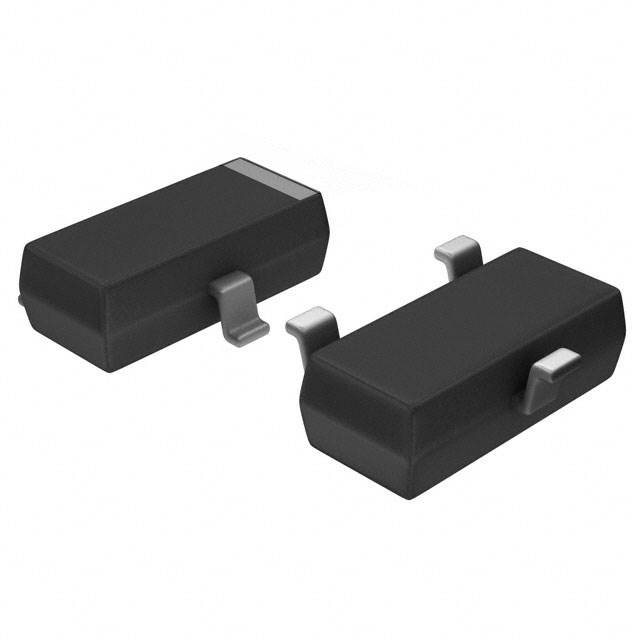
| Mounting type | Surface Mount (SOT-23-3) | Surface Mount (24-SSOP) | MMBF5485 has a small 3-pin package; TB6612FNG requires larger 24-pin footprint. |
| Noise figure | 4 dB | N/A | MMBF5485 suitable for low-noise RF front-ends; TB6612FNG noise figure not relevant. |
| Output power max | Not specified | Not specified | Not directly comparable; TB6612FNG IC power limited by motor driver specs. |
| Package case | TO-236-3 / SC-59 / SOT-23-3 | 24-LSSOP (5.6 mm width) | MMBF5485 is compact transistor; TB6612FNG is a multi-function IC with larger footprint. |
| Technology | JFET | Power MOSFET | Different transistor types; JFET for RF, MOSFET for power switching/driving. |
| Voltage rated | 25 V | Load voltage 2.5V ~ 13.5V, Supply 2.7V ~ 5.5V | MMBF5485 can tolerate higher voltage; TB6612FNG limited to motor supply range. |
| Voltage test | 15 V | N/A | MMBF5485 rated/tested at 15 V; TB6612FNG voltage specs reflect operating limits. |
| Applications | RF switching, low current | General purpose motor driver | MMBF5485 suited for signal-level RF; TB6612FNG for motor control applications. |
| Function | Discrete transistor | Fully integrated driver + power stage | TB6612FNG integrates control logic and power MOSFETs; MMBF5485 is a single transistor. |
| Interface | N/A | Parallel inputs | TB6612FNG requires parallel control signals; MMBF5485 is a transistor controlled by gate. |
| Motor type supported | N/A | Brushed DC motors | TB6612FNG explicitly designed for brushed DC motors; MMBF5485 not suitable for motors. |
| Operating temperature | Not specified | -20°C to 85°C | TB6612FNG specified temperature range; MMBF5485 datasheet should be consulted for details. |
Design trade-offs
The MMBF5485 is a discrete N-channel JFET optimized for RF switching and low-noise amplification up to 400 MHz. Its maximum current rating of 10 mA and voltage rating of 25 V limit it to signal-level applications rather than power switching. The low noise figure (4 dB) makes it suitable for front-end RF designs where signal integrity is critical. Its small SOT-23-3 package simplifies board space but requires careful layout to minimize parasitic capacitances and maintain RF performance.
In contrast, the TB6612FNG,C,8,EL is a fully integrated dual half-bridge driver IC designed for driving brushed DC motors up to 1 A load current. It integrates power MOSFETs with control logic, handling gate drive internally, which significantly reduces firmware and hardware design complexity. The operating voltage range (load 2.5 V to 13.5 V, logic 2.7 V to 5.5 V) is typical for embedded motor control systems. The 24-SSOP package is considerably larger, requiring more PCB area and careful thermal management to dissipate heat generated during motor operation at up to 1 A output current.
Thermally, the MMBF5485 dissipates minimal power due to low current operation, but the TB6612FNG may require heatsinking or thermal vias depending on current draw and duty cycle. The discrete transistor approach of the MMBF5485 demands external biasing and gate drive circuitry, increasing BOM and layout complexity, especially at RF frequencies. The TB6612FNG abstracts this complexity, providing a functional motor driver with standardized parallel interface inputs, but sacrifices flexibility and requires a larger PCB footprint.
Cost-wise, the MMBF5485 is a low-cost discrete component, often cheaper per unit and smaller, suitable for volume RF designs. The TB6612FNG, as an integrated IC, costs more but reduces system-level component count and development time. Designers must weigh integration benefits against PCB space and power dissipation constraints.
Use-case fit
Choose MMBF5485 when…
- Designing RF front-end switching circuits requiring low noise and operation up to 400 MHz.
- Implementing low-current analog switching or small-signal amplification under 10 mA load.
- Minimizing PCB space in sensitive RF or analog signal paths, where a small SOT-23 package is preferred.
- Operating circuits requiring voltage ratings up to 25 V, beyond typical logic-level voltages.
- Requiring a discrete transistor for custom biasing or gain control in analog signal chains.
Choose TB6612FNG,C,8,EL when…
- Driving brushed DC motors up to 1 A, with integrated half-bridge drivers to simplify design.
- Implementing motor control with parallel interface inputs for straightforward firmware integration.
- Operating from battery or embedded system voltages between 2.5 V and 13.5 V load voltage.
- Needing a compact integrated solution with built-in gate drive and protection features.
- Designing systems requiring multiple half-bridge outputs in a single IC for space and component reduction.
Drop-in compatibility
These parts are not pin- or footprint-compatible. The MMBF5485 is a 3-pin discrete transistor in a SOT-23-3 package, while the TB6612FNG,C,8,EL is a 24-pin SSOP IC. Substituting one for the other requires a complete redesign of the PCB footprint and associated circuitry. The MMBF5485 requires external gate drive and biasing components, whereas the TB6612FNG integrates these internally with a parallel control interface. Therefore, they are not interchangeable without significant design changes.
Alternatives to consider
- BSS138: A low-voltage N-channel MOSFET in SOT-23, suitable for logic-level switching but with lower frequency and current ratings compared to MMBF5485.
- DRV8833 (Texas Instruments): A dual H-bridge motor driver IC similar to TB6612FNG with integrated power stages, offering slightly higher current capability and more advanced features.
- 2N7002: A widely used N-channel MOSFET transistor in a small package, good for low-voltage switching but not optimized for RF like MMBF5485.