MMBF5485 vs STSPIN240: Component Comparison for Power Electronics Engineers
Quick verdict
For high-frequency, low-current RF switching and small-signal amplification applications, the MMBF5485 is the clear choice due to its JFET technology and 400 MHz frequency rating. Conversely, for driving inductive loads like DC motors with significant current requirements (up to 1.3A per channel) and integrated fault protection, the STSPIN240 half-bridge driver excels as a complete power stage solution.
Spec comparison table
| Spec | MMBF5485 | STSPIN240 | Notes |
|---|---|---|---|
| Configuration | N-Channel JFET | Half Bridge (4) Power MOSFET | MMBF5485 is a single JFET transistor; STSPIN240 is an integrated half-bridge driver. |
| Current rating (amps) | 10 mA | 1.3 A (per channel) | STSPIN240 supports 130x higher continuous current, suitable for power loads. |
| Frequency | 400 MHz | Not specified (low-frequency PWM driver) | MMBF5485 is suitable for RF; STSPIN240 targets motor control PWM frequencies. |
| Gain | Not specified | Not applicable | MMBF5485 gain is device-dependent; STSPIN240 is a driver IC, gain not relevant. |
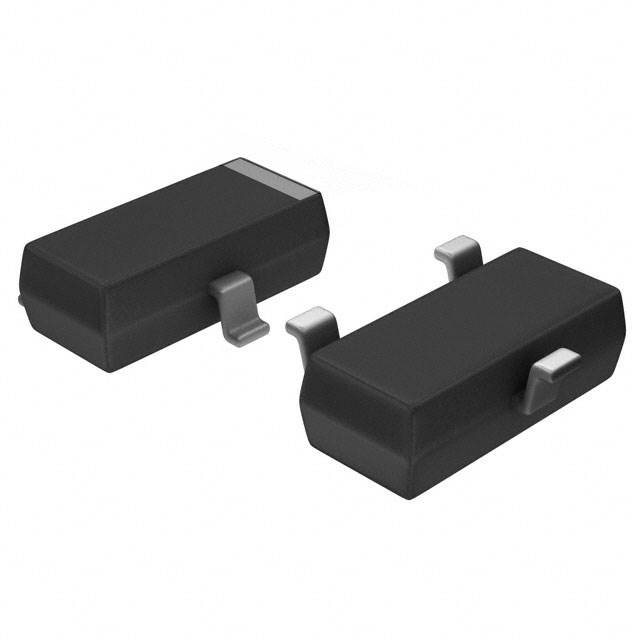
| Mounting type | Surface Mount (SOT-23-3) | Surface Mount (16-VFQFN 3x3 mm) | STSPIN240’s package is larger with more pins, affecting PCB footprint. |
| Noise figure (dB) | 4 dB | Not specified | MMBF5485 offers low noise figure for sensitive RF applications; STSPIN240 irrelevant. |
| Output power max | Not specified | Not specified | Neither datasheet provides explicit output power rating. |
| Package case | TO-236-3 / SC-59 / SOT-23-3 | 16-VFQFN Exposed Pad (3x3 mm) | STSPIN240’s exposed pad improves thermal dissipation for higher power. |
| Technology | JFET | Power MOSFET | Different device physics; JFET for low noise, MOSFET for power switching. |
| Voltage rated (max) | 25 V | 10 V (load), 5 V (supply) | MMBF5485 supports higher voltage; STSPIN240 limited to 10 V load and 5 V supply max. |
| Voltage test | 15 V | Not specified | MMBF5485 tested at 15 V; STSPIN240’s test voltages not specified. |
| Applications | RF MOSFET (implied) | DC Motors, General Purpose | MMBF5485 suited for RF/signal level; STSPIN240 designed for motor and inductive loads. |
| Current output channel | 10 mA | 1.3 A | STSPIN240 delivers 1300 mA, orders of magnitude higher current capability. |
| Fault protection | None specified | Current limiting, over temperature, short circuit | STSPIN240 includes integrated protections, important for reliability in power stages. |
| Interface | Not specified | PWM | STSPIN240 designed for PWM control; MMBF5485 is a passive transistor requiring external drive. |
| Operating temperature range | Not specified | -40°C to 150°C (junction) | STSPIN240 rated for wide temperature range, suitable for harsh environments. |
| Output configuration | Single transistor | Half Bridge (4) | STSPIN240 integrates a full half-bridge, MMBF5485 is a discrete transistor. |
| RDS(on) typical | Not applicable | 400 mΩ (low + high side combined) | STSPIN240’s RDS(on) affects conduction losses; no equivalent for JFET. |
| Voltage load range | Not applicable | 1.8 V to 10 V | STSPIN240’s load voltage limited to 10 V; MMBF5485 can handle up to 25 V. |
| Voltage supply | Not applicable | 0 to 5 V | STSPIN240 supply limited to 5 V max; MMBF5485 no supply voltage (passive device). |
Design trade-offs
The fundamental difference is that the MMBF5485 is a discrete N-channel JFET transistor optimized for high-frequency, low-current applications, whereas the STSPIN240 is an integrated half-bridge driver IC containing four power MOSFETs designed for driving inductive loads with PWM signals at currents up to 1.3 A per channel.
From a layout perspective, the MMBF5485’s small SOT-23-3 package allows for a compact footprint and minimal parasitic inductance, which is critical at RF frequencies (up to 400 MHz). Its JFET technology favors low noise figure (4 dB) and high input impedance, making it suitable for sensitive analog front ends or RF switches. However, the current rating is limited to 10 mA, so it cannot be used for power switching or motor drive.
In contrast, the STSPIN240’s 16-pin VFQFN package (3x3 mm) is larger but includes an exposed pad for thermal dissipation, which is necessary when switching loads drawing up to 1.3 A continuously. The integrated half-bridge topology simplifies board design by removing the need to select and match discrete MOSFETs, and the built-in fault protections (current limiting, over-temperature, short circuit) enhance system reliability. Its typical RDS(on) of 400 mΩ (combined low and high side) will result in conduction losses that must be accounted for in thermal management, especially at higher currents or duty cycles.
Firmware-wise, the STSPIN240 requires PWM signals for control, with timing and dead-time considerations to prevent shoot-through. The MMBF5485, being a passive transistor, requires an external biasing and driving network, providing more flexibility but increasing design complexity.
Cost-wise, the MMBF5485 is a low-cost discrete transistor suitable for high-volume RF designs where minimal noise and high frequency are paramount. The STSPIN240, as an integrated driver IC with protections, will carry higher unit cost but reduce overall BOM and design effort in motor control or power switching applications.
Use-case fit
Choose MMBF5485 when…
- Designing RF front-end circuits requiring low-noise, high-frequency (400 MHz) switching or amplification at very low currents (<10 mA).
- Implementing analog switches or buffer stages in sensitive signal chains where 4 dB noise figure is critical.
- Space-constrained PCB layouts where a small SOT-23-3 package is required.
- Operating voltages up to 25 V are needed with minimal active control circuitry.
- Applications where discrete JFET transistor characteristics (e.g., high input impedance) are necessary.
Choose STSPIN240 when…
- Building motor driver circuits requiring integrated half-bridge MOSFETs with 1.3 A continuous current capability.
- Controlling inductive loads via PWM signals with built-in protection against over-current, short circuits, and over-temperature.
- Designing robust power stages where integration reduces component count and simplifies PCB layout.
- Operating in environments with wide temperature ranges (-40°C to 150°C junction temperature).
- Targeting a 1.8 V to 10 V load voltage range with a 0 to 5 V supply voltage.
Drop-in compatibility
There is no pin or footprint compatibility between the MMBF5485 (3-pin SOT-23) and the STSPIN240 (16-pin VFQFN 3x3 mm). The MMBF5485 is a single transistor device, while the STSPIN240 is a complex integrated half-bridge driver IC. Substituting one for the other would require a complete redesign of the PCB and associated circuitry, including driver logic and power stage layout. From the data provided, no drop-in substitution is possible.
Alternatives to consider
- BSS138 (N-Channel MOSFET, SOT-23): Low-voltage logic-level MOSFET suitable for small-signal switching at low currents, an alternative to MMBF5485 in discrete transistor applications.
- DRV8833 (Texas Instruments): Dual full-bridge motor driver IC with higher current capability and integrated protections, an alternative to STSPIN240 for motor control.
- IRLML2502 (N-Channel MOSFET, SOT-23): Logic-level power MOSFET with low RDS(on), suitable for low-voltage power switching where discrete MOSFETs are preferred over integrated drivers.