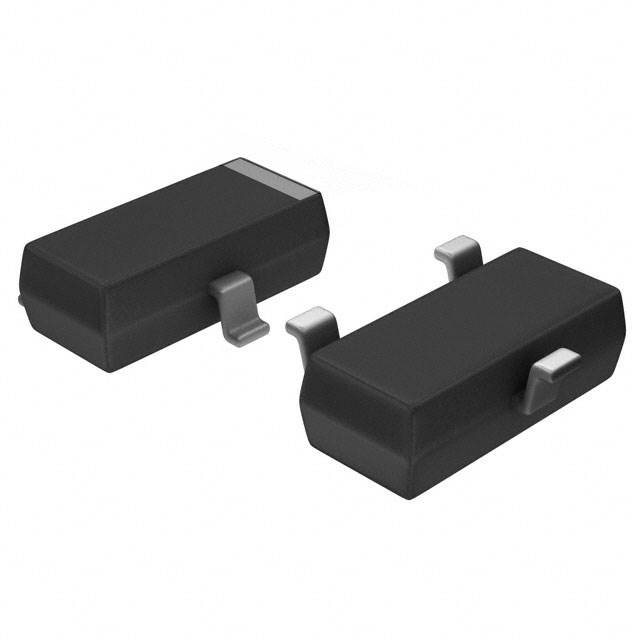
MMBF5485 vs SSM6N67NU,LF: A Detailed Component Comparison
Quick verdict
For low-current, high-frequency RF switching and small-signal amplification up to 400 MHz, the MMBF5485 is the clear choice due to its JFET technology and low noise figure. For medium-power switching or load-driving applications requiring up to 4 A continuous current and logic-level gate drive, the SSM6N67NU,LF outperforms the MMBF5485 by orders of magnitude in current handling, R_DS(on), and thermal dissipation.
Spec comparison table
| Spec | MMBF5485 | SSM6N67NU,LF | Notes |
|---|---|---|---|
| Configuration | N-Channel JFET | Dual N-Channel MOSFET | Dual MOSFET enables half-bridge or dual-switch designs; JFET better for low-noise RF amplification. |
| Continuous Current Rating | 10 mA | 4 A (Ta) | SSM6N67NU,LF supports 400x higher current, enabling power switching applications. |
| Frequency | 400 MHz | Not specified | MMBF5485 rated for RF use up to 400 MHz; SSM6N67NU,LF not designed for high-frequency RF. |
| Noise Figure | 4 dB | Not specified | MMBF5485 suitable for low-noise front-end circuits; no noise specs available for SSM6N67NU,LF. |
| Mounting Type | Surface Mount (SOT-23-3) | Surface Mount (6-µDFN 2x2) | Both SMT, but package styles differ significantly in size and thermal characteristics. |
| Package Case | TO-236-3, SC-59, SOT-23-3 | 6-WDFN Exposed Pad | SSM6N67NU,LF’s exposed pad improves thermal dissipation; MMBF5485 smaller footprint for RF boards. |
| Technology | JFET | MOSFET (Metal Oxide) | JFET preferred for linear/RF; MOSFET better for power switching and logic-level drive. |
| Voltage Rated | 25 V | 30 V | SSM6N67NU,LF has 20% higher voltage margin, beneficial for power stage headroom. |
| Voltage Test | 15 V | Not specified | MMBF5485 test voltage specified; SSM6N67NU,LF datasheet does not specify. |
| Drain-Source Voltage Max | Not specified | 30 V | Only SSM6N67NU,LF provides this spec, confirming power device use case. |
| Gate Charge (Q_g) | Not specified | 3.2 nC @ 4.5V | SSM6N67NU,LF’s gate charge indicates switching speed and driver requirements. |
| Input Capacitance (C_iss) | Not specified | 310 pF @ 15V | SSM6N67NU,LF has moderate input capacitance; impacts gate drive and switching losses. |
| Power Max (Ta) | Not specified | 2 W (Ta) | SSM6N67NU,LF can dissipate 2W at ambient temperature; MMBF5485 not specified, likely much lower. |
| R_DS(on) Max | Not specified | 39.1 mΩ @ 2A, 4.5V | Low R_DS(on) reduces conduction losses; MMBF5485 has no R_DS(on) spec, not a power MOSFET. |
| Gate Threshold Voltage (V_GS_th) | Not specified | 1 V @ 1 mA | SSM6N67NU,LF is logic-level with low threshold, compatible with 1.8V–5V digital logic. |
| Operating Temperature Range | Not specified | Up to 150°C | SSM6N67NU,LF suitable for high-temperature environments; MMBF5485 data not provided. |
Design trade-offs
The MMBF5485 is a JFET optimized for RF applications, offering low noise figure (4 dB) and operation up to 400 MHz, which makes it suitable for front-end amplification or switching in RF signal paths. Its maximum continuous current rating of only 10 mA severely limits its use to signal-level tasks rather than power switching. The small SOT-23 package is convenient for dense RF boards, but thermal dissipation is minimal and typically not a concern given the low current.
In contrast, the SSM6N67NU,LF is a dual N-channel MOSFET array designed for power switching with a continuous current rating of 4 A and maximum power dissipation of 2 W at ambient temperature. Its low R_DS(on) of 39.1 mΩ at 2 A and 4.5 V gate drive enables efficient switching with minimal conduction losses, critical for battery-powered or thermal-constrained designs. The exposed pad 6-WDFN package allows better heat sinking on the PCB, improving reliability and thermal management. The device’s logic-level gate threshold (1 V max) facilitates direct interfacing with low-voltage microcontrollers or FPGAs, reducing or eliminating gate driver complexity.
However, the SSM6N67NU,LF’s input capacitance of 310 pF and gate charge of 3.2 nC at 4.5 V imply higher gate drive losses at high switching frequencies compared to smaller, discrete MOSFETs or JFETs. This means that in high-frequency switching applications (>1 MHz), the power lost in gate drive can become significant, and gate driver design must account for this. The MMBF5485’s JFET structure inherently has lower gate capacitance and no gate charge in the MOSFET sense, favoring RF applications.
From a PCB layout standpoint, the MMBF5485’s SOT-23 package is easier to place in tight RF circuits but provides limited thermal handling. The SSM6N67NU,LF’s 2x2 mm 6-WDFN package requires careful thermal via design to make full use of its exposed pad. Designers must also consider the dual transistor configuration of the SSM6N67NU,LF, which can simplify half-bridge or push-pull topologies but complicate single-channel replacement if only one transistor is needed.
Cost at volume is not provided explicitly, but MOSFET arrays in WDFN packages typically have a higher unit cost than discrete JFETs in SOT-23. However, the integration of two MOSFETs and better power handling can reduce overall BOM and assembly costs in power switching designs.
Use-case fit
Choose MMBF5485 when…
- Designing RF front-end switches or small-signal amplifiers requiring operation up to 400 MHz.
- Low noise figure (around 4 dB) is critical to maintain signal integrity in sensitive receivers.
- Signal currents are extremely low (under 10 mA), and power dissipation is minimal.
- PCB space is constrained, and a small SOT-23 package is preferred.
- The application involves analog switching or impedance tuning in communication devices.
Choose SSM6N67NU,LF when…
- Switching or driving loads up to 4 A continuous current at voltages up to 30 V.
- Designing power management circuits with logic-level gate drive (1.8 V–5 V) from microcontrollers or FPGAs.
- Thermal dissipation of up to 2 W at ambient is required, with an exposed pad for heat sinking.
- A dual MOSFET configuration is advantageous for half-bridge or synchronous rectifier designs.
- The switching frequency is moderate, and gate drive losses can be managed within system constraints.
Drop-in compatibility
These parts are neither pin-compatible nor footprint-compatible. The MMBF5485 is a single JFET in a SOT-23-3 package, while the SSM6N67NU,LF is a dual MOSFET array in a 6-lead 2x2 mm WDFN with an exposed pad. Substituting one for the other requires a complete redesign of the PCB footprint and possibly circuit topology due to the difference in device type (JFET vs MOSFET), number of transistors, and electrical characteristics. Gate drive and biasing circuits will also differ significantly.
Alternatives to consider
- BSS138 (NXP Semiconductor): A popular logic-level N-channel MOSFET in SOT-23, suitable for low-current switching up to ~200 mA, bridging the gap between small signal and power switching.
- 2N4416 (ON Semiconductor): Another N-channel JFET with similar RF performance to MMBF5485, useful for RF switching with slightly different pinout or characteristics.
- IRLML6344 (Infineon): Logic-level N-channel MOSFET with extremely low R_DS(on) in SOT-23, suitable for load switching up to a few amps in a small package.