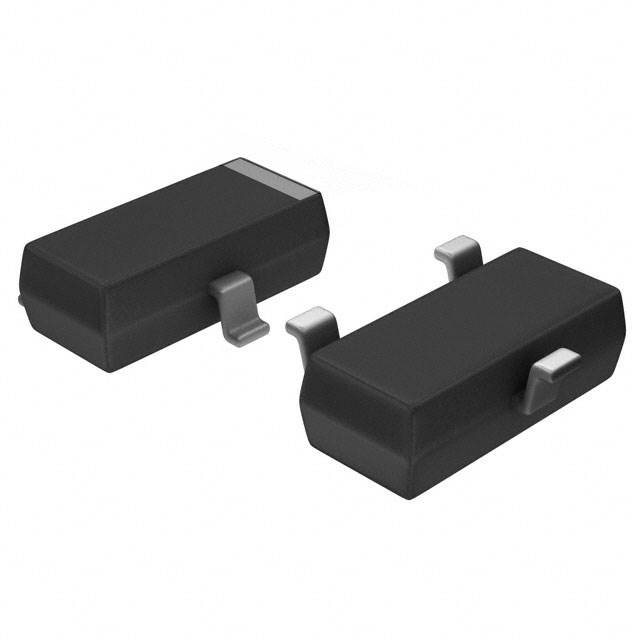
MMBF5485 vs SSM6N57NU,LF: Component Comparison for Power Electronics Engineers
Quick verdict
The MMBF5485 excels in low-current, high-frequency RF switching and amplification applications up to 400 MHz due to its JFET technology and low noise figure. The SSM6N57NU,LF is the clear choice for power switching and load driving up to 4 A at 30 V, offering low R_DS(on) and integrated dual MOSFETs in a compact package suitable for power management and DC-DC conversion.
Spec comparison table
| Spec | MMBF5485 | SSM6N57NU,LF | Notes |
|---|---|---|---|
| Configuration | N-Channel JFET | 2 × N-Channel MOSFETs | Dual MOSFET array vs single JFET transistor; SSM6N57NU,LF offers two devices per package. |
| Current Rating (continuous) | 10 mA | 4 A | SSM6N57NU,LF supports 400× higher current; critical for power applications. |
| Frequency (max) | 400 MHz | Not specified | MMBF5485 supports RF applications up to 400 MHz; SSM6N57NU,LF is not RF-optimized. |
| Gain | Not specified | Not specified | MMBF5485 being a JFET likely provides gain suitable for low-noise amplification; SSM6N57NU,LF is a switch. |
| Mounting Type | Surface Mount (SOT-23-3) | Surface Mount (6-µDFN 2x2) | Both surface mount; SOT-23-3 is larger, easier for hand soldering than 2x2 mm DFN. |
| Noise Figure | 4 dB | Not specified | MMBF5485 optimized for low noise; SSM6N57NU,LF not intended for low-noise applications. |
| Output Power (max) | Not specified | 1 W | SSM6N57NU,LF can dissipate 1 W, suitable for power applications; MMBF5485 not specified. |
| Package Case | TO-236-3, SC-59, SOT-23-3 | 6-WDFN Exposed Pad | SSM6N57NU,LF’s exposed pad improves thermal dissipation compared to SOT-23-3 package. |
| Voltage Rated (Drain-Source) | 25 V | 30 V | SSM6N57NU,LF has a higher voltage rating, allowing more headroom in power circuits. |
| Voltage Test | 15 V | Not specified | MMBF5485 tested at 15 V; no direct equivalent for SSM6N57NU,LF. |
| Technology | JFET | MOSFET | JFET for analog/RF use; MOSFET for power switching. |
| Gate Charge (Q_g) | Not specified | 4 nC @ 4.5 V | SSM6N57NU,LF requires moderate gate charge, impacting switching losses and driver requirements. |
| Input Capacitance (C_iss) | Not specified | 310 pF @ 10 V | SSM6N57NU,LF input capacitance impacts switching speed and EMI; MMBF5485 likely lower but unspecified. |
| R_DS(on) | Not specified | 46 mΩ @ 2 A, 4.5 V | SSM6N57NU,LF has specified R_DS(on), important for conduction loss calculations; no data for MMBF5485. |
| Operating Temperature Range (TJ) | Not specified | 150 °C | SSM6N57NU,LF supports higher junction temperatures, improving reliability under thermal stress. |
| V_GS(th) (max) | Not specified | 1 V @ 1 mA | SSM6N57NU,LF has low threshold voltage, facilitating low-voltage gate drive. |
Design trade-offs
The MMBF5485 is a JFET optimized for high-frequency analog/RF applications, with a maximum frequency of 400 MHz and a noise figure of 4 dB, making it suitable for low-level RF switching or amplification. Its current rating is very low (10 mA), which excludes it from power-switching roles. The SOT-23-3 package is easy to handle and common in RF designs, but lacks a thermal pad, limiting power dissipation.
In contrast, the SSM6N57NU,LF is a dual N-channel MOSFET array designed for power switching with a continuous drain current of 4 A and a maximum power dissipation of 1 W. Its 6-µDFN package includes an exposed thermal pad, essential for effective heat sinking in power circuits. The MOSFET’s R_DS(on) of 46 mΩ at 2 A and 4.5 V gate drive is moderate, indicating reasonable efficiency in low-voltage DC-DC converters or load switches. The gate charge of 4 nC at 4.5 V means switching losses and gate driver design must be considered, especially at high switching frequencies.
From a layout perspective, the MMBF5485’s small SOT-23-3 footprint is standard for RF front-ends, with minimal gate charge and input capacitance (though unspecified) that simplifies driver design and reduces EMI. The SSM6N57NU,LF’s dual MOSFET configuration and exposed pad require careful thermal layout and adequate PCB copper area to dissipate heat properly. Gate drive must be capable of sourcing/sinking the gate charge quickly to minimize switching losses.
Firmware-wise, the MMBF5485 is generally used as an analog or RF element, not requiring active gate drive control beyond biasing. The SSM6N57NU,LF demands proper gate drive timing and voltage to avoid high conduction and switching losses. It can support load switching, synchronous rectification, or DC-DC conversion functions.
Cost-wise, the MMBF5485 is likely inexpensive in volume due to simple JFET construction and common package, but its niche function limits use cases. The SSM6N57NU,LF’s more complex MOSFET array and advanced package usually come at higher cost but provide greater functional flexibility.
Use-case fit
Choose MMBF5485 when…
- Designing low-noise RF front-end switches or amplifiers operating up to 400 MHz.
- You require extremely low current operation (<10 mA) with minimal noise figure (~4 dB).
- The application involves small-signal analog switching in communication or sensor circuits.
- Space is limited but a common SOT-23-3 footprint is preferred for ease of assembly.
- Thermal dissipation is minimal and power handling is not needed.
Choose SSM6N57NU,LF when…
- You need to switch or drive loads up to 4 A at voltages up to 30 V.
- Implementing DC-DC converters, load switches, or power management circuits requiring dual MOSFETs.
- Thermal management is crucial, and the exposed pad package aids heat dissipation.
- Gate drive circuitry can handle 4 nC gate charge for efficient switching.
- You want a compact 2×2 mm footprint with integrated dual devices to save board space.
Drop-in compatibility
These parts are neither pin-compatible nor footprint-compatible. The MMBF5485 is a single JFET in a SOT-23-3 package with three leads, while the SSM6N57NU,LF is a dual MOSFET array in a 6-µDFN (2x2 mm) package with an exposed pad and more pins. Substituting one for the other requires complete circuit redesign, including power supply, gate drive, and PCB layout changes. No direct drop-in replacement exists between these devices.
Alternatives to consider
- BSS138: Small-signal N-Channel MOSFET in SOT-23 for low-current switching; closer to MMBF5485 in application but MOSFET technology.
- Si2302: N-Channel MOSFET with low R_DS(on) in SOT-23, suitable for power switching up to ~2 A.
- FDN337N: N-Channel MOSFET with low gate charge and R_DS(on) for efficient power switching in compact packages.