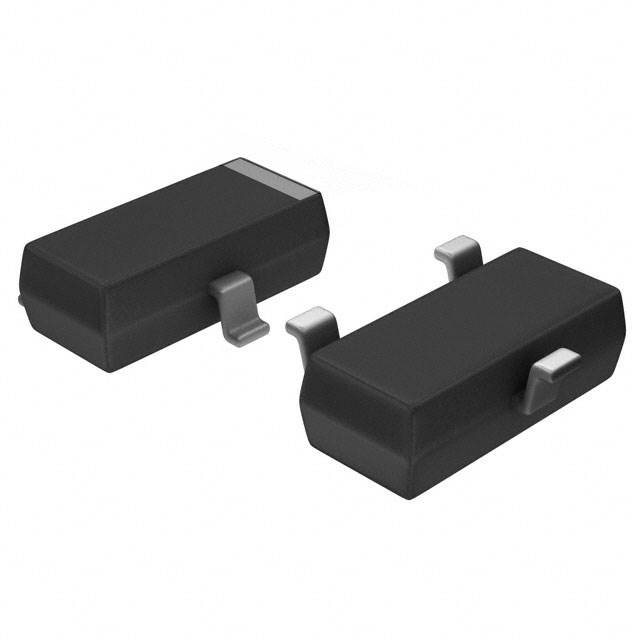
MMBF5485 vs SSM6L56FE,LM: Component Comparison for Power Electronics Engineers
Quick verdict
For low-current, high-frequency RF switching or amplification up to 400MHz, the MMBF5485 is the clear choice due to its JFET technology and low voltage operation. For general-purpose low-voltage switching or level shifting where higher current capacity (up to 800mA) and integrated N/P channels are needed, the SSM6L56FE,LM offers better versatility and gate drive ease.
Spec comparison table
| Spec | MMBF5485 | SSM6L56FE,LM | Notes |
|---|---|---|---|
| Configuration | N-Channel JFET | N and P-Channel MOSFET | SSM6L56FE,LM supports complementary pairs, enabling push-pull or half-bridge topologies. |
| Current Rating (Continuous) | 10mA | 800mA (Ta) | SSM6L56FE,LM supports 80x higher current, suitable for power switching. |
| Frequency | 400MHz | Not specified (general MOSFET) | MMBF5485 supports RF frequencies; SSM6L56FE,LM is not designed for RF applications. |
| Gain | Not specified | Not specified | MMBF5485 is a JFET, inherently providing gain; MOSFETs are voltage-controlled switches. |
| Mounting Type | Surface Mount (SOT-23-3) | Surface Mount (ES6: SOT-563/666) | Different footprints; SOT-23-3 is larger than ES6 packages. |
| Noise Figure | 4dB | Not specified | MMBF5485 is optimized for low noise, important in RF front-ends. |
| Output Power Max | Not specified | 150mW (Ta) | SSM6L56FE,LM has defined power dissipation; MMBF5485 data not provided. |
| Package Case | TO-236-3 (SOT-23-3) | SOT-563, SOT-666 (ES6) | Smaller ES6 package favors high-density layouts; SOT-23-3 is more common and easier to handle. |
| Technology | JFET | MOSFET (Logic Level Gate, 1.5V Drive) | SSM6L56FE,LM logic-level MOSFET simplifies gate drive; MMBF5485 JFET is voltage-controlled with different bias requirements. |
| Voltage Rated | 25 V | 20 V | MMBF5485 has slightly higher voltage rating. |
| Voltage Test | 15 V | Not specified | MMBF5485 tested at 15 V, suitable for low-voltage RF circuits. |
| Drain-Source Voltage Max | 25 V | 20 V | MMBF5485 has a marginal advantage here. |
| Gate Charge (Qg) Max @ 10V | Not specified | 1nC | SSM6L56FE,LM’s low gate charge reduces switching losses and gate drive power. |
| Input Capacitance (Ciss) | Not specified | 55pF @ 10V (N-Channel), 100pF @ 10V (P-Channel) | SSM6L56FE,LM input capacitances are moderate, affecting switching speed and EMI. |
| RDS(on) Max @ 800mA, 4.5V | Not specified | 235mΩ (N), 390mΩ (P) | SSM6L56FE,LM provides specific on-resistance data; useful for conduction loss calculations. |
| Vgs Threshold Max @ 1mA | Not specified | 1 V | SSM6L56FE,LM logic-level gate threshold facilitates 3.3/5V system compatibility. |
| Operating Temperature Range | Not specified | Up to 150°C | SSM6L56FE,LM rated for high-temp operation; MMBF5485 data not provided. |
Design trade-offs
The MMBF5485 is a JFET optimized for RF applications up to 400MHz, offering a low noise figure of 4dB, which is critical in front-end amplifier and low-noise switching applications. Its 25V rating and low current rating (10mA) restrict it to signal-level applications rather than power switching. The JFET structure means it requires a bias voltage for operation and typically has a high input impedance, which can simplify certain analog front-end designs but complicate gate drive compared to MOSFETs.
In contrast, the SSM6L56FE,LM is a logic-level MOSFET array containing both N- and P-channel devices, which is valuable for integrated complementary switching stages like push-pull drivers or load switches. Its 800mA continuous drain current and defined RDS(on) values (235mΩ N-channel at 800mA, 4.5V gate drive) enable it to handle moderate power loads. The 1nC gate charge at 10V and 1V Vgs threshold make it suitable for low-voltage digital control, reducing gate driver complexity and switching losses, an advantage in battery-powered or high-frequency switching applications.
Thermally, the SSM6L56FE,LM has a specified maximum power dissipation of 150mW at ambient, which must be observed to avoid thermal runaway in compact layouts. The MMBF5485’s power dissipation is unspecified, but its low current rating and RF focus suggest it is not intended for power dissipation beyond signal-level conditions. The smaller ES6 package of the SSM6L56FE,LM favors high-density PCB layouts but requires careful thermal management due to limited thermal mass.
From a layout standpoint, the MMBF5485’s SOT-23-3 package is larger and more mechanically robust, easing hand assembly and inspection, while the SSM6L56FE,LM’s ES6 package demands finer pitch and more precise placement. The complementary N/P configuration in SSM6L56FE,LM reduces component count and board complexity in certain switching circuits but requires careful gate drive sequencing to avoid shoot-through.
Cost-wise, while exact pricing is not provided, the MMBF5485’s single JFET structure and simpler process might be less expensive for low-volume RF designs, whereas the SSM6L56FE,LM’s integrated dual-channel MOSFET array and logic-level features typically carry a premium but save BOM cost and board area in digital switching applications.
Use-case fit
Choose MMBF5485 when…
- Designing low-noise RF front-end switches or amplifiers operating up to 400MHz.
- Working with low-current (≤10mA) analog signal paths requiring a JFET’s linearity and noise characteristics.
- Implementing circuits needing a 25V rating with low-noise figure and minimal distortion.
- Space is less constrained and a standard SOT-23-3 package is acceptable.
- You require a JFET device rather than MOSFET for specific analog characteristics.
Choose SSM6L56FE,LM when…
- Building low-voltage load switches or level shifters with up to 800mA continuous current.
- Designing complementary push-pull or half-bridge drivers integrated into a single package.
- Operating from 1.5–5V logic gate drive voltages where low Vgs(th) and gate charge reduce switching losses.
- Needing a compact ES6 package for high-density layouts and cost-effective BOM reduction.
- Designing circuits with elevated operating temperatures (up to 150°C ambient).
Drop-in compatibility
The parts are not pin-compatible or footprint-compatible. The MMBF5485 is a single N-channel JFET in a SOT-23-3 package (TO-236-3), while the SSM6L56FE,LM is a dual N- and P-channel MOSFET array in a much smaller ES6 package (SOT-563 or SOT-666). Substitution would require redesigning the PCB footprint and potentially the gate drive circuitry due to differing device technologies and electrical characteristics. Gate drive voltage and polarity, as well as device configuration (single vs dual complementary), must be reconsidered.
Alternatives to consider
- BSS138 (N-channel MOSFET, SOT-23): Low-voltage, low-current MOSFET with similar gate thresholds, common in logic-level switching.
- 2N5457 (N-channel JFET): Classic JFET with similar voltage ratings, suitable for RF and analog circuits where MMBF5485 is used.
- Si2302 (N-channel MOSFET, SOT-23): Logic-level MOSFET with low RDS(on), suitable for low-voltage load switch applications similar to SSM6L56FE,LM.