MMBF5485 vs SQ2308FES-T1_GE3: Component Comparison for Hardware Engineers
Quick verdict
For RF switching and low-current signal-level applications up to 400 MHz, the MMBF5485 JFET is the clear choice due to its low noise figure and suitable frequency rating. For power switching or load driving in low-voltage DC circuits requiring up to 2.3 A continuous current and up to 60 V blocking, the SQ2308FES-T1_GE3 MOSFET is far superior, offering significantly higher current capacity and ruggedness.
Spec comparison table
| Spec | MMBF5485 | SQ2308FES-T1_GE3 | Notes |
|---|---|---|---|
| Configuration | N-Channel JFET | N-Channel MOSFET | Both N-channel; MOSFET generally better for power switching due to lower on-resistance. |
| Current rating (continuous) | 10 mA | 2.3 A (Tc) | SQ2308FES-T1_GE3 supports 230× higher continuous current, critical for load driving or power stages. |
| Frequency | 400 MHz | Not specified | MMBF5485 supports RF operation up to 400 MHz; SQ2308FES-T1_GE3 is not RF-optimized. |
| Gain | Not specified | Not specified | No gain data; JFETs often used for low-noise amplification at RF. |
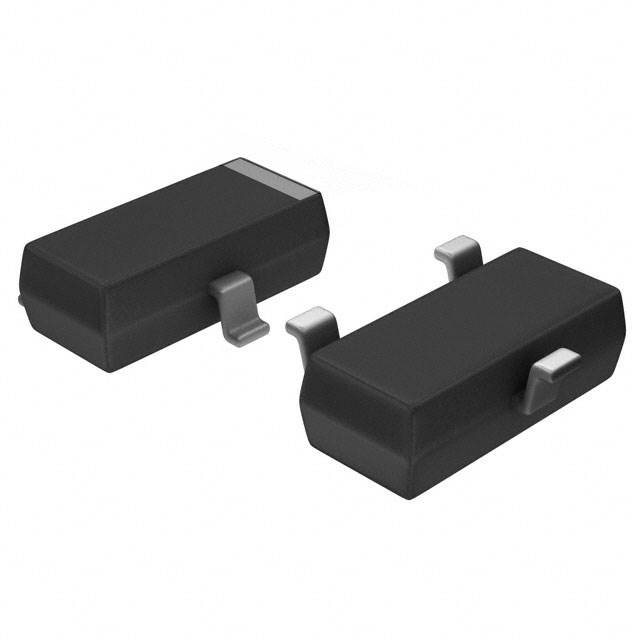
| Mounting type | Surface Mount | Surface Mount | Both use SOT-23-3 package, suitable for compact PCB layouts. |
| Noise figure | 4 dB | Not specified | MMBF5485’s 4 dB noise figure suits low-noise front-ends; MOSFET noise figure not given, likely higher. |
| Output power max | Not specified | Not specified | No direct output power ratings; relevant only in RF or power switching context. |
| Package case | TO-236-3, SC-59, SOT-23-3 | TO-236-3, SC-59, SOT-23-3 | Identical package footprint facilitates layout considerations. |
| Technology | JFET | MOSFET (Metal Oxide) | Different device physics affect drive requirements and switching behavior. |
| Voltage rating (max) | 25 V | 60 V | SQ2308FES-T1_GE3 supports >2× higher voltage, enabling use in higher-voltage rails. |
| Voltage test | 15 V | Not specified | MMBF5485 tested to 15 V; SQ2308FES-T1_GE3 voltage test not specified but voltage rating is 60 V. |
| Drive voltage (max Rds(on)) | Not specified | 4.5V (typ), 10V | SQ2308FES-T1_GE3 has gate drive requirements; 4.5 V gate drive achieves Rds(on) characteristic. |
| Gate charge (Qg) | Not specified | 5.3 nC @ 10 V | SQ2308FES-T1_GE3’s gate charge affects switching speed and gate driver sizing. |
| Gate-source voltage max | Not specified | ±20 V | SQ2308FES-T1_GE3 supports ±20 V gate-source voltage, allowing some margin beyond logic levels. |
| Input capacitance (Ciss) | Not specified | 205 pF @ 30 V | SQ2308FES-T1_GE3 input capacitance relevant for switching speed and EMI considerations. |
| Operating temperature range | Not specified | -55°C to 175°C (TJ) | SQ2308FES-T1_GE3 rated for automotive-grade temperature range, suitable for harsh environments. |
| Power dissipation max | Not specified | 2 W (Tc) | SQ2308FES-T1_GE3 can dissipate 2 W at case temperature, suitable for moderate power applications. |
| Rds(on) max | Not specified | 150 mΩ @ 2.3A, 10V | SQ2308FES-T1_GE3 offers a known conduction resistance, important for efficiency calculations. |
| Threshold voltage (Vgs_th) | Not specified | 2.5 V @ 250 µA | SQ2308FES-T1_GE3’s threshold voltage informs gate drive design; JFET has different threshold behavior. |
Design trade-offs
The MMBF5485 JFET is designed for low-level analog/RF applications, evident from its 400 MHz frequency rating and 4 dB noise figure. Its extremely low current rating (10 mA) and low voltage rating (25 V max) make it unsuitable for power switching or load driving. The JFET’s device physics yield low noise and good linearity but require careful biasing and have no specified on-resistance or gate charge metrics, indicating it is not optimized for fast switching or power applications.
In contrast, the SQ2308FES-T1_GE3 is a power MOSFET optimized for DC switching with a much higher continuous drain current (2.3 A) and voltage rating (60 V). The MOSFET’s gate charge of 5.3 nC at 10 V and input capacitance of 205 pF imply moderate gate drive requirements; a dedicated gate driver or at least a low-impedance MCU output stage is recommended for efficient switching. The Rds(on) of 150 mΩ at 10 V gate drive is relatively high compared to larger power MOSFETs but acceptable for low-power DC loads in a SOT-23 footprint. Thermal dissipation capability of 2 W at case temperature means power dissipation must be carefully managed, especially in constrained PCB layouts.
From a layout perspective, both devices share the SOT-23-3 package, so footprint changes are unnecessary when switching between them. However, the JFET’s high-frequency application demands careful transmission line and grounding considerations to minimize parasitic capacitances and inductances, while the MOSFET’s switching performance requires minimizing gate loop inductance and optimizing thermal paths.
On cost, generally, low-current RF JFETs like the MMBF5485 tend to be more expensive per unit than commodity MOSFETs due to lower volumes and specialized processing. The SQ2308FES-T1_GE3 is automotive-qualified (AEC-Q101), which may increase its cost but also guarantees reliability in harsh environments.
Use-case fit
Choose MMBF5485 when…
- Designing low-noise RF front-end switches or analog multiplexers operating up to 400 MHz.
- Implementing biasing or signal routing in sensitive analog circuits with <10 mA current requirements.
- Replacing legacy JFETs in RF circuits where noise figure and frequency response are critical.
- Amplifying or switching small-signal RF signals with minimal added noise.
- Designing circuits where switching speed is less critical than linearity and low noise.
Choose SQ2308FES-T1_GE3 when…
- Driving DC loads up to 2.3 A on 60 V rails in power management or load switching applications.
- Designing automotive or industrial systems requiring AEC-Q101 qualification and wide temperature range (-55°C to 175°C).
- Implementing low-side or high-side switching in battery-powered devices with limited PCB space.
- Handling moderate power dissipation (up to 2 W) in a compact SOT-23 package.
- Replacing general-purpose N-channel MOSFETs in switching regulators, load switches, or DC-DC converters.
Drop-in compatibility
Both MMBF5485 and SQ2308FES-T1_GE3 share the same package type: SOT-23-3 (TO-236-3), so the footprint on PCB is compatible. However, the internal pin functions and device type differ fundamentally (JFET vs MOSFET), and their gate, drain, source characteristics are not guaranteed to match pin-for-pin. Without explicit pinout confirmation from datasheets, do not assume pin compatibility.
Replacing one with the other without verifying pinout and circuit requirements can lead to malfunction or device damage due to different voltage/current capabilities and drive requirements. For example, the MMBF5485 may require biasing networks absent in MOSFET circuits, and the SQ2308FES-T1_GE3 requires proper gate drive voltage and protection.
Alternatives to consider
- BSS138: Widely used low-voltage N-channel MOSFET in SOT-23, suitable for low-current switching up to ~200 mA, with well-documented characteristics and low gate charge.
- 2N5457: A general-purpose N-channel JFET used in low-noise analog and RF switching applications, with higher current rating than MMBF5485 but lower frequency.
- Si2302DS: A logic-level N-channel MOSFET with low Rds(on) and gate charge, suitable for low-voltage power switching in SOT-23 packages.