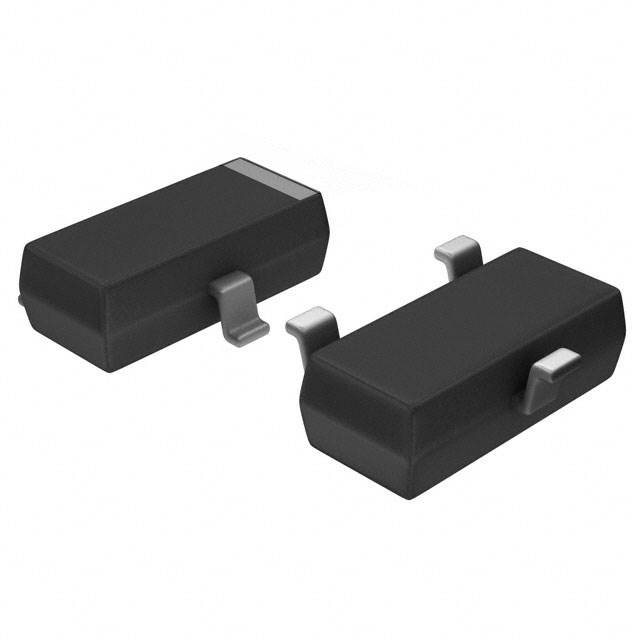
Component Comparison: MMBF5485 vs SQ1922EEH-T1_GE3
1. Quick verdict
For low-current RF switching and amplification at frequencies up to 400 MHz, the MMBF5485 is the clear choice due to its JFET technology and low noise figure. For general-purpose low-voltage switching and load driving up to nearly 1 A continuous current, particularly in automotive or industrial environments, the SQ1922EEH-T1_GE3 offers superior conduction capability, lower on-resistance, and integrated dual MOSFETs, making it the better option.
2. Spec comparison table
| Spec | MMBF5485 | SQ1922EEH-T1_GE3 | Notes |
|---|---|---|---|
| Configuration | N-Channel JFET | Dual N-Channel MOSFET | SQ1922 offers dual devices, useful for half-bridge or complementary switching. |
| Current rating (continuous) | 10 mA | 840 mA (Tc), 1 A typical, 1.2 A min | SQ1922 supports ~80x higher continuous current; MMBF5485 unsuitable for power loads. |
| Frequency | 400 MHz | Not specified (low frequency/MOSFET) | MMBF5485 suited for RF; SQ1922 not designed for RF applications. |
| Noise figure | 4 dB | Not specified | MMBF5485’s noise figure relevant for low-noise RF front-ends; SQ1922 not optimized for noise. |
| Mounting type | Surface Mount (SOT-23-3) | Surface Mount (SC-70-6) | Different packages; affects PCB layout and space. |
| Voltage rating (max) | 25 V | 20 V | MMBF5485 has a slightly higher voltage rating. |
| Voltage test | 15 V | Not specified | Limited data for SQ1922 voltage test; nominal max rating is 20 V. |
| Gain | Not specified | Not specified | Neither device specifies gain; MMBF5485 is active device, SQ1922 is a MOSFET switch. |
| Output power max | Not specified | Not specified | No direct output power rating; inferred from current and voltage specs. |
| Package case | TO-236-3, SC-59, SOT-23-3 | 6-TSSOP, SC-88, SOT-363 (SC-70-6) | SQ1922’s smaller 6-pin package with dual MOSFETs vs MMBF5485’s 3-pin. |
| Technology | JFET | MOSFET (Metal Oxide) | JFET better for RF low-noise; MOSFET better for switching efficiency and load current. |
| Power max | Not specified | 1.5 W | SQ1922 can dissipate significantly more power. |
| Drain-Source Voltage max | 25 V | 20 V | MMBF5485 supports slightly higher voltage. |
| On-resistance (Rds(on)) | Not specified | 0.350 Ω (typ @ 25°C, 4.5V gate) | SQ1922 has low on-resistance, important for conduction losses in switching applications. |
| Gate charge (Qg) max | Not specified | 1.2 nC @ 4.5 V | SQ1922 gate charge low but present; MMBF5485 gate charge unspecified (JFET). |
| Gate threshold voltage (Vgs_th) | Not specified | 0.5 V (min) – 1.5 V (max), 1 V typical | SQ1922 threshold well-defined, important for gate drive design. |
| Gate resistance (typ) | Not specified | 4.5 – 13.7 Ω | SQ1922 gate resistance affects switching speed and drive strength requirements. |
| Input capacitance (Ciss) | Not specified | 50 pF @ 10 V | SQ1922 input capacitance moderate for MOSFET; MMBF5485 unknown but JFET input typically low. |
| Output capacitance (Coss) | Not specified | 21 pF (typ) | SQ1922 output capacitance impacts switching losses and EMI. |
| Reverse transfer capacitance (Crss) | Not specified | 10 pF (typ) | SQ1922 Crss affects switching speed and Miller effect. |
| Operating temperature range | Not specified | -55°C to 175°C (junction) | SQ1922 supports extended automotive temp range; MMBF5485 data not listed. |
| Pulsed current (I_pulse) | Not specified | 3 A (min) | SQ1922 can handle short pulses much higher than continuous current. |
| Turn-on delay time | Not specified | 15 ns (typ), -10 to 15 ns (min/max) | SQ1922 switching speed suitable for fast switching applications; no data for MMBF5485. |
| Fall time | Not specified | 6 – 10 ns | SQ1922 fall time fast; important for switching efficiency and EMI. |
| Noise figure | 4 dB | Not specified | MMBF5485 noise figure relevant for RF low-noise stages. |
| Gate-source leakage current | Not specified | Max 10 mA | SQ1922 gate leakage current is high compared to small-signal BJTs/JFETs; must consider in low leakage circuits. |
| Forward voltage (body diode) | Not specified | 0.5 A, 0–0.8 V typical, max 1.2 V | SQ1922 has intrinsic body diode forward voltage, relevant in synchronous rectification. |
| Duty cycle (typ) | Not specified | 0.5 | SQ1922 specified for 50% duty cycle typical. |
3. Design trade-offs
The MMBF5485 is a single N-channel JFET optimized for RF applications up to 400 MHz, with a low noise figure of 4 dB. This makes it suitable for small-signal amplification and switching in RF front-ends where low noise and linearity are critical. Its maximum continuous current rating is only 10 mA, so it cannot be used for power switching or load driving. The 25 V rating offers some headroom for RF biasing and signal swings. Being a JFET, it requires a biasing scheme different from MOSFETs and usually a negative gate bias to operate in the desired region, which complicates the driver design but offers low noise and high input impedance.
In contrast, the SQ1922EEH-T1_GE3 is a dual N-channel MOSFET array designed for low-voltage load switching applications. It supports continuous drain currents up to 840 mA (thermal case) and a minimum of 1.2 A pulsed current, with a maximum power dissipation of 1.5 W. The on-resistance at 25°C is 0.35 Ω, which is reasonable for small loads but not for high current power stages. The device’s gate charge (1.2 nC at 4.5 V) and gate resistance (4.5–13.7 Ω typical) require a moderately strong gate drive, but the fast switching times (turn-on delay ~15 ns, fall time 6–10 ns) enable efficient switching in low-voltage DC/DC converters or automotive load switching.
Thermally, the SQ1922’s extended junction temperature range (-55°C to 175°C) and 1.5 W power dissipation rating make it suitable for harsh environments, unlike the MMBF5485, which lacks explicit thermal specs but is generally intended for low-power, controlled RF environments. The SQ1922’s SC-70-6 package is compact but requires careful PCB layout to manage thermal dissipation and minimize parasitic inductance affecting switching performance.
From a layout perspective, the MMBF5485’s SOT-23-3 package is simpler and smaller with fewer pins, easing board routing for RF signals. The SQ1922’s 6-pin SC-70-6 package complicates routing but integrates two MOSFETs, potentially reducing BOM and PCB area for dual-switch applications. Gate drive requirements differ fundamentally: the JFET requires biasing for proper operation, while the MOSFET demands a strong gate drive voltage (around 4.5 V) and low drive impedance to minimize switching losses.
In terms of cost at volume, JFETs like the MMBF5485 tend to be more specialized and can be more expensive per unit than general-purpose MOSFET arrays like the SQ1922. However, the MOSFET array’s integrated dual devices may reduce overall system cost when replacing two discrete MOSFETs.
4. Use-case fit
Choose MMBF5485 when…
- Designing low-noise RF amplifiers or switches operating up to 400 MHz.
- You need a JFET input device with a low noise figure (~4 dB) for sensitive RF front-end stages.
- The application requires very low continuous current (<10 mA) and minimal power dissipation.
- Space is limited and a