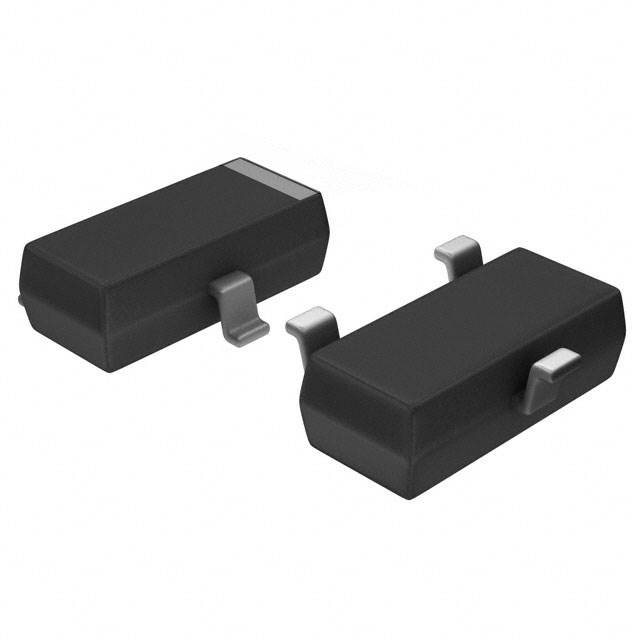
MMBF5485 vs SQ1922AEEH-T1_GE3: Component Comparison for Power Electronics Design
Quick verdict
For low-current, high-frequency RF switching or amplification up to 400 MHz, the MMBF5485 JFET offers a simpler, lower-noise solution with a 25 V rating and low current requirements. For power switching or load-driving applications requiring up to 0.85 A continuous current at 20 V, the dual N-channel MOSFET array SQ1922AEEH-T1_GE3 delivers significantly higher current capability and integrated dual devices in a compact SC-70-6 package.
Spec comparison table
| Spec | MMBF5485 | SQ1922AEEH-T1_GE3 | Notes |
|---|---|---|---|
| Configuration | N-Channel JFET | 2 × N-Channel MOSFET | SQ1922AEEH offers dual devices in one package, enabling half-bridge or dual-switch designs. |
| Current rating (continuous) | 10 mA | 850 mA (Tc), 1 A (min), 1.2 A (typ) | SQ1922AEEH supports ~85× higher continuous current, critical for power applications. |
| Frequency | 400 MHz | Not specified (switching freq typical 10 ms) | MMBF5485 targets RF applications; SQ1922AEEH is low-frequency switching/power MOSFET. |
| Voltage rating (max) | 25 V | 20 V | MMBF5485 has slightly higher voltage rating, useful in some RF or low-power circuits. |
| Gain | Not specified | Not specified | Gain not specified for either; MMBF5485 JFET likely has gain for RF; MOSFET used as switch. |
| Noise figure | 4 dB | Not specified | MMBF5485 offers low noise figure, important for RF front-ends. |
| Mounting type | Surface Mount (SOT-23-3) | Surface Mount (SC-70-6) | Both surface mount; SQ1922AEEH uses smaller 6-pin SC-70-6 package vs 3-pin SOT-23-3. |
| Package case | TO-236-3, SC-59, SOT-23-3 | SC-70-6 (6-pin MOSFET array) | SQ1922AEEH’s smaller package supports dual devices, saving PCB area. |
| Technology | JFET | MOSFET (Metal Oxide) | Different transistor types; JFET better for RF linearity/noise, MOSFET better for power switching. |
| Voltage test (max) | 15 V | 20 V | SQ1922AEEH rated for higher test voltage, aligns with max voltage rating. |
| Continuous drain current min | 10 mA | 0.85 A (Tc), 1 A (min) | SQ1922AEEH supports significantly higher load current. |
| Continuous drain current typ | Not specified | 0.53 A | Typical current lower than min rating; design for min rating for reliability. |
| Drain-source on-state resistance (Rds(on)) | Not specified | 0.490 Ω (typ), 0.530 Ω (max) @ 4.5 V, 400 mA | SQ1922AEEH has defined Rds(on); low but not ultra-low, appropriate for low-power switching. |
| Gate charge (Qg) max | Not specified | 1.2 nC @ 4.5 V | SQ1922AEEH requires moderate gate charge drive, manageable with low gate drive currents. |
| Gate-source threshold voltage (Vth) | Not specified | 1.5 V (min), 2 V (typ), 2.5 V (max) | SQ1922AEEH’s threshold voltage suitable for low-voltage logic-level operation. |
| Maximum junction temperature (Tj) | Not specified | 175 °C | SQ1922AEEH rated for automotive high-temp operation. |
| Operating temperature range | Not specified | -55 °C to 175 °C (TJ) | SQ1922AEEH supports wide automotive temperature range. |
| Power dissipation max | Not specified | 0.2 W (max), 0.5 W (typ) | SQ1922AEEH power dissipation limited, requires thermal management for high current. |
| Pulsed drain current max | Not specified | 3.3 A | SQ1922AEEH supports short pulses up to 3.3 A, useful for switching transients. |
| Package dimensions (L × W) | SOT-23-3 (typ ~2.9 × 1.3 mm) | 0.5 × 0.6 in (12.7 × 15.24 mm) | SQ1922AEEH package larger due to dual MOSFETs but still compact. |
| Gate resistance (Rg) typical | Not specified | 8.5 Ω | SQ1922AEEH moderate gate resistance affects switching speed and drive requirements. |
| Noise figure | 4 dB | Not specified | MMBF5485 better for low-noise RF front ends. |
| Rise time / fall time typical | Not specified | 15 ns (rise), 10 ns (fall) | SQ1922AEEH switching speed suitable for low-frequency power switching. |
| Body diode forward voltage (max) | Not specified | Limited by R a (max) | SQ1922AEEH has body diode; voltage drop depends on package thermal resistance. |
| Technology | JFET | MOSFET | JFET better for linear low-noise RF; MOSFET better for power switching and load handling. |
| Supplier device package | SOT-23-3 | SC-70-6 | Different footprint and pin count. |
| Qualification | Not specified | AEC-Q101 (Automotive Grade) | SQ1922AEEH qualified for automotive applications, indicating higher reliability standards. |
Design trade-offs
The MMBF5485 and SQ1922AEEH-T1_GE3 serve fundamentally different application niches despite both being N-channel devices in surface-mount packages. The MMBF5485 is a JFET designed for RF front-end use, supporting operation up to 400 MHz with a noise figure of 4 dB, which is critical in low-noise amplifier or RF switching applications. Its voltage rating is higher (25 V max) and it operates at very low continuous current (10 mA max), meaning it is not intended for power switching but rather signal-level amplification or switching. The JFET technology enables low input capacitance and good linearity but requires careful biasing and is less tolerant of voltage spikes.
In contrast, the SQ1922AEEH-T1_GE3 is a dual MOSFET array optimized for power switching and load control at voltages up to 20 V and continuous drain currents up to 850 mA (Tc). It is built in a 6-pin SC-70 package containing two N-channel MOSFETs, simplifying half-bridge or dual-switch designs in compact spaces. The MOSFET’s Rds(on) of ~0.5 Ω at moderate gate drive voltages (4.5 V) results in conduction losses that must be considered in thermal design, especially since the power dissipation max is 0.5 W typical. Gate charge is moderate (1.2 nC @ 4.5 V), requiring gate drivers capable of sourcing tens of milliamps for fast switching, but this is manageable in typical low-voltage control circuits.
Thermally, the SQ1922AEEH-T1_GE3 has well-documented thermal resistances and is qualified for automotive-grade temperature ranges (-55 °C to 175 °C), which is an advantage for robust industrial or automotive use. The MMBF5485 datasheet does not specify thermal limits or ruggedness, reflecting its intended use in controlled low-power RF circuits. From a layout perspective, the SQ1922AEEH’s dual MOSFETs in a single package reduce PCB area and routing complexity for dual-switch topologies, but its SC-70-6 footprint is not compatible with the MMBF5485’s 3-pin SOT-23-3, requiring different PCB layouts.
Cost-wise, the MMBF5485 is likely less expensive due to simpler device structure and packaging, but this is offset by its limited current capability and niche use. The SQ1922AEEH-T1_GE3, with automotive qualification and dual MOSFETs, is more complex and typically higher cost but adds design flexibility and robustness.
Use-case fit
Choose MMBF5485 when…
- Designing RF front-end amplifiers or switches operating up to 400 MHz, where low noise figure (4 dB) is critical.
- Operating at low currents (≤10 mA) where signal-level switching or amplification is required rather than power switching.
- Voltage requirements up to 25 V and JFET linearity are needed for sensitive analog or RF applications.
- Minimal board space is available