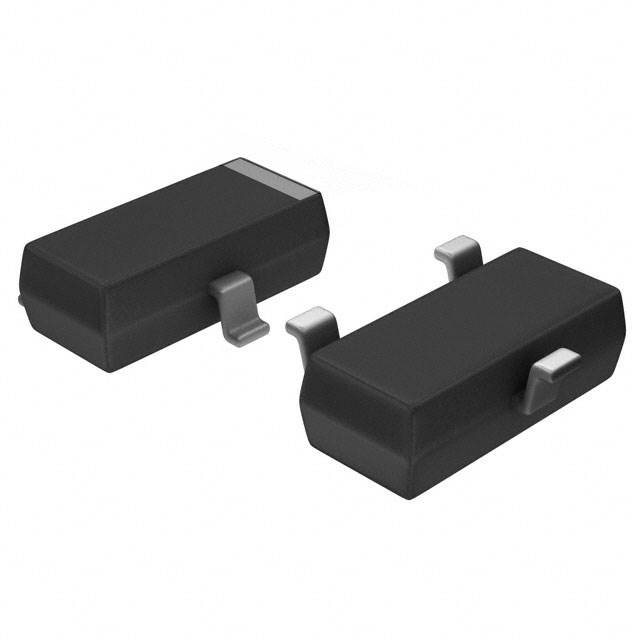
MMBF5485 vs SQ1912AEEH-T1_GE3: Component Comparison for Power Electronics Engineers
Quick verdict
For low-current, high-frequency RF switching or amplification up to 400 MHz, the MMBF5485 is the clear choice due to its JFET technology and low noise figure. For automotive-grade power switching requiring up to 800 mA continuous current, higher voltage rating, and dual MOSFET functionality, the SQ1912AEEH-T1_GE3 offers far superior performance, robustness, and integration.
Spec comparison table
| Spec | MMBF5485 | SQ1912AEEH-T1_GE3 | Notes |
|---|---|---|---|
| Configuration | N-Channel JFET | 2 × N-Channel MOSFET | Dual MOSFET allows more complex switching, but JFET better for low noise, high frequency. |
| Current rating (continuous) | 10 mA | 800 mA (Tc) | SQ1912AEEH-T1_GE3 supports 80× higher current, critical for power switching. |
| Frequency | 400 MHz | Not specified (MOSFET, slower switching) | MMBF5485 optimized for RF applications; SQ1912AEEH-T1_GE3 not intended for high-frequency RF. |
| Gain | Not specified | Not specified | No data; gain not primary factor here. |
| Noise figure | 4 dB | Not specified | MMBF5485’s 4 dB noise figure suits low-noise RF front-ends. |
| Max voltage rating | 25 V | 20 V | MMBF5485 offers slightly higher voltage rating, but marginal. |
| Test voltage | 15 V | Not specified | Only MMBF5485 lists test voltage. |
| Package | TO-236-3 / SC-59 / SOT-23-3 | SC-70-6 (6-pin TSSOP) | SQ1912AEEH-T1_GE3 package is smaller but with more pins (dual device). |
| Mounting type | Surface Mount | Surface Mount | Both surface mount; no difference here. |
| Technology | JFET | MOSFET (Metal Oxide) | JFET better for RF, MOSFET better for switching power. |
| Output power max | Not specified | Not specified | No data on output power max for either. |
| Diode forward voltage (typ/max) | Not specified | 20 mV (typ), 50 mV (max) | SQ1912AEEH-T1_GE3 has integrated body diode with low forward voltage, beneficial in switching. |
| Drain-source voltage max | 25 V | 20 V | MMBF5485 slightly higher max voltage rating. |
| On-resistance (typ) | Not specified | 0.200 Ω (typ) | SQ1912AEEH-T1_GE3 offers a low on-resistance, critical for conduction losses in power stages. |
| On-resistance (max) | Not specified | 0.510 Ω (max) | SQ1912AEEH-T1_GE3 max Rds(on) still low; MMBF5485 data not provided. |
| Gate charge (Qg typ) | Not specified | 1.25 nC @ 4.5 V | SQ1912AEEH-T1_GE3 gate charge low, enabling fast switching with moderate drive current. |
| Gate-source threshold voltage | Not specified | 0.45 V (min), 0.6 V (typ), 1.5 V (max) | SQ1912AEEH-T1_GE3 threshold well documented, low voltage gate drive. |
| Zero gate voltage drain current | Not specified | 50 µA (typ) | Leakage current for SQ1912AEEH-T1_GE3 is low; no data for MMBF5485. |
| Max gate-source voltage | Not specified | ±12 V | SQ1912AEEH-T1_GE3 gate voltage rating safe for typical MOSFET drive signals. |
| Junction temperature range | Not specified | -55°C to +175°C (TJ) | SQ1912AEEH-T1_GE3 rated for automotive-grade temperature range; MMBF5485 not specified. |
| Power dissipation max | Not specified | 1.5 W | SQ1912AEEH-T1_GE3 can dissipate significantly more power; MMBF5485 not specified. |
| Thermal resistance (junction to foot) | Not specified | ~80 µC/W (typ, copper) | SQ1912AEEH-T1_GE3 thermal specs support higher power dissipation. |
| Switching speed (turn-on delay) | Not specified | 66 ns (min), 82 ns (typ) | SQ1912AEEH-T1_GE3 switching times suitable for moderate frequency switching. |
| Fall time | Not specified | 390 ns (min), 487 ns (typ) | SQ1912AEEH-T1_GE3 fall times indicate switching speed limitations compared to RF JFET. |
| Package pin count | 3 | 6 | SQ1912AEEH-T1_GE3 dual MOSFET requires more pins; affects PCB layout. |
| Evaluation board dimensions | Not specified | 0.6 in × 0.5 in | SQ1912AEEH-T1_GE3 evaluation board size indicates compact dual MOSFET integration. |
| Grade | Not specified | Automotive (AEC-Q101 qualified) | SQ1912AEEH-T1_GE3 suitable for automotive applications; MMBF5485 lacks automotive qualification. |
| Drain current max | Not specified | 3 A (max) | SQ1912AEEH-T1_GE3 can handle short bursts up to 3A, useful for transient conditions. |
Design trade-offs
The MMBF5485 is a JFET optimized for RF applications up to 400 MHz with a very low current rating of just 10 mA. Its low noise figure of 4 dB makes it suitable for front-end amplification or switching in sensitive RF circuits. However, the lack of detailed on-resistance data and limited current capacity make it unsuitable for power switching applications. The JFET structure offers inherently low gate leakage and high input impedance, which eases biasing in RF designs but requires a dedicated bias network and careful layout to minimize parasitic capacitances.
In contrast, the SQ1912AEEH-T1_GE3 is a dual N-channel MOSFET array designed for power switching with a continuous current rating up to 800 mA and peak drain current up to 3 A. Its on-resistance of ~0.2 Ω typical at 4.5 V gate drive is moderate, reflecting a trade-off between low drive voltage and conduction losses. The 6-pin SC-70 package supports integration of two MOSFETs, useful for half-bridge or dual-switch applications in automotive or industrial environments. The MOSFET requires gate drive voltages around 4.5 V and has a gate charge on the order of 1.25 nC, meaning gate drive circuits must be designed to supply this charge efficiently to achieve switching speeds in the tens of nanoseconds range.
Thermally, the SQ1912AEEH-T1_GE3 supports up to 1.5 W dissipation and junction temperatures up to 175°C, with a typical junction-to-foot thermal resistance of about 80 µC/W on copper. This allows it to handle significant power in compact layouts, but careful PCB thermal design is necessary to avoid overheating. The MMBF5485 lacks published power dissipation or thermal resistance data, but given its low current rating and RF focus, it is unlikely to handle comparable power levels.
From a layout perspective, the MMBF5485’s 3-pin SOT-23 package is simpler and smaller, beneficial for dense RF boards. The SQ1912AEEH-T1_GE3’s 6-pin SC-70 package is still compact but requires more PCB real estate and routing considerations for dual devices. The integrated body diode in the SQ1912AEEH-T1_GE3 with a low forward voltage (20–50 mV) reduces losses in switching applications involving inductive loads, an advantage over the JFET which may lack such integrated diodes.
Cost-wise, the MMBF5485 is likely cheaper due to simpler device structure and single transistor function, but its niche RF performance limits its use. The SQ1912AEEH-T1_GE3 carries automotive qualification and dual MOSFET integration, likely commanding a higher price but offering value in power switching and automotive-grade reliability.
Use-case fit
Choose MMBF5485 when…
- Designing a low-noise RF front-end amplifier or switch operating up to 400 MHz where noise figure is critical.
- Implementing small-signal switching or buffering circuits in RF transceiver modules with currents below 10 mA.
- You require a JFET device for high input impedance and minimal distortion in analog RF signal paths.
- Compact 3-pin SOT-23 packaging is needed on a dense RF PCB.
- Your design voltage requirements do not exceed