MMBF5485 vs SI2310B-TP: Component Comparison for Power Electronics Design
Quick verdict
The MMBF5485 is primarily an RF JFET optimized for low-noise, high-frequency applications up to 400 MHz, suited for signal amplification and small-signal switching with very low current requirements (~10 mA). The SI2310B-TP, a logic-level MOSFET, excels in power switching scenarios up to 3 A continuous drain current and 60 V rating, making it the clear choice for low-voltage power management and load switching. For RF/signal integrity roles, use the MMBF5485; for power switching and load driving, use the SI2310B-TP.
Spec comparison table
| Spec | MMBF5485 | SI2310B-TP | Notes |
|---|---|---|---|
| Configuration | N-Channel JFET | N-Channel MOSFET | Both N-Channel, but JFET vs MOSFET changes drive and conduction characteristics |
| Current rating (continuous) | 10 mA | 3 A (Tj) | SI2310B-TP supports 300× higher current, enabling power switching |
| Frequency | 400 MHz | Not specified | MMBF5485 is designed for RF use, SI2310B-TP not suitable for RF |
| Gain | Not specified | Not specified | No direct gain data; MMBF5485 used for amplification, SI2310B-TP is a switch |
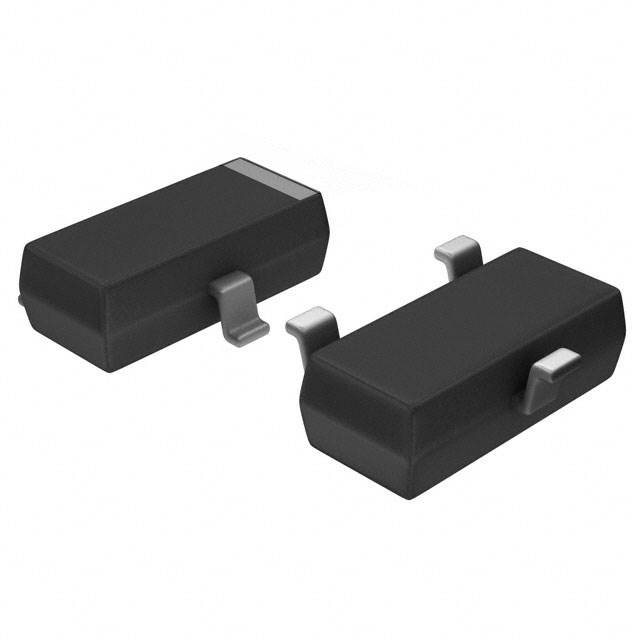
| Mounting type | Surface mount | Surface mount | Both SOT-23-3 packages, easy PCB integration |
| Noise figure | 4 dB | Not specified | MMBF5485 optimized for low noise at RF frequencies |
| Output power max | Not specified | Not specified | Not directly comparable |
| Package case | TO-236-3, SC-59, SOT-23-3 | TO-236-3, SC-59, SOT-23-3 | Identical package footprint |
| Technology | JFET | MOSFET | JFET (low noise, high frequency) vs MOSFET (power switching, logic-level drive) |
| Voltage rated (max Vds) | 25 V | 60 V | SI2310B-TP handles more than double voltage, better for higher-voltage loads |
| Voltage test (max) | 15 V | Not specified | MMBF5485 tested at 15 V |
| Drain-Source On Resistance (Rds(on)) | Not specified | 105 mΩ @ 3A, 10V | SI2310B-TP has specified Rds(on), low enough for efficient switching |
| Gate charge (Qg) | Not specified | 6 nC @ 4.5 V | SI2310B-TP has moderately low gate charge, relevant for switching losses |
| Gate-source voltage max (Vgs) | Not specified | ±16 V | SI2310B-TP supports ±16 V gate drive margin |
| Drive voltage for Rds(on) spec | Not specified | 4.5 V, 10 V | SI2310B-TP specified for logic-level drive, compatible with 5 V MCU outputs |
| Input capacitance (Ciss) | Not specified | 247 pF @ 30 V | SI2310B-TP has moderate input capacitance, impacts switching speed and EMI |
| Operating temperature range | Not specified | -55°C to 150°C (Tj) | SI2310B-TP rated for wide temperature range, suitable for industrial |
| Power dissipation max | Not specified | 1.2 W | SI2310B-TP can dissipate 1.2 W, suitable for moderate power applications |
| Threshold voltage (Vgs_th) | Not specified | 1.3 V @ 250 µA | SI2310B-TP has low threshold voltage, suitable for logic-level drive |
Design trade-offs
The MMBF5485, a JFET tailored for RF applications, is optimized for low noise figure (4 dB) and operation up to 400 MHz. Its maximum continuous current rating of 10 mA and voltage rating of 25 V make it unsuitable for power switching or load driving. From a layout perspective, the MMBF5485’s low input capacitance typical of JFETs helps preserve signal integrity at high frequencies, but its small current capability limits it to front-end amplifier or signal conditioning roles. Additionally, the JFET gate is voltage-driven with high input impedance, but care must be taken to protect the gate from static discharge due to its delicate structure.
The SI2310B-TP, in contrast, is a logic-level N-channel MOSFET designed for power switching. It supports continuous drain currents up to 3 A and blocking voltages up to 60 V. Its specified Rds(on) of 105 mΩ at 3 A and 10 V gate drive means conduction losses are modest for low-power switching but would be high for more demanding power stages. The gate charge of 6 nC at 4.5 V is moderate; switching losses will be non-negligible in high-frequency switching applications but acceptable for low-frequency load switching or DC-DC converters operating at sub-100 kHz. The MOSFET’s maximum gate-source voltage of ±16 V provides robust gate drive margin, and its max power dissipation of 1.2 W allows for some thermal headroom if proper PCB thermal design is applied.
Thermally, the MMBF5485’s low current rating and lack of power dissipation rating imply it’s not intended to handle significant power, so thermal management is minimal. The SI2310B-TP requires consideration of conduction and switching losses, with layout optimized for low thermal resistance and possibly the addition of a thermal pad or copper pours to maintain junction temperatures below 150°C. The MOSFET’s input capacitance and gate charge also influence gate driver design; a capable driver or microcontroller output pin with sufficient drive strength is necessary to switch the device efficiently without excessive losses or slow transitions.
From a cost and volume standpoint, both devices are commonly available in SOT-23-3 packages, widely used and inexpensive in volume. However, the MMBF5485 is a specialized RF JFET with a niche application scope, which may affect availability and pricing compared to the more generic power MOSFET SI2310B-TP.
Use-case fit
Choose MMBF5485 when…
- Designing low-noise RF front-end amplifiers or mixers operating up to 400 MHz where minimal noise figure is critical.
- Implementing small-signal RF switches or attenuators requiring ultra-low input capacitance and high-frequency response.
- Building instrumentation amplifiers or buffer stages with very low current requirements (<10 mA).
- Integrating into circuits where gate voltage protection and high input impedance are needed in a surface-mount package.
- Replacing legacy JFETs in existing RF designs without needing increased power dissipation or current handling.
Choose SI2310B-TP when…
- Implementing low-voltage DC-DC converter synchronous rectification or power switches up to 3 A load current.
- Driving loads such as LEDs, small motors, or relays requiring logic-level MOSFET switches with 60 V margin.
- Designing battery-powered systems where low threshold voltage (1.3 V) enables direct MCU control without a dedicated gate driver.
- Switching moderate power at frequencies where 6 nC gate charge does not cause excessive switching loss (e.g., <100 kHz).
- Replacing or upgrading older MOSFETs in power management circuits requiring improved voltage and current ratings in SOT-23-3.
Drop-in compatibility
Both the MMBF5485 and SI2310B-TP come in identical TO-236-3 / SC-59 / SOT-23-3 packages, and both are N-Channel devices. However, they are not pin-compatible in function or internal structure. The MMBF5485 is a JFET with gate, source, and drain configured differently than a MOSFET. The SI2310B-TP is a standard MOSFET with gate, drain, and source pins arranged per MOSFET conventions. Without exact pinout data here, it cannot be assumed these devices are drop-in replacements. Substituting one for the other without verifying pin assignments and circuit function risks damaging the device or circuit malfunction.
Alternatives to consider
- 2N7002 (NXP): A widely used N-channel MOSFET with low gate charge and similar SOT-23 packaging, good for low-voltage switching.
- BSS138 (ON Semiconductor): A small-signal N-channel MOSFET with low threshold voltage, popular for level shifting and logic-level switching.
- J310 (ON Semiconductor): A high-frequency N-channel JFET comparable to the MMBF5485, suitable for RF applications up to VHF frequencies.