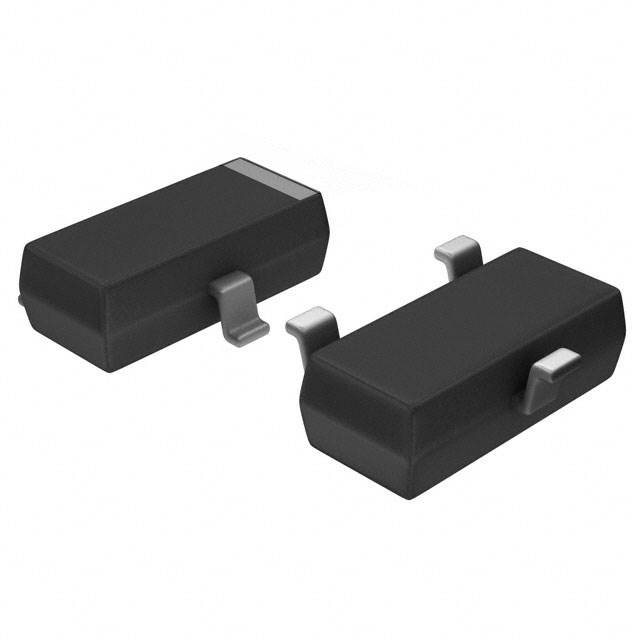
MMBF5485 vs SI2302A: Component Comparison for N-Channel Small-Signal and Power MOSFETs
Quick verdict
For RF and low-current analog switching or signal amplification up to a few hundred MHz, the MMBF5485 is the clear choice due to its JFET technology, low noise figure, and high-frequency capability. For general-purpose low-voltage power switching or load driving up to a few amps, the SI2302A dominates with its much higher current rating, low R_DS(on), and standard MOSFET switching characteristics.
Spec comparison table
| Spec | MMBF5485 | SI2302A | Notes |
|---|---|---|---|
| Configuration | N-Channel JFET | N-Channel MOSFET | Different device technologies; JFET better for low-noise analog, MOSFET better for power. |
| Continuous current rating (I_D) | 10 mA | 3.6 A (Ta) | SI2302A supports 360× higher continuous current; better for power switching. |
| Max pulse current (I_D max) | Not specified | 250 A (max) | SI2302A can handle high surge currents briefly; MMBF5485 not rated for power pulses. |
| Frequency rating | 400 MHz | Not specified | MMBF5485 designed for RF; SI2302A not intended for high-frequency analog. |
| Gain | Not specified | Not specified | Gain not defined for MOSFET; JFET typically used in gain stages, MOSFET as switches. |
| Noise figure | 4 dB | Not specified | MMBF5485 has low noise figure, suitable for RF front-ends; SI2302A not characterized for noise. |
| Output power max | Not specified | Not specified | No data for power output; MMBF5485 is small-signal device, SI2302A is power switch. |
| Mounting type | Surface mount (SOT-23-3) | Surface mount (SOT-23-3) | Both identical package and mounting style. |
| Package case | TO-236-3, SC-59, SOT-23-3 | TO-236-3, SC-59, SOT-23-3 | Directly comparable package size and footprint. |
| Technology | JFET | MOSFET (Metal Oxide) | JFET better for analog linearity and noise; MOSFET better for switching and power handling. |
| Voltage rated (V_DS max) | 25 V | 20 V | MMBF5485 has slightly higher voltage rating; relevant in voltage margin considerations. |
| Voltage test | 15 V (max test voltage) | 20 V | SI2302A rated for higher voltage test. |
| C_iss (typ) | Not specified | 300 pF | SI2302A input capacitance relevant to switching speed and gate drive losses. |
| C_oss (typ) | Not specified | 120 pF | SI2302A output capacitance affects switching performance. |
| C_rss (typ) | Not specified | 80 pF | SI2302A reverse transfer capacitance impacts switching behavior. |
| Gate charge (Q_g max) | Not specified | 10 nC @ 4.5 V | SI2302A gate charge defines drive requirements; MMBF5485 JFET gate drive is different. |
| Gate-source voltage max (V_GS) | Not specified | ±8 V | SI2302A supports ±8 V gate voltage; useful for robust gate drive margin. |
| Drive voltage max R_DS(on) | Not specified | 2.5 V, 4.5 V | SI2302A on-resistance specified at these gate voltages; useful for low-voltage drive. |
| Transconductance (gfs typ) | Not specified | 8 S | SI2302A transconductance indicates strong drive capability at gate voltages. |
| Gate leakage (I_GSS max) | Not specified | +100 nA (max) | SI2302A has minimal gate leakage, important for low standby power. |
| On resistance (R_DS(on)) | Not specified | 85 mΩ (typ) @ V_GS=4.5 V, I_D=3.6 A | SI2302A provides low on-resistance for efficient power switching; MMBF5485 not specified. |
| Power dissipation (P_D max) | Not specified | 1.25 W (Ta) | SI2302A can dissipate significant power in small package; MMBF5485 not rated for power. |
| Thermal resistance (R_θJA typ) | Not specified | 100 °C/W | SI2302A thermal resistance relevant for power dissipation limits. |
| Threshold voltage (V_GS(th)) | Not specified | 0.95 V (typ), 1.9 V (max @ 250 µA) | SI2302A threshold voltage defines switching gate drive level; JFET operates differently. |
| Switching times (t_on, t_off) | Not specified | 15 ns (t_on), 25 ns (t_off) | SI2302A switching speed suitable for PWM and fast switching. |
| Operating temperature range | Not specified | Up to 150 °C (TJ max) | SI2302A supports high junction temperature operation. |
| Storage temperature | Not specified | -55 to 150 °C | SI2302A storage range specified; MMBF5485 not listed. |
| Dimensions (length × width) | Not specified | 0.300–1.150 mm length, 0.900–0.950 mm width | SI2302A dimensions typical for SOT-23 package; MMBF5485 assumed similar. |
Design trade-offs
The MMBF5485 is a JFET optimized for RF applications up to 400 MHz, with a low noise figure of 4 dB, making it suitable for small-signal amplification or low-level analog switching. Its current handling is very limited (10 mA), so it cannot drive loads or switch significant power. From a layout perspective, its JFET gate requires biasing schemes different from MOSFETs and is more sensitive to gate leakage and noise pickup, which means careful grounding and shielding may be necessary in sensitive RF designs.
In contrast, the SI2302A is a power MOSFET designed for load switching and power conversion at voltages up to 20 V and continuous currents up to 3.6 A, with pulsed current capability up to 250 A. Its low R_DS(on) of 85 mΩ at 4.5 V gate drive enables moderate efficiency switching with acceptable conduction losses for low-voltage DC loads. The typical gate charge of 10 nC is moderate, requiring a gate driver capable of sourcing/sinking tens of milliamps at switching frequencies in the hundreds of kHz range without excessive losses or slow transitions.
Thermally, the SI2302A can dissipate up to 1.25 W at ambient temperature, with a typical thermal resistance of 100 °C/W, meaning thermal design and PCB copper area are critical for continuous high-current operation. The MMBF5485, lacking specified power dissipation data, is not suited for power dissipation and should be considered only for low-power signal paths.
From a firmware and drive perspective, the SI2302A needs a proper gate drive voltage (2.5 V minimum, ideally 4.5 V) to achieve specified R_DS(on) and switching times. The MMBF5485 gate drive is fundamentally different (JFET gate) and cannot be driven with the same logic-level signals; it is typically biased rather than switched.
Layout-wise, both come in SOT-23-3 packages, which eases mechanical integration. However, the SI2302A’s MOSFET structure is more robust to ESD and transient events at the gate compared to the JFET. The SI2302A’s capacitances (C_iss, C_oss, C_rss) should be accounted for in high-speed switching designs, impacting switching losses and EMI.
Cost-wise, the SI2302A is likely more expensive due to power MOSFET process and characterization, but benefits from widespread use in load-switching applications. The MMBF5485 is specialized and may be priced higher per unit in low volumes but is rare and necessary in RF front-ends.
Use-case fit
Choose MMBF5485 when…
- Designing a low-noise, low-current RF front-end amplifier or buffer operating up to 400 MHz.
- Implementing analog switches or small-signal level tuning circuits requiring minimal noise figure.
- Working with circuits needing a JFET input device for linearity or impedance matching purposes.
- The load current is below 10 mA, and switching speed or frequency response is critical.
- Minimizing noise contribution is more important than power handling or switching efficiency.
Choose SI2302A when…
- Switching DC loads up to 3.6 A at volt