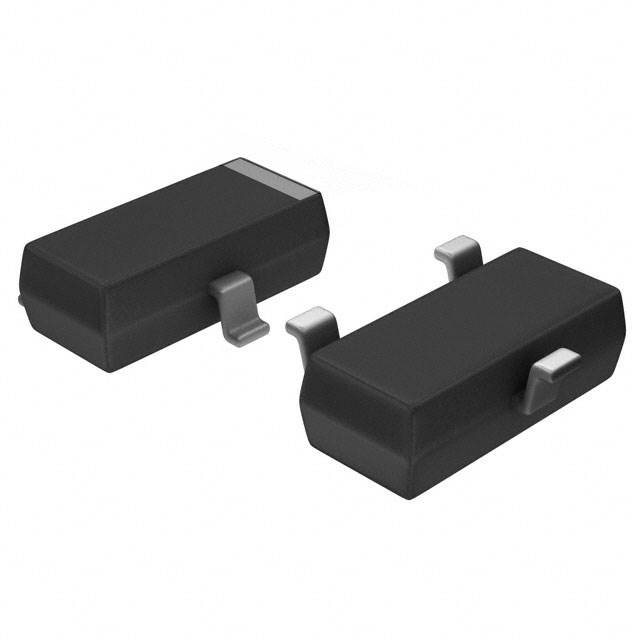
MMBF5485 vs PJA3404_R1_00001: Component Comparison for Power Electronics Design
Quick verdict
For low-current, high-frequency RF switching or small-signal amplification up to 400 MHz, the JFET MMBF5485 is the clear choice due to its RF-optimized characteristics and low noise figure. For power switching or load-driving applications requiring several amps and low Rds(on), the MOSFET PJA3404_R1_00001 dominates with its 5.6 A continuous current rating and low on-resistance.
Spec comparison table
| Spec | MMBF5485 | PJA3404_R1_00001 | Notes |
|---|---|---|---|
| Configuration | N-Channel JFET | N-Channel MOSFET | Different device physics; JFET better for RF, MOSFET better for power switching |
| Current rating (continuous) | 10 mA | 5.6 A (Ta) | PJA3404_R1_00001 supports 560× higher current; critical for load-driving |
| Frequency | 400 MHz | Not specified | MMBF5485 designed for RF frequencies; PJA3404_R1_00001 not suitable for high-frequency RF |
| Gain | Not specified | Not specified | No direct gain spec; JFET expected to have better linearity at RF |
| Noise figure | 4 dB | Not specified | MMBF5485 optimized for low noise figure in RF applications |
| Output power max | Not specified | Not specified | Insufficient data to compare |
| Mounting type | Surface Mount | Surface Mount | Both in SOT-23-3 packages, compatible with standard SMT processes |
| Package case | TO-236-3, SC-59, SOT-23-3 | TO-236-3, SC-59, SOT-23-3 | Physically compatible packages |
| Technology | JFET | MOSFET (Metal Oxide) | JFET preferred for RF linearity; MOSFET preferred for power switching |
| Voltage rated | 25 V | 30 V | PJA3404_R1_00001 has higher voltage margin |
| Voltage test | 15 V | Not specified | MMBF5485 tested to 15 V; PJA3404_R1_00001 max Vds is 30 V |
| Drain-source voltage max | Not specified | 30 V | PJA3404_R1_00001 supports higher voltage |
| Drive voltage (max Rds(on)) | Not specified | 4.5 V (min), 10 V | PJA3404_R1_00001 requires gate drive voltage for low Rds(on); MMBF5485 gate driven differently |
| Gate charge (Qg max) | Not specified | 7.8 nC @ 10 V | PJA3404_R1_00001 gate charge impacts switching speed and driver sizing |
| Gate-source voltage max | Not specified | ±20 V | PJA3404_R1_00001 supports ±20 V gate voltage; MMBF5485 data not specified |
| Input capacitance (Ciss) | Not specified | 343 pF @ 15 V | PJA3404_R1_00001 input capacitance affects switching losses and driver requirements |
| Operating temperature range | Not specified | -55°C to 150°C (TJ) | PJA3404_R1_00001 better specified for wide temperature range |
| Power dissipation max | Not specified | 1.25 W (Ta) | PJA3404_R1_00001 power dissipation rating critical for thermal design |
| Rds(on) max | Not specified | 30 mΩ @ 5.6 A, 10 V | PJA3404_R1_00001 low Rds(on) critical for conduction loss |
| Threshold voltage (Vgs_th) | Not specified | 2.1 V @ 250 µA | PJA3404_R1_00001 threshold voltage important for logic-level gate drive |
Design trade-offs
The MMBF5485 is a JFET optimized for RF applications up to 400 MHz with low noise figure (4 dB). Its extremely low continuous current rating of 10 mA makes it unsuitable for power switching or load driving. The JFET topology offers low input capacitance and high input impedance, favorable for low-level signal amplification and RF switching. However, lacking detailed gate charge and Rds(on) specs, it is not designed for fast, high-current switching.
In contrast, the PJA3404_R1_00001 is a power MOSFET designed for continuous drain currents up to 5.6 A with a maximum Vds of 30 V and a low Rds(on) of 30 mΩ at 10 V gate drive. The gate charge of 7.8 nC at 10 V is moderate, requiring a gate driver capable of supplying tens of milliamps for efficient switching at high frequencies. The larger input capacitance (343 pF) compared to typical RF JFETs means higher switching losses and slower transitions, but this is an acceptable trade-off for power applications.
Thermally, the PJA3404_R1_00001 supports up to 1.25 W dissipation at ambient temperature, requiring careful PCB thermal design including copper areas and possibly thermal vias to maintain junction temperature within limits under load. The MMBF5485 does not specify power dissipation but given its low current, thermal concerns are minimal.
From a layout perspective, both devices share the same SOT-23-3 package, simplifying footprint compatibility. However, the PJA3404_R1_00001’s higher gate charge and current handling necessitate low-inductance gate traces and possibly dedicated gate drivers. The MMBF5485, as an RF JFET, is more sensitive to parasitics and requires controlled impedance layout to maintain RF performance.
Cost-wise, JFETs like the MMBF5485 are typically more expensive per unit than standard small-signal MOSFETs but the difference may be negligible depending on volume and sourcing. The PJA3404_R1_00001 is a commodity MOSFET likely cheaper at scale but may require additional gate driver components, increasing overall system cost.
Use-case fit
Choose MMBF5485 when…
- Designing an RF front-end switch or low-noise amplifier operating up to 400 MHz where low noise figure and linearity matter.
- Implementing a high-impedance buffer stage with minimal loading on the preceding circuit.
- Replacing a JFET in a legacy RF design requiring a direct replacement footprint.
- Working with very low current signals (< 10 mA) where device noise and parasitic capacitances dominate.
- Prototyping RF circuits where device gain and noise figure impact overall link budget.
Choose PJA3404_R1_00001 when…
- Switching or driving loads at currents up to 5.6 A and voltages up to 30 V, such as in DC-DC converters or motor drivers.
- Designing power management circuits requiring low conduction losses, where 30 mΩ Rds(on) at 10 V gate drive reduces heat dissipation.
- Operating in wide temperature ranges (-55°C to 150°C junction), such as automotive or industrial environments.
- Needing a logic-level MOSFET with a 2.1 V threshold for compatibility with 3.3 V or 5 V logic gate drive.
- Minimizing PCB area and component count by using a single SOT-23 MOSFET for medium power switching.
Drop-in compatibility
Both devices share the SOT-23-3 package and similar pinouts typical of three-terminal transistors. However, the MMBF5485 is a JFET with different electrical characteristics and gate control compared to the PJA3404_R1_00001 MOSFET. The gate of the JFET is a reverse-biased pn junction, whereas the MOSFET gate is insulated, requiring different biasing and drive schemes.
Substituting one for the other without circuit modifications is not recommended. The MMBF5485 cannot handle the high currents the PJA3404_R1_00001 can, and the MOSFET requires a gate driver capable of sourcing/sinking gate charge. The data does not explicitly confirm pin-to-pin equivalence, so verify pin assignment against the datasheets before substitution.
Alternatives to consider
- BSS138: A common N-channel logic-level MOSFET in SOT-23 with ~200 mΩ Rds(on), suitable for low power switching.
- 2N5457: An N-channel JFET similar to MMBF5485 but with slightly different frequency and noise characteristics for RF applications.
- IRLML6344: Logic-level N-channel MOSFET with very low Rds(on) (~30 mΩ at 4.5 V), useful for low-voltage power switching in compact packages.