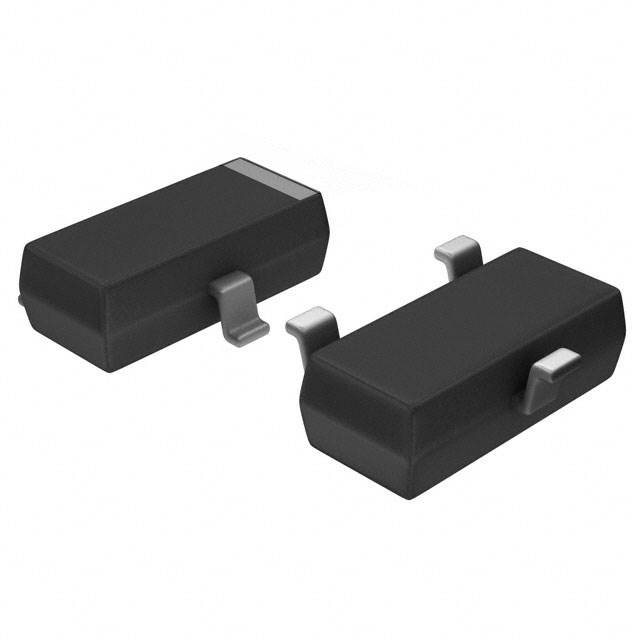
MMBF5485 vs MCM3400A-TP: Component Comparison for Power Electronics Engineers
Quick verdict
For low-current, high-frequency analog/RF signal applications such as front-end RF switches or low-noise amplifiers, the MMBF5485 is the clear choice due to its JFET technology, low noise figure, and 400 MHz frequency rating. For power switching, load driving, or DC-DC conversion up to several amps, the MCM3400A-TP dominates with a much higher continuous drain current rating (5 A vs 10 mA), lower R_DS(on), and integrated dual MOSFET array in a compact DFN package suitable for power stages.
Spec comparison table
| Spec | MMBF5485 | MCM3400A-TP | Notes |
|---|---|---|---|
| Configuration | N-Channel JFET | Dual N-Channel MOSFET | MCM3400A-TP offers dual devices, enabling half-bridge or complementary switching topologies. |
| Current rating (continuous) | 10 mA | 5 A (typ), 4 A (min), 5 A (max) | MCM3400A-TP supports 500× higher continuous current, critical for power applications. |
| Frequency rating | 400 MHz | 100 kHz (min), 1 MHz (typ) switching | MMBF5485 is optimized for RF; MCM3400A-TP targets switching power electronics. |
| Gain | Not specified | Not specified | Gain data unavailable for both; MMBF5485 likely has intrinsic gain as JFET. |
| Mounting type | SOT-23-3 | 6-VDFN Exposed Pad | MMBF5485 is a common small-signal package; MCM3400A-TP uses thermally enhanced DFN for power. |
| Noise figure | 4 dB | Not specified | MMBF5485’s low noise figure suits low-noise RF front ends. |
| Output power max | Not specified | 1.4 W (typical power dissipation) | MCM3400A-TP handles significant power dissipation; MMBF5485 is not rated for power. |
| Package case | TO-236-3, SC-59, SOT-23-3 | DFN2020-6L (6-pin) | Different packages affect PCB layout and thermal management. |
| Technology | JFET | MOSFET | JFET better for low-noise, high-frequency analog; MOSFET better for power switching. |
| Voltage rated (drain-source) | 25 V | 30 V | MCM3400A-TP has slightly higher voltage rating, useful for 24 V systems. |
| Voltage test | 15 V | Not specified | MMBF5485 voltage test lower, consistent with low-power applications. |
| Diode forward voltage max | Not specified | 1 V max | MCM3400A-TP includes body diode with known forward voltage, important for synchronous rectification. |
| Drain-source on-resistance (R_DS(on)) | Not specified | 38 mΩ typical, 27 mΩ min, 45 mΩ max | MCM3400A-TP’s R_DS(on) defines conduction losses; lower values improve efficiency. |
| Gate charge Q_g | Not specified | Not specified | Gate charge unknown for MCM3400A-TP; MMBF5485 data not provided. |
| Gate resistance min | Not specified | 1.7 Ω min | Non-negligible gate resistance affects switching speed and driver requirements. |
| Gate-source leakage current max | Not specified | +100 nA max | Leakage current negligible but useful for precise biasing considerations. |
| Gate threshold voltage (V_GS(th)) | Not specified | 0.7 V min, 0.9 V typ, 1.5 V max | MCM3400A-TP gate threshold fits logic-level drive; MMBF5485 threshold not specified. |
| Input capacitance (C_iss) | Not specified | 1155 pF @ 15 V | High input capacitance in MCM3400A-TP affects switching losses and driver design. |
| Operating temperature range | Not specified | -55°C to +150°C | MCM3400A-TP supports wide industrial temperature range, important for rugged applications. |
| Junction temperature max | Not specified | 150°C max | MCM3400A-TP thermal limits typical for power MOSFETs. |
| Power dissipation max | Not specified | 1.4 W | MCM3400A-TP can dissipate moderate power; MMBF5485 not specified, likely very low. |
| Pulsed drain current max | Not specified | 20 A max | MCM3400A-TP supports high pulsed currents, useful for transient loads or switching spikes. |
| Reverse recovery charge (Q_rr) | Not specified | 11 nC min | Important for switching loss in synchronous rectification; only MCM3400A-TP data provided. |
| Reverse recovery time (t_rr) | Not specified | 10 ns min | Fast recovery time reduces switching losses at high frequency. |
| Thermal resistance junction-ambient | Not specified | 89 °C/W max | Indicates thermal management needs; MCM3400A-TP requires good PCB thermal design. |
| Storage temperature range | Not specified | -55°C to +150°C | Matches operating range, suitable for industrial environments. |
Design trade-offs
The MMBF5485 and MCM3400A-TP serve fundamentally different niches despite both being “MOSFET” category devices. The MMBF5485 is a JFET designed for analog/RF applications with a frequency rating up to 400 MHz and a noise figure of 4 dB. Its current rating is very low (10 mA), and it is not intended for power switching. Designers should expect very low power dissipation and minimal heating, enabling simple PCB layouts without heavy copper or thermal vias.
In contrast, the MCM3400A-TP is a dual N-channel MOSFET array optimized for power switching applications with continuous drain currents up to 5 A and pulsed currents up to 20 A. Its R_DS(on) is in the 27–45 mΩ range, which is moderate but acceptable for low-voltage DC-DC converters or load switches where efficiency and conduction loss matter. The 6-pin DFN package with exposed pad allows for effective thermal management, but requires careful PCB layout to minimize thermal resistance and ensure reliable operation at up to 1.4 W dissipation.
Gate drive requirements differ substantially. The MMBF5485’s JFET nature means it has a high input impedance and negligible gate current, making it easy to bias and control with minimal driver complexity. The MCM3400A-TP MOSFETs require gate drive voltages from approximately 2.25 V to 5.5 V, with typical threshold around 0.9 V, and have a measurable gate resistance (1.7 Ω min) and gate charge (not specified but implied by input capacitance of 1155 pF). This means the MCM3400A-TP demands a gate driver capable of sourcing sufficient current at switching speeds up to 1 MHz, with attention to minimizing switching losses.
Thermal considerations are minimal for MMBF5485 due to low current and power, but critical for MCM3400A-TP. The 89 °C/W junction-to-ambient thermal resistance implies that at 1 W dissipation, the junction may run nearly 90 °C above ambient without additional cooling, necessitating careful PCB design with thermal vias and copper planes. The operating temperature range to 150 °C junction temperature is typical for power MOSFETs.
Cost at volume will generally favor MMBF5485 for simple analog/RF circuits due to its small size and simple packaging, but the MCM3400A-TP’s dual MOSFET array and power capability justify its price in power electronics designs. The different package types (SOT-23 vs DFN) and pin counts also impact BOM and assembly complexity.
Use-case fit
Choose MMBF5485 when…
- You need a low-noise, low-current N-channel JFET for RF front-end circuits operating near 400 MHz.
- Designing analog switches or RF switches where minimal distortion and noise figure (4 dB) are critical.
- Implementing buffer stages or preamplifiers in sensitive sensor or communication circuits that require low gate leakage.
- Space-constrained PCB designs that benefit from the common and compact SOT-23 package.
- Your application voltage does not exceed 25 V and current stays below 10 mA.
Choose MCM3400A-TP when…
- Designing low-voltage (up to 30 V) DC-DC converters or synchronous rectifiers requiring 4–5 A continuous current.
- Building power management circuits with switching frequencies up to 1 MHz, where fast switching time (10 ns reverse recovery) is needed.
- Implementing dual MOSFET configurations such as half-bridges or complementary push-pull stages in a compact 6-pin DFN package