MMBF5485 vs IRFZ44N,127: Component Comparison for Hardware Design
Quick verdict
For high-frequency, low-current analog/RF front-end applications, the MMBF5485 excels due to its JFET technology, low noise figure, and operation up to 400 MHz. Conversely, the IRFZ44N,127 is the clear choice for power switching, handling up to 49 A continuous current and 110 W dissipation, suitable for load switching and motor control at moderate voltages.
Spec comparison table
| Spec | MMBF5485 | IRFZ44N,127 | Notes |
|---|---|---|---|
| Configuration | N-Channel JFET | N-Channel MOSFET | Different transistor types; affects drive and switching characteristics |
| Current rating (continuous) | 10 mA | 49 A (Tc) | IRFZ44N supports ~4900x more current; critical for power applications |
| Frequency | 400 MHz | 6 MHz (typ switching frequency) | MMBF5485 supports much higher frequency, suited for RF use |
| Gain | - | - | Not specified; MMBF5485 is a JFET, typically higher gain for small-signal |
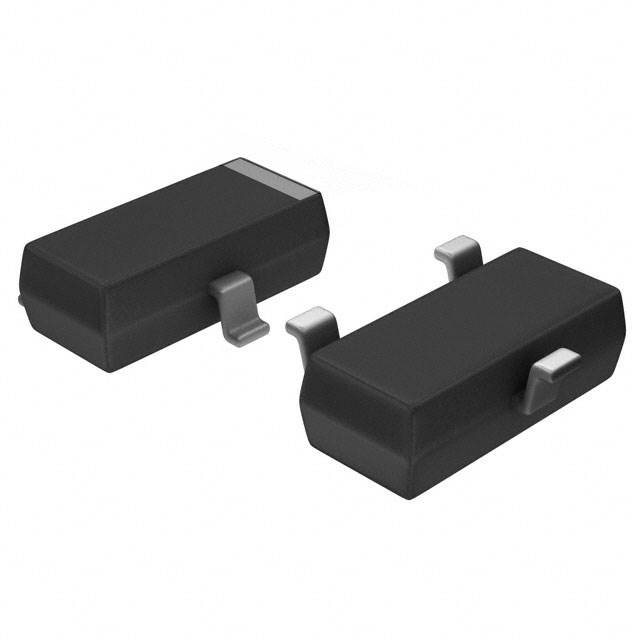
| Mounting type | Surface mount (SOT-23-3) | Through hole (TO-220AB) | MMBF5485 is SMT, better for compact PCBs; IRFZ44N requires heatsinking |
| Noise figure | 4 dB | Not specified | MMBF5485 suitable for low-noise designs |
| Output power max | Not specified | 110 W (Tc) | IRFZ44N designed for high power dissipation |
| Package case | TO-236-3 (SC-59, SOT-23-3) | TO-220-3 | Size and thermal dissipation differ significantly |
| Technology | JFET | MOSFET (Metal Oxide) | Different device physics, affecting gate drive and switching |
| Voltage rated | 25 V (test 15 V) | 55 V | IRFZ44N handles higher voltage |
| Avalanche energy max | Not specified | 110 mJ (max) | IRFZ44N can absorb avalanche energy; useful in inductive switching |
| Avalanche energy rating max | Not specified | 90 % (max) | IRFZ44N ratings indicate ruggedness for transient events |
| Avalanche energy typical | Not specified | 120 mJ (typ) | Same as above |
| Input capacitance (Ciss) | Not specified | 1800 pF @ 25 V | High input capacitance increases gate drive losses in IRFZ44N |
| Feedback capacitance (Crss) | Not specified | 155 pF (min), 215 pF (typ) | IRFZ44N has significant Miller capacitance, affecting switching speed |
| Output capacitance (Coss) | Not specified | 330 pF (min), 400 pF (typ) | IRFZ44N output capacitance impacts switching losses |
| Gate charge (Qg) | Not specified | 62 nC @ 10 V (max), 44 nC (typ) | IRFZ44N requires substantial gate drive current |
| Gate threshold voltage (Vth) | Not specified | 2.0–4.0 V (typ 3.0 V @ 1 mA) | IRFZ44N requires gate drive above ~3 V for full enhancement |
| Drain-source voltage max (Vds) | 25 V (test 15 V) | 55 V | IRFZ44N supports higher voltage applications |
| Drain current max | 10 mA | 80 A (max pulsed), 49 A (continuous) | IRFZ44N supports high current loads |
| Power dissipation max | Not specified | 110 W (Tc) | IRFZ44N can dissipate high power with heatsinking |
| Thermal resistance (junction-case) | Not specified | ~0.62 °C/W (typ) (TO-220) | IRFZ44N requires thermal management; MMBF5485 lower power means less thermal concern |
| Operating temperature range | Not specified | -55°C to 175°C (TJ) | IRFZ44N rated for wide temperature range |
| Diode forward voltage | Not specified | 1.2 V (typ) | IRFZ44N includes body diode; relevant for inductive loads |
| Reverse recovery time | Not specified | 47 ns (min) | IRFZ44N recovery time impacts switching losses |
| Internal inductances (drain/source) | Not specified | Drain: 3.5–4.5 nH; Source: 7.5 nH (min) | IRFZ44N inductances affect switching transients and EMI |
| Package mass | Not specified | 2 g (max) | IRFZ44N heavier, larger package |
Design trade-offs
The MMBF5485 and IRFZ44N,127 serve fundamentally different roles despite both being N-channel devices. The MMBF5485 is a JFET optimized for operation at RF frequencies up to 400 MHz with very low current (10 mA max) and low noise figure (4 dB). This makes it suitable for analog front-end stages such as low-noise amplifiers or mixer circuits. Its SOT-23-3 SMT package facilitates compact PCB layouts and minimizes parasitic inductance and capacitance, critical at high frequencies.
In contrast, the IRFZ44N,127 is a power MOSFET designed for switching applications with continuous currents up to 49 A and voltage ratings of 55 V. Its TO-220 through-hole package supports high power dissipation (110 W with a suitable heatsink), but at the cost of larger footprint and increased parasitic inductances, which must be managed carefully in high-speed switching circuits. The IRFZ44N’s relatively high input capacitance (Ciss ~1800 pF) and gate charge (Qg up to 62 nC) demand robust gate drivers capable of sourcing significant transient currents to switch efficiently.
Thermally, the IRFZ44N necessitates careful heatsinking and possibly active cooling depending on power levels, while the MMBF5485’s low current and power dissipation allow it to operate without special thermal considerations. The IRFZ44N’s avalanche energy ratings (up to 110 mJ) provide robustness against inductive load transients, a feature absent from the MMBF5485 datasheet, further emphasizing their different application domains.
From a layout perspective, the MMBF5485’s SOT-23 package enables dense, low-inductance PCB routing critical for RF performance. The IRFZ44N’s larger TO-220 package introduces higher parasitic inductances (3.5–7.5 nH), impacting switching speed and EMI; minimizing lead lengths and using low-inductance gate drive loops are essential. Additionally, the IRFZ44N’s body diode with a 1.2 V forward drop and 47 ns reverse recovery time must be accounted for in synchronous rectification or motor drive circuits.
Cost-wise, the MMBF5485 is a small-signal device with lower silicon area and simpler packaging, typically cheaper in volume than power MOSFETs like the IRFZ44N, which require larger die and more robust packaging. However, the IRFZ44N remains a commodity power MOSFET with widespread availability and low cost per ampere switched, making it economical for power electronics.
Use-case fit
Choose MMBF5485 when…
- You need a low-noise, high-frequency front-end transistor for RF amplification stages up to 400 MHz.
- Circuit space is constrained and surface-mount assembly is preferred.
- Operating currents are in the low milliamp range (<10 mA) in analog or switching applications.
- The design benefits from the JFET’s high input impedance and low gate noise.
- Voltage requirements do not exceed 25 V and device robustness is less critical.
Choose IRFZ44N,127 when…
- You require a power MOSFET capable of switching or controlling loads drawing tens of amperes (up to 49 A continuous).
- Operating voltages are up to 55 V, suitable for automotive, industrial, or motor drive circuits.
- High power dissipation (up to 110 W with heatsinking) is expected.
- The application involves inductive loads requiring avalanche energy capability.
- Through-hole mounting and robust mechanical attachment are acceptable or preferred.
Drop-in compatibility
These devices are neither pin-compatible nor footprint-compatible. The MMBF5485 is packaged in a small surface-mount SOT-23-3 (TO-236-3) with three leads arranged for low-noise analog use, whereas the IRFZ44N,127 is a large, through-hole TO-220-3 package designed for high-power switching. Substituting one for the other requires a complete redesign of the PCB footprint, gate drive circuitry, and thermal management. No direct substitution is possible.