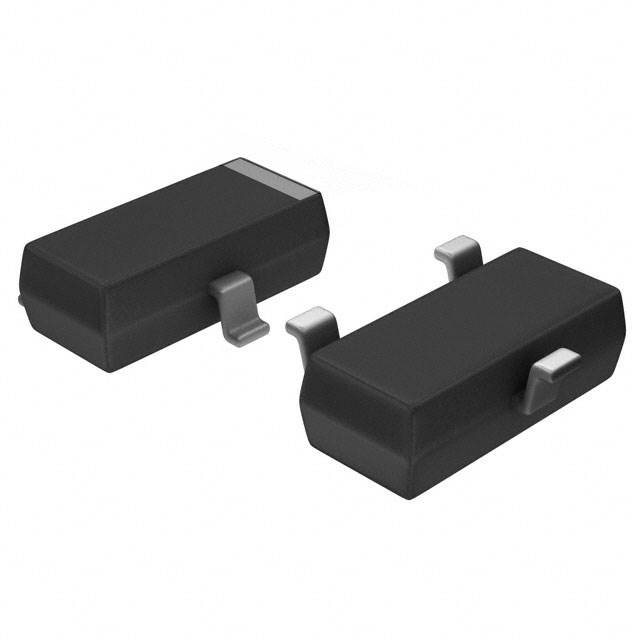
MMBF5485 vs IRF540N_R4942: Component Comparison for Power Electronics Design
Quick verdict
For high-frequency, low-current RF switching and signal amplification up to 400 MHz, the MMBF5485 JFET in SOT-23-3 is the clear choice due to its low noise figure and small package. For power switching applications requiring high current (up to 33 A) and voltage (100 V), the IRF540N_R4942 MOSFET in a TO-220 package is the practical choice, offering robust thermal dissipation and low R_DS(on).
Spec comparison table
| Spec | MMBF5485 | IRF540N_R4942 | Notes |
|---|---|---|---|
| Configuration | N-Channel JFET | N-Channel MOSFET | Both N-Channel; JFET for low noise/RF, MOSFET for power switching |
| Current rating (continuous) | 10 mA | 33 A (Tc) | IRF540N handles 3300× higher current; MMBF5485 is for signal-level currents |
| Frequency | 400 MHz | Not specified | MMBF5485 supports RF frequencies; IRF540N unsuitable for RF due to high capacitance |
| Gain | Not specified | Not specified | N/A from datasheets |
| Mounting type | Surface Mount (SOT-23-3) | Through Hole (TO-220-3) | SOT-23-3 for compact PCB, TO-220 for better heat sinking |
| Noise figure | 4 dB | Not specified | MMBF5485 designed for low-noise RF applications |
| Output power max | Not specified | Not specified | Not specified for either |
| Package case | TO-236-3, SC-59, SOT-23-3 | TO-220-3 | SOT-23-3 small signal, TO-220 large power package |
| Technology | JFET | MOSFET (Metal Oxide) | JFET better for RF linearity; MOSFET better for power switching |
| Voltage rated | 25 V | 100 V | IRF540N supports 4× higher voltage |
| Voltage test | 15 V | Not specified | MMBF5485 rated/tested to 15 V only |
| Continuous drain current at 25°C | 10 mA | 33 A (Tc) | IRF540N vastly higher current handling capability |
| Drive voltage max | Not specified | 10 V (R_DS(on) spec), ±20 V max gate-source voltage | IRF540N requires up to 10 V gate drive for low R_DS(on) |
| Gate charge (Q_g) max | Not specified | 79 nC @ 20 V | IRF540N gate charge significant, impacting switching speed and drive power |
| Input capacitance (C_iss) max | Not specified | 1220 pF @ 25 V | High input capacitance on IRF540N limits switching speed |
| Operating temperature range | Not specified | -55°C to 175°C (TJ) | IRF540N suitable for high temp power applications |
| Power dissipation max | Not specified | 120 W (Tc) | IRF540N can dissipate significantly more power with proper heatsinking |
| R_DS(on) max @ 33 A, 10 V | Not specified | 40 mΩ | IRF540N has low on-resistance for power efficiency |
| V_GS(th) max | Not specified | 4 V @ 250 µA | IRF540N threshold voltage relevant for gate drive design |
Design trade-offs
The MMBF5485 and IRF540N_R4942 are fundamentally distinct devices targeted at very different application spaces. The MMBF5485 is a low-current, high-frequency JFET optimized for RF front-end circuits, with a low noise figure of 4 dB and operation up to 400 MHz. Its tiny SOT-23-3 package enables very compact PCB layouts but limits power dissipation and current handling to around 10 mA. The JFET technology offers superior linearity and low noise compared to MOSFETs in this frequency range, but it cannot scale to power levels needed in switching regulators or motor drives.
In contrast, the IRF540N_R4942 is a classic power MOSFET designed for robust switching and linear power applications. Its TO-220-3 through-hole package supports thermal management with heatsinks, enabling continuous drain currents up to 33 A at a junction temperature range up to 175°C and power dissipation up to 120 W (with adequate cooling). The 100 V drain-source rating provides headroom for many industrial and automotive applications. However, its large input capacitance (1220 pF) and 79 nC gate charge at 20 V require a gate driver capable of delivering significant charge quickly to achieve fast switching speeds, impacting efficiency and EMI. The relatively high threshold voltage (~4 V) means a 10 V drive voltage is necessary to achieve the specified R_DS(on) of 40 mΩ.
From a layout perspective, the MMBF5485’s small SOT-23-3 footprint favors dense RF front-end boards but demands careful impedance matching and short lead lengths to preserve high-frequency performance. The IRF540N_R4942’s larger TO-220 package is easier to handle manually and mount with robust screw-down heatsinks but is incompatible with high-density surface-mount layouts. In volume production, the MMBF5485 is cheaper per unit but much lower power and current ratings limit its use cases; the IRF540N is cost-effective for power switching but requires gate drivers and thermal management that increase BOM and assembly complexity.
Use-case fit
Choose MMBF5485 when…
- Designing low-noise RF amplifiers or switches operating up to 400 MHz, where the 4 dB noise figure is critical.
- You need a compact surface-mount transistor in a SOT-23 package for space-constrained RF front-ends.
- The application current is limited to signal-level currents around 10 mA or less.
- You require a JFET device for superior linearity in analog or mixed-signal RF circuits.
- Your design operates below 25 V and does not require power switching capabilities.
Choose IRF540N_R4942 when…
- You need to switch or control loads drawing up to 33 A continuously at voltages up to 100 V.
- Thermal dissipation is a concern and you can accommodate a TO-220 package with a heatsink.
- Your application demands low conduction losses with an R_DS(on) of 40 mΩ at 10 V gate drive.
- You have a gate driver capable of delivering 79 nC of gate charge quickly for efficient switching.
- You require ruggedness and wide operating temperature range (-55°C to 175°C junction).
Drop-in compatibility
These two devices are neither pin-compatible nor footprint-compatible. The MMBF5485 uses a three-terminal SOT-23-3 surface-mount package optimized for RF signals, while the IRF540N_R4942 is a larger TO-220-3 through-hole package designed for power switching. Substituting one for the other would require a complete redesign of the PCB footprint, gate drive circuitry, and thermal management. The device technologies (JFET vs MOSFET) also imply different biasing and driving requirements, so no direct substitution is feasible.
Alternatives to consider
- BSS138 (N-Channel MOSFET, SOT-23): A small-signal MOSFET alternative for low-voltage, low-current switching in compact layouts.
- IRLZ44N (N-Channel MOSFET, TO-220): A logic-level MOSFET with lower gate threshold voltage and similar power ratings to IRF540N, better for 5 V gate drive.
- 2N5457 (N-Channel JFET, TO-92): JFET alternative for low-noise analog or RF applications in through-hole format.