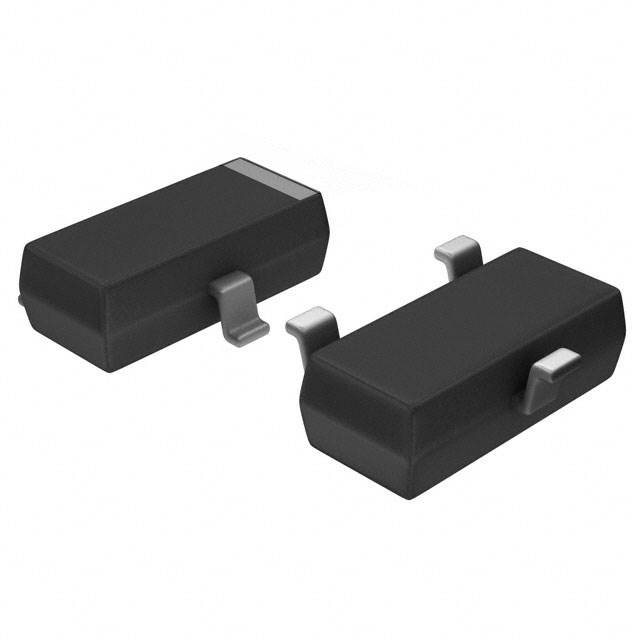
MMBF5485 vs IMZA65R020M2HXKSA1: Component Comparison for Practicing Engineers
Quick verdict
For low-current, high-frequency RF switching or amplification applications under 15 V, the MMBF5485 is the clear choice due to its JFET technology optimized for 400 MHz operation and extremely low current ratings (10 mA). Conversely, for high-power switching applications requiring up to 650 V and 83 A continuous current, such as motor drives or solar inverters, the IMZA65R020M2HXKSA1 (SiC MOSFET) dominates with its superior voltage rating, current capacity, and thermal performance.
Spec comparison table
| Spec | MMBF5485 | IMZA65R020M2HXKSA1 | Notes |
|---|---|---|---|
| Configuration | N-Channel JFET | N-Channel MOSFET (SiC) | Both N-channel, but different device types affect drive and switching characteristics. |
| Voltage rating (max) | 25 V | 650 V | IMZA65R020M2HXKSA1 supports much higher voltage, enabling high-power applications. |
| Voltage test | 15 V | - | MMBF5485 tested up to 15 V, aligns with low-voltage RF use. |
| Current rating (continuous) | 10 mA | 83 A (Tc) | IMZA65R020M2HXKSA1 supports orders of magnitude higher current. |
| Frequency | 400 MHz | 2.0 MHz (typ switching frequency) | MMBF5485 optimized for RF frequencies; IMZA65R020M2HXKSA1 for power switching. |
| Gain | - | - | Gain not specified for either; MMBF5485 likely used for amplification, MOSFET for switching. |
| Noise figure | 4 dB | - | MMBF5485 provides noise figure data, relevant for RF design; IMZA65R020M2HXKSA1 not. |
| Output power max | - | - | Not specified for either. |
| Mounting type | Surface Mount (SOT-23-3) | Through Hole (PG-TO247-4) | MMBF5485 favors compact SMT; IMZA65R020M2HXKSA1 is for high-power, heatsinkable THD. |
| Package case | TO-236-3, SC-59, SOT-23-3 | TO-247-4 | Reflects application environment differences: compact vs power dissipation. |
| Technology | JFET | SiCFET (Silicon Carbide MOSFET) | SiC MOSFET allows higher voltage, temperature, and efficiency. |
| Noise figure | 4 dB | - | Only MMBF5485 specifies noise figure. |
| Capacitance (typical) | - | 103 pF (input), 151 pF (output) | IMZA65R020M2HXKSA1 capacitances impact switching losses; MMBF5485 not listed. |
| Gate charge | - | 57 nC @ 18 V (max) | IMZA65R020M2HXKSA1 requires significant gate drive energy. |
| Gate threshold voltage | - | 3.5 V (min), 4.5 V (typ), 5.6 V (max) | IMZA65R020M2HXKSA1 gate drive requirements are moderate but not logic-level. |
| Gate-source voltage max | - | +23 V / -7 V | IMZA65R020M2HXKSA1 supports wide gate voltage range. |
| Gate-source leakage current max | - | 100 nA | Low leakage typical for MOSFET; no data for MMBF5485. |
| Drain-source on-state resistance | - | 0.024 Ω (typ) to 0.057 Ω (max) @ 20V | IMZA65R020M2HXKSA1 on-resistance critical for conduction losses; MMBF5485 not specified. |
| Avalanche current (single pulse) | - | 10.2 A (typ) | IMZA65R020M2HXKSA1 avalanche capability important for robustness; MMBF5485 no data. |
| Avalanche energy (single pulse) | - | 272 mJ (typ) | Indicates robustness under transient conditions. |
| Power dissipation (typ) | - | 273 W (Tc) | IMZA65R020M2HXKSA1 designed for high power dissipation; MMBF5485 not specified. |
| Operating temperature range | - | -55°C to 175°C (TJ) | IMZA65R020M2HXKSA1 rated for wide industrial temp range; MMBF5485 data not given. |
| Storage temperature range | -55°C to ? | -55°C to 150°C (max) | IMZA65R020M2HXKSA1 specified; MMBF5485 storage temp data not given. |
| Switching loss | - | Ultra-low (min) | IMZA65R020M2HXKSA1 optimized for efficient switching at power frequencies. |
| Switching time (max) | - | 103 ns | IMZA65R020M2HXKSA1 switching speed relevant for high-frequency power electronics. |
| Thermal resistance (junction-case) | - | 0.55 °C/W | IMZA65R020M2HXKSA1 thermal design critical for heat sinking; MMBF5485 likely negligible. |
| Package marking | - | See Appendix A | No direct relevance for design. |
| Mounting torque | - | 60 Ncm | Relevant for mechanical assembly of IMZA65R020M2HXKSA1. |
Design trade-offs
The MMBF5485 and IMZA65R020M2HXKSA1 represent fundamentally different device classes, targeting different domains of power electronics.
The MMBF5485 is a low-voltage, low-current JFET optimized for RF applications up to 400 MHz. Its 10 mA current rating and 25 V voltage rating limit it to signal-level switching or amplification. The 4 dB noise figure and SOT-23-3 surface mount package make it suitable for compact, low-noise front-end circuits in communications or instrumentation. The JFET nature means gate drive is voltage-controlled with very low input current, simplifying driver design, but it is not intended for power switching.
In contrast, the IMZA65R020M2HXKSA1 is a Silicon Carbide MOSFET designed for high-power switching at voltages up to 650 V and continuous currents up to 83 A (at case temperature). This device supports typical switching frequencies around 2 MHz with ultra-low switching losses and a maximum switching time of 103 ns. Its on-resistance is as low as 24 mΩ, critical for minimizing conduction losses in power converters. The TO-247-4 through-hole package facilitates robust heat sinking and mechanical mounting, essential for managing 273 W of typical power dissipation.
Gate drive requirements differ significantly. The IMZA65R020M2HXKSA1 requires a gate drive voltage between -7 V and +23 V, with a maximum gate charge of 57 nC at 18 V. This necessitates a dedicated gate driver capable of delivering relatively high peak currents to switch efficiently. The MMBF5485, as a JFET, has inherently low input capacitance and negligible gate drive current, simplifying the driver circuitry but limiting switching speed and power handling.
Thermal management considerations are critical for the IMZA65R020M2HXKSA1 due to its high power dissipation and junction temperatures up to 175°C. Thermal resistance of 0.55 °C/W junction-to-case requires appropriate heat sinking and PCB layout to maintain reliability. The MMBF5485’s low current and power dissipation mean thermal issues are minimal.
From a layout perspective, the MMBF5485’s small SOT-23-3 footprint suits dense RF boards, while the IMZA65R020M2HXKSA1’s TO-247 package demands more board space and through-hole mounting, impacting mechanical design and assembly cost.
Cost at volume will heavily favor the MMBF5485 for low-power, low-cost RF applications due to its simple structure and SMT packaging. The IMZA65R020M2HXKSA1, a SiC device with complex fabrication and robust packaging, will be more expensive but justified in high-voltage, high-current, and high-temperature designs.
Use-case fit
Choose MMBF5485 when…
- Designing low-voltage (≤25 V), low-current (≤10 mA) RF front-end circuits requiring operation up to 400 MHz.
- Implementing signal amplification or switching with a requirement for low noise figure (~4 dB).
- Space-constrained applications needing surface-mount devices in SOT-23-3 packages.
- Circuits where gate drive simplicity and low gate current are priorities.
- Prototyping or production of RF instrumentation or