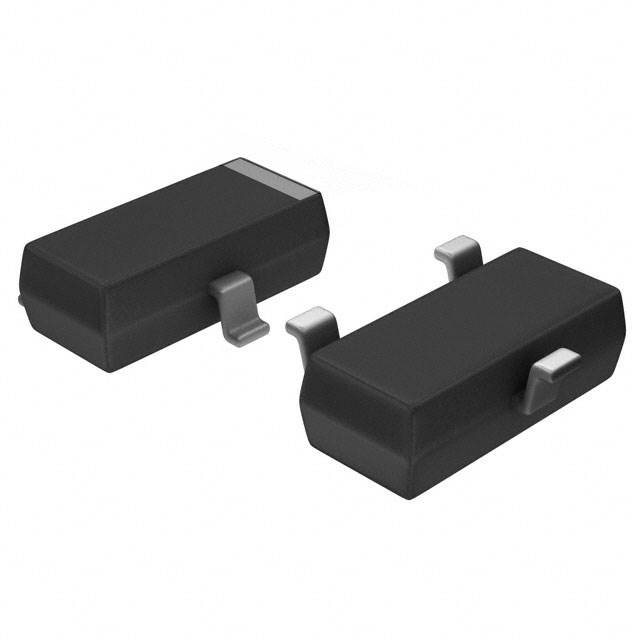
MMBF5485 vs IMZA65R015M2HXKSA1: Component Comparison for Power Electronics Engineers
Quick verdict
For low-current, high-frequency RF switching and amplification up to 400 MHz, the MMBF5485 JFET is the clear choice due to its low noise figure and SOT-23 surface-mount package. For high-voltage, high-current power switching in industrial or automotive applications, the IMZA65R015M2HXKSA1 SiC MOSFET provides vastly superior voltage rating, continuous current capability, and power dissipation, albeit with much higher gate drive complexity and thermal management requirements.
Spec comparison table
| Spec | MMBF5485 | IMZA65R015M2HXKSA1 | Notes |
|---|---|---|---|
| Configuration | N-Channel JFET | N-Channel SiC MOSFET | Both N-channel; fundamentally different device technologies affecting drive and switching. |
| Current rating | 10 mA | 103 A (Tc) | IMZA65R015M2HXKSA1 supports >10,000× higher current; critical for power applications. |
| Frequency | 400 MHz | Not specified (power MOSFET) | MMBF5485 designed for RF up to 400 MHz; IMZA65R015M2HXKSA1 not intended for RF use. |
| Gain | Not specified | Not specified | No gain data; MMBF5485 is a JFET often used in amplifiers, IMZA65R015M2HXKSA1 is a switch. |
| Noise figure | 4 dB | Not specified | MMBF5485 optimized for low-noise RF front-ends; IMZA65R015M2HXKSA1 noise figure irrelevant. |
| Output power max | Not specified | Not specified | Not comparable; IMZA65R015M2HXKSA1 power limited by dissipation, MMBF5485 by current. |
| Package case | TO-236-3 / SC-59 / SOT-23-3 | TO-247-4 | MMBF5485 is small SMT; IMZA65R015M2HXKSA1 is large through-hole suited for heat sinking. |
| Mounting type | Surface Mount | Through Hole | IMZA65R015M2HXKSA1 requires heavier mechanical mounting and thermal interface. |
| Technology | JFET | Silicon Carbide (SiC) MOSFET | SiC FET enables high voltage, high temperature, and high frequency switching in power. |
| Voltage rated | 25 V | 650 V | IMZA65R015M2HXKSA1 supports 26× higher voltage, enabling high-voltage DC/DC or inverter use. |
| Voltage test | 15 V | Not specified | MMBF5485 rated for 15 V test voltage, IMZA65R015M2HXKSA1 max gate voltage specified separately. |
| Continuous drain current (Id) at 25°C | 10 mA | 103 A (Tc) | IMZA65R015M2HXKSA1 supports very high currents for power stages. |
| Drive voltage max / Rds(on) | Not specified | 15 V max drive, 13.2 mΩ @ 64.2 A, 20 V gate | IMZA65R015M2HXKSA1 requires strong gate drive (15-20 V) for low Rds(on). |
| Gate charge (Qg) | Not specified | 79 nC @ 18 V | IMZA65R015M2HXKSA1 gate charge is high, impacting switching losses and gate driver choice. |
| Gate-source voltage max | Not specified | +23 V / -7 V | IMZA65R015M2HXKSA1 allows high Vgs, but requires careful gate drive design. |
| Input capacitance (Ciss) | Not specified | 2792 pF @ 400 V | Large input capacitance increases switching losses and gate drive requirements. |
| Operating temperature range | Not specified | -55°C to 175°C (TJ) | IMZA65R015M2HXKSA1 can operate at much higher junction temperatures, useful in harsh environments. |
| Power dissipation max | Not specified | 341 W (Tc) | IMZA65R015M2HXKSA1 can dissipate significant power with proper cooling; MMBF5485 limited. |
| Threshold voltage (Vgs_th) | Not specified | 5.6 V @ 13 mA | IMZA65R015M2HXKSA1 threshold suitable for power gate drive; MMBF5485 JFET gate behavior different. |
Design trade-offs
The MMBF5485 and IMZA65R015M2HXKSA1 represent fundamentally different device classes and target applications, with correspondingly different design considerations.
The MMBF5485 is a low-current JFET optimized for RF switching and low-noise amplification up to 400 MHz. Its ultra-small SOT-23 package supports compact, lightweight layouts in sensitive RF front ends. The low current rating (10 mA) and relatively low voltage rating (25 V) confine it to signal-level or low-power applications. Its JFET structure means it requires no gate drive voltage swing like MOSFETs, simplifying biasing but limiting power handling. The 4 dB noise figure indicates moderate noise performance, acceptable for many RF designs but not ultra-low noise.
In contrast, the IMZA65R015M2HXKSA1 is a high-power Silicon Carbide MOSFET designed for demanding power switching applications. Its 650 V rating and 103 A continuous current capability enable use in industrial motor drives, automotive DC/DC converters, or renewable energy inverters. The large TO-247-4 package allows for robust thermal management and mechanical mounting. However, the device demands a 15-20 V gate drive voltage and has a significant gate charge (79 nC), necessitating a strong gate driver with low output impedance and careful switching transition control to minimize losses and EMI. The high input capacitance (2792 pF) further complicates gate drive design and switching speed optimization.
Thermal management is a critical consideration: the IMZA65R015M2HXKSA1 can dissipate up to 341 W at case temperature, requiring a substantial heat sink or liquid cooling in high-power designs. The MMBF5485 dissipates negligible power and can rely on PCB copper alone for thermal conduction. Efficiency curves for the SiC MOSFET will show lower conduction and switching losses than silicon MOSFETs at high voltages and frequencies, but the absolute power levels are orders of magnitude higher than the MMBF5485.
From a layout perspective, the MMBF5485’s small SOT-23 package minimizes parasitic inductance and capacitance, critical for RF performance. The IMZA65R015M2HXKSA1’s large package and through-hole mounting increase lead inductance and require careful PCB and heat sink integration to maintain switching performance and device reliability.
Cost at volume will differ dramatically: the MMBF5485 is a low-cost signal-level component, while the IMZA65R015M2HXKSA1 is a specialized SiC device with a significantly higher unit price justified by its high voltage and current ratings.
Use-case fit
Choose MMBF5485 when…
- Designing low-noise RF front ends or switches operating up to 400 MHz in portable or space-constrained devices.
- Implementing small-signal amplification stages requiring a JFET for linearity and low noise.
- Targeting ultra-low current applications with supply voltages below 25 V.
- Needing a compact surface-mount device with minimal PCB real estate.
- Cost sensitivity favors simple, low-power RF components with minimal thermal management.
Choose IMZA65R015M2HXKSA1 when…
- Building high-voltage DC/DC converters, inverters, or motor drives requiring blocking voltages up to 650 V.
- Designing power stages with continuous currents above 100 A and power dissipation up to several hundred watts.
- Operating in harsh environments with junction temperatures approaching 175°C.
- Requiring the efficiency and switching speed advantages of Silicon Carbide MOSFETs over silicon counterparts.
- Able to accommodate larger, through-hole packages with robust thermal management and high gate drive voltage.
Drop-in compatibility
The MMBF5485 and IMZA65R015M2HXKSA1 are neither pin-compatible nor footprint-compatible. The MMBF5485’s SOT-23-3 surface-mount package and JFET technology serve low-voltage, low-current RF/signal applications, while the IMZA65R015M2HXKSA1’s TO-247-4 through-hole package and SiC MOSFET structure target high-power switching. Substituting one for the other would require a complete redesign of the PCB footprint, power supply, gate drive circuitry, and thermal management system.
Alternatives to consider
- BSS138 (NXP): Small-signal N-channel MOSFET in SOT-23 package, commonly used for low-voltage switching but with higher gate threshold and different frequency response than a JFET.
- C2M0160120D (Cree/Wolfspeed): SiC MOSFET 120