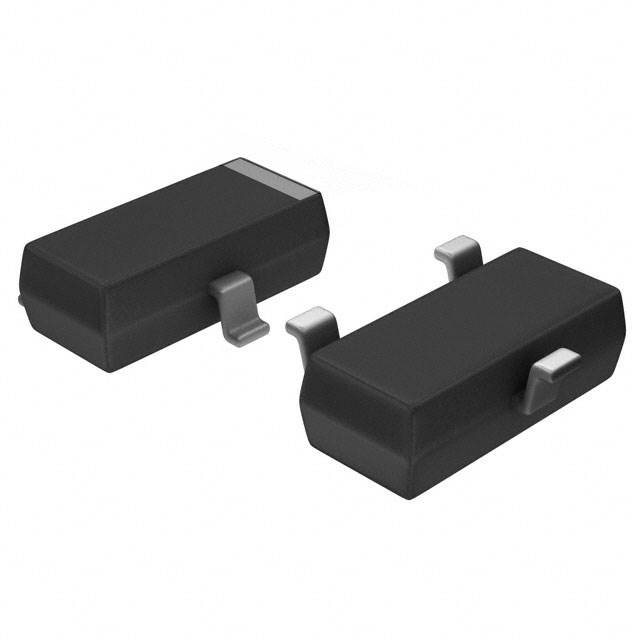
MMBF5485 vs IMW120R090M1HXKSA1: Component Comparison for Hardware Engineers
Quick verdict
For low-current, high-frequency RF switching or small-signal amplification up to 400 MHz, the MMBF5485 is the only practical choice given its JFET technology, low current rating (10 mA), and low-voltage operation (25 V max). For power switching applications requiring high voltage blocking (1200 V), high continuous current (26 A), and high power dissipation (115 W), the IMW120R090M1HXKSA1 is the clear winner due to its Silicon Carbide MOSFET technology and robust thermal and electrical ratings.
Spec comparison table
| Spec | MMBF5485 | IMW120R090M1HXKSA1 | Notes |
|---|---|---|---|
| Configuration | N-Channel JFET | N-Channel SiC MOSFET | Different device types; JFET for RF/small signal, SiC MOSFET for high power switching |
| Current rating (continuous) | 10 mA | 26 A (Tc) | IMW120R090M1HXKSA1 supports 2600× higher current; MMBF5485 only suitable for tiny currents |
| Frequency | 400 MHz | 161 kHz switching frequency (typ) | MMBF5485 suited for RF frequencies; IMW120R090M1HXKSA1 for power electronics switching freq |
| Voltage rating (max) | 25 V | 1200 V | IMW120R090M1HXKSA1 supports 48× higher blocking voltage |
| Noise figure | 4 dB | Not specified | MMBF5485 designed for low noise RF applications |
| Mounting type | Surface Mount (SOT-23-3) | Through Hole (PG-TO247-3) | IMW120R090M1HXKSA1 requires larger PCB area and heatsinking |
| Package case | TO-236-3 / SOT-23-3 | TO-247-3 | Size difference affects thermal management and layout |
| Output power max | Not specified | 115 W (Tc) | IMW120R090M1HXKSA1 handles significant power dissipation; MMBF5485 not designed for power |
| Technology | JFET | SiCFET (Silicon Carbide MOSFET) | SiC MOSFET offers higher voltage and temperature tolerance |
| Gate charge (Qg) | Not specified | 21 nC @ 18 V | IMW120R090M1HXKSA1 requires substantial gate drive charge, affecting gate driver design |
| Gate threshold voltage (Vgs_th) | Not specified | 3.5 V (min) – 5.7 V (max), typ 4.5 V | IMW120R090M1HXKSA1 requires gate voltage above ~5 V for full conduction |
| Drain-source on-resistance (Rds(on)) | Not specified | 90–170 mΩ (typ 125 mΩ @ 8.5 A, 18 V) | IMW120R090M1HXKSA1 conduction losses significant at high current, but low for SiC MOSFET |
| Thermal resistance (junction-case) | Not specified | 62 K/W (max) | IMW120R090M1HXKSA1 needs heatsinking; MMBF5485 thermal limits not relevant at low current |
| Operating temperature range | Not specified | -55°C to 175°C | IMW120R090M1HXKSA1 covers wide industrial and automotive temperature range |
| Gate-source voltage max | 15 V test voltage | +23 V / -7 V max | IMW120R090M1HXKSA1 has wider gate voltage tolerance |
| Reverse recovery charge (body diode) | Not specified | 8–50 µC (typ min-max) | IMW120R090M1HXKSA1 body diode switching losses important in hard switching applications |
| Rise/fall times | Not specified | Rise time min -4 ns; typical not specified | IMW120R090M1HXKSA1 switching speed relevant to switching losses and EMI |
| Gate resistance (typical) | Not specified | 2–10 Ω | IMW120R090M1HXKSA1 gate drive resistance impacts switching speed and gate driver design |
| Storage temperature | Not specified | -55°C to 150°C | IMW120R090M1HXKSA1 supports harsh storage conditions |
| Zero gate voltage drain current | Not specified | 0.5–1.6 µA (typ/max) | IMW120R090M1HXKSA1 leakage current low for high voltage device |
| Mounting torque | Not specified | 0.6 Nm (min) | Relevant for TO-247 mechanical mounting and heatsink installation |
Design trade-offs
The most fundamental difference is the application domain: the MMBF5485 is a low-voltage, low-current JFET optimized for RF and small-signal analog circuits, while the IMW120R090M1HXKSA1 is a high-voltage, high-current SiC MOSFET targeting power switching. This dictates everything from layout to drive circuitry.
The MMBF5485’s SOT-23-3 package supports compact PCB layouts and surface-mount processes, enabling dense RF front-end designs. Its low current rating (10 mA) and 400 MHz frequency capability are ideal for small-signal switching or amplification, but it cannot handle power loads. Moreover, the JFET technology means it has a normally-on characteristic and relatively low gate voltage requirements, simplifying gate drive but limiting integration in power applications.
Conversely, the IMW120R090M1HXKSA1’s TO-247 package requires careful thermal design, including heatsinking and possibly forced air or liquid cooling, to handle up to 115 W dissipation at the case. The high blocking voltage (1200 V) and continuous current rating (26 A) enable its use in industrial, automotive, or renewable energy power conversion. The SiC MOSFET gate requires a strong gate driver capable of delivering 21 nC of charge at voltages up to +23 V, which increases gate driver complexity and power consumption. Gate resistance and switching speed become critical parameters — with gate resistance between 2–10 Ω and switching energies in the 200–300 mJ range, layout must minimize parasitic inductance to prevent voltage overshoot and EMI.
Thermal management is non-trivial in the IMW120R090M1HXKSA1. The 62 K/W junction-to-case thermal resistance mandates a well-designed heatsink and possibly thermal interface materials. The MMBF5485’s low power dissipation makes thermal considerations minimal.
Cost-wise, the MMBF5485 is a low-cost commodity RF transistor, whereas the silicon carbide MOSFET is significantly more expensive, justified only for high voltage, high power applications. Volume cost implications favor the MMBF5485 for RF and signal switching, and the IMW120R090M1HXKSA1 for power conversion.
Use-case fit
Choose MMBF5485 when…
- Designing RF front-end switches or low-noise amplifiers operating at frequencies up to 400 MHz.
- Building low-current analog signal routing circuits requiring a compact SOT-23-3 package.
- Implementing small-signal switching circuits with voltage requirements under 25 V and currents under 10 mA.
- Developing sensitive communication modules where noise figure (~4 dB) and low distortion are critical.
- Replacing small JFETs or similar low-voltage N-channel transistors in legacy RF designs.
Choose IMW120R090M1HXKSA1 when…
- Designing high-voltage (up to 1200 V) power converters, such as inverters or motor drives requiring continuous currents up to 26 A.
- Developing industrial or automotive systems operating in wide temperature ranges (-55°C to 175°C).
- Implementing power switching with high efficiency and fast switching speeds where SiC technology’s low switching losses are beneficial.
- Building circuits requiring robust body diode performance for inductive load switching, with pulsed diode currents up to 50 A.
- Needing a through-hole package (TO-247) for ease of heatsinking, mechanical robustness, and tested mounting torque.
Drop-in compatibility
These two devices are not pin-compatible or footprint-compatible. The MMBF5485 is a low-power JFET in a small SOT-23-3 surface-mount package, while the IMW120R090M1HXKSA1 is a high-power SiC MOSFET in a large TO-247 through-hole package. Their electrical characteristics and gate drive requirements are fundamentally different, requiring different gate driving circuits and power supply rails.
Substituting one for the other would require a complete redesign of the PCB footprint, gate drive circuitry, thermal management, and likely the entire application architecture.
Alternatives to consider
- BSS138: Small-signal N-channel MOSFET in SOT-23 package, suitable for low-voltage switching up to ~50 V, higher current (200 mA) than MMBF5485;