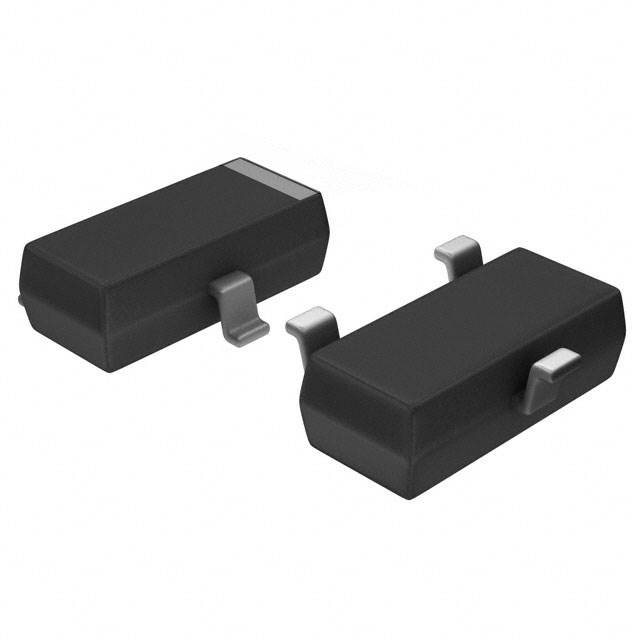
MMBF5485 vs IMT40R011M2HXTMA1: Component Comparison for Hardware Engineers
Quick verdict
For low-current, high-frequency RF switching or amplification applications up to 400 MHz with minimal gate drive requirements, the MMBF5485 is clearly the practical choice due to its JFET technology and RF-optimized characteristics. Conversely, for power switching at high voltages (400 V) and currents up to 13.4 A (continuous) with robust avalanche energy ratings and low on-resistance, the IMT40R011M2HXTMA1 is the superior device, suited for demanding power conversion and motor drive scenarios.
Spec comparison table
| Spec | MMBF5485 | IMT40R011M2HXTMA1 | Notes |
|---|---|---|---|
| Configuration | N-Channel JFET | N-Channel SiC MOSFET | Different device technologies; JFET for RF, SiC MOSFET for power |
| Current rating (continuous) | 10 mA | 13.4 A (Ta), 144 A (Tc) | IMT40R011M2HXTMA1 supports ~1300x higher continuous current |
| Frequency | 400 MHz | Not specified (SiC MOSFET, switching freq 4000 A/μs) | MMBF5485 designed for RF; IMT40R011M2HXTMA1 for power switching, not RF |
| Gain | - | - | No gain specified for either |
| Mounting type | Surface mount (SOT-23-3) | Surface mount (PG-HSOF-8-2) | Different packages; IMT40R011M2HXTMA1 much larger |
| Noise figure | 4 dB | Not specified | MMBF5485 optimized for low noise; IMT40R011M2HXTMA1 not characterized for noise |
| Output power max | - | - | Not specified |
| Package case | TO-236-3, SC-59, SOT-23-3 | 8-PowerSFN (PG-HSOF-8-2) | IMT40R011M2HXTMA1 package significantly larger and more complex |
| Voltage rated | 25 V | 400 V | IMT40R011M2HXTMA1 supports 16x higher voltage |
| Voltage test | 15 V | 15 V | Both tested at 15 V |
| Avalanche energy repetitive | Not specified | 1.1 mJ (typ) | IMT40R011M2HXTMA1 provides avalanche robustness |
| Avalanche energy single pulse | Not specified | 220 mJ (typ) | IMT40R011M2HXTMA1 can absorb large single avalanche pulses |
| Capacitance (typical) | Not specified | 1 nF | IMT40R011M2HXTMA1 gate capacitance relevant for gate drive design |
| Drain-source breakdown voltage | 25 V (rated) | 400 V (typ) | IMT40R011M2HXTMA1 rated for high-voltage operation |
| Drain-source on-resistance (Rds(on)) | Not specified | 11.3 mΩ (typ), 14.4 mΩ max @ 37.1 A, 18 V | IMT40R011M2HXTMA1 low Rds(on) for power efficiency |
| Gate charge (Qg) | Not specified | 85 nC @ 18 V | IMT40R011M2HXTMA1 requires substantial gate drive current |
| Gate threshold voltage (Vth) | Not specified | Typ 4.5 V, Min 3.5 V, Max 5.6 V | IMT40R011M2HXTMA1 requires higher gate voltage than typical logic levels |
| Gate-source voltage max | Not specified | +23 V / -7 V | IMT40R011M2HXTMA1 can withstand higher gate voltages |
| Max pulsed drain current | Not specified | 432 A (typ) | IMT40R011M2HXTMA1 can handle high surge currents |
| Max power dissipation | Not specified | 3.8 W (Ta), 429 W (Tc) | IMT40R011M2HXTMA1 supports high power dissipation with proper cooling |
| Operating temperature range | Not specified | -55°C to 175°C (TJ) | IMT40R011M2HXTMA1 supports wide temperature range, suitable for harsh environments |
| Thermal resistance junction-ambient | Not specified | Typ 40 °C/W | IMT40R011M2HXTMA1 thermal resistance critical for power dissipation |
| Package dimensions (a×b×c) | SOT-23-3 (~2.9 mm × 1.3 mm × 1.1 mm) | 2.20–2.40 mm × 9.70–9.90 mm × 0.40–0.60 mm | IMT40R011M2HXTMA1 is physically much larger, affecting layout size |
Design trade-offs
The MMBF5485 and IMT40R011M2HXTMA1 are fundamentally different devices intended for very different applications, so the choice is rarely a direct substitution but rather a question of design requirements.
The MMBF5485 is a JFET optimized for RF applications up to 400 MHz with a very low current rating (10 mA). Its low noise figure (4 dB) and small SOT-23-3 package make it suitable for signal amplification and switching in sensitive RF front ends where gate drive requirements are minimal and efficiency is less about power conduction and more about signal integrity. The device’s low voltage rating (25 V) further limits it to low-voltage circuits. Its small size benefits dense layouts but thermal dissipation is negligible given its low current and power handling.
In contrast, the IMT40R011M2HXTMA1 is a Silicon Carbide (SiC) MOSFET designed for power electronics, supporting up to 400 V and continuous currents of 13.4 A at ambient (Ta), with pulsed currents exceeding 400 A. Its very low Rds(on) of ~11.3 mΩ at 18 V gate drive enables lower conduction losses in power conversion circuits. However, the SiC MOSFET requires a robust gate drive with voltages up to +23 V and careful consideration of gate charge (85 nC), which impacts switching speed and drive power. The large package (PG-HSOF-8-2) and significant power dissipation capability (up to 429 W at case temperature) demand careful thermal management including heatsinking and PCB layout optimized for low thermal resistance and current handling.
From a layout perspective, the MMBF5485’s tiny SOT-23 footprint is easy to integrate on compact RF boards, while the IMT40R011M2HXTMA1’s larger package and higher pin count require more board area and careful high-current trace design. The IMT40R011M2HXTMA1’s avalanche energy ratings (1.1 mJ repetitive, 220 mJ single pulse) provide robustness against inductive switching transients, a key consideration for power converters and motor drives.
Cost at volume will generally favor the MMBF5485 in RF or low-power applications due to its simpler technology and smaller package, whereas the IMT40R011M2HXTMA1’s SiC technology and power ratings come at a premium justified only in high voltage/high current designs.
Use-case fit
Choose MMBF5485 when…
- Designing RF front-end switches, low-noise amplifiers, or mixers operating up to 400 MHz with minimal power dissipation.
- Working with low-voltage circuits (<25 V) where signal integrity and noise figure are critical.
- Space-constrained designs requiring a compact SOT-23-3 package.
- Circuits with very low continuous current (<10 mA), such as biasing or small-signal switching.
- Projects where simple gate drive (JFET gate) with minimal control circuitry is preferred.
Choose IMT40R011M2HXTMA1 when…
- Building high-voltage (up to 400 V) power converters, motor drives, or industrial power switching systems.
- Handling continuous currents above 10 A, up to 13.4 A at ambient, with pulsed capability over 400 A.
- Efficiency gains from low Rds(on) (~11.3 mΩ) significantly reduce conduction losses in power stages.
- Thermal management strategies (heatsinks, thermal vias) can be implemented to handle dissipated power up to several watts.
- Robustness under avalanche conditions is required, such as in inductive load switching.
Drop-in compatibility
The MMBF5485 and IMT40R011M2HXTMA1 are not pin-compatible nor footprint-compatible. The MMBF5485 is a 3-pin JFET in a tiny SOT-23-3 package, while the IMT40R011M2HXTMA1 is an 8-pin