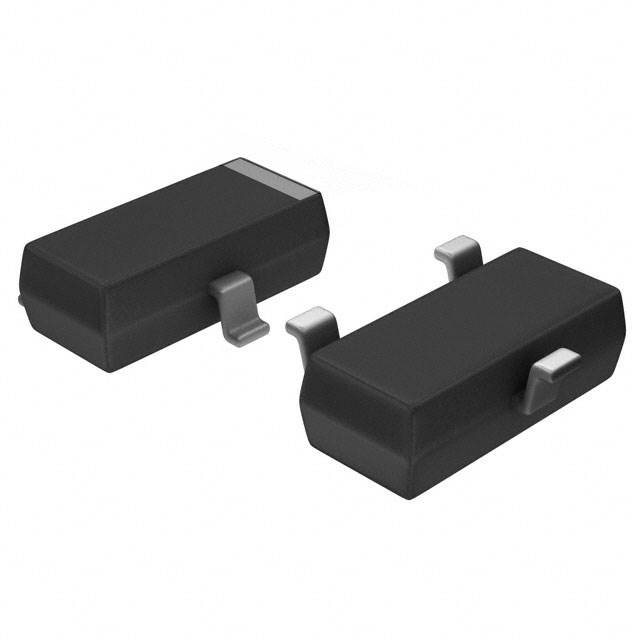
MMBF5485 vs IMLT65R015M2HXTMA1: Component Comparison for Power Electronics Engineers
Quick verdict
For low-current, high-frequency RF switching and amplification up to a few tens of MHz, the MMBF5485 JFET excels due to its low voltage rating and appropriate noise figure at 400 MHz. For high-voltage, high-current power conversion and switching applications demanding robustness, efficiency, and thermal management at hundreds of amps and hundreds of volts, the IMLT65R015M2HXTMA1 SiC MOSFET is clearly the better choice.
Spec comparison table
| Spec | MMBF5485 | IMLT65R015M2HXTMA1 | Notes |
|---|---|---|---|
| Configuration | N-Channel JFET | N-Channel SiC MOSFET | Both N-Channel, but different device physics and control characteristics. |
| Current rating (continuous) | 10 mA | 142 A (Tc) | IMLT65R015M2HXTMA1 supports four orders of magnitude higher current. |
| Frequency | 400 MHz | Not specified | MMBF5485 is designed for RF operation; IMLT65R015M2HXTMA1 is not RF-oriented. |
| Gain | - | - | No gain spec for either; MMBF5485 is a JFET, commonly used as a low-noise amplifier. |
| Mounting type | Surface Mount (SOT-23-3) | Surface Mount (PG-HDSOP-16-6) | Different package types impacting footprint and thermal dissipation. |
| Noise figure | 4 dB | Not specified | MMBF5485 has a defined noise figure suitable for low-noise RF applications. |
| Output power max | - | - | Not specified for either device. |
| Package case | TO-236-3 / SC-59 / SOT-23-3 | 16-PowerSOP Module | IMLT65R015M2HXTMA1’s larger package supports high power dissipation. |
| Voltage rating (drain/source max) | 25 V | 650 V | IMLT65R015M2HXTMA1 supports 26× higher voltage, suitable for industrial power systems. |
| Voltage test | 15 V | - | Not relevant for direct comparison. |
| Technology | JFET | SiCFET (Silicon Carbide MOSFET) | SiC MOSFET offers superior high-voltage blocking and high-temperature operation. |
| Drive voltage max | - | 15 V (max), 18 V (recommended) | IMLT65R015M2HXTMA1 requires gate drive up to 18 V vs. MMBF5485 gate driven by JFET bias. |
| R_DS(on) max | - | 18 mΩ @ 64.2 A, 18 V | IMLT65R015M2HXTMA1 has low on-resistance for high current conduction; MMBF5485 not specified. |
| Gate threshold voltage (V_GS) max | - | 5.6 V @ 13 mA | IMLT65R015M2HXTMA1 needs higher gate voltage for full enhancement. |
| Gate charge (Q_G) | - | 79 nC @ 18 V | High gate charge impacts switching losses and gate driver design for IMLT65R015M2HXTMA1. |
| Input capacitance (C_iss) | - | 2792 pF @ 400 V | High input capacitance means slower switching and higher gate drive requirements. |
| Power dissipation max | - | 600 W (Tc) | IMLT65R015M2HXTMA1 handles high power dissipation, MMBF5485 not specified. |
| Operating temperature range | - | -55°C to 175°C (TJ) | IMLT65R015M2HXTMA1 supports a broad industrial temperature range. |
| Thermal resistance junction-case | - | 0.25 °C/W | Low thermal resistance supports efficient heat sinking for IMLT65R015M2HXTMA1. |
| Gate-source voltage max | - | +23 V / -7 V | IMLT65R015M2HXTMA1 has wide gate voltage tolerance. |
| Turn-on delay time | - | 11.6 ns (typ) | Fast switching suitable for high-frequency power conversion. |
| Rise time | - | 14.7 ns (min) | Fast switching speed. |
| Turn-off delay time | - | 22 ns (min) | Fast turn-off time reduces switching losses. |
| Fall time | - | 6.4 ns (min) | Fast fall time improves efficiency in switching applications. |
| Avalanche energy | - | 372 mJ (min) | Robustness against inductive load transients. |
| Reverse transfer capacitance (C_rss) | - | 16 pF | Lower C_rss reduces Miller effect and switching losses. |
| Zero gate voltage drain current (I_DSS) | - | 3 µA | Low leakage current at zero gate voltage. |
| Gate-source leakage current | - | 100 nA (max) | Low leakage is good for gate drive stability. |
| Package dimensions | SOT-23-3 (small) | 16-PowerSOP Module (large) | Size difference impacts PCB layout and thermal design. |
| Soldering temperature reflow | - | 260 °C | Standard lead-free reflow compatible. |
Design trade-offs
The MMBF5485 and IMLT65R015M2HXTMA1 are fundamentally different devices aimed at very different applications. The MMBF5485 is a low-voltage JFET optimized for RF frequencies up to 400 MHz, supporting only tiny currents (~10 mA). Its low noise figure (4 dB) suits sensitive front-end amplification or switching in RF circuits. The SOT-23 package keeps board area minimal and simplifies integration in small-signal analog front ends.
Conversely, the IMLT65R015M2HXTMA1 is a Silicon Carbide MOSFET designed for high voltage (650 V) and heavy current loads (up to 142 A continuous, 398 A peak). Its low on-resistance (18 mΩ typical) and ability to dissipate 600 W at case temperature indicate suitability for power conversion and motor drives. The large PG-HDSOP-16-6 package facilitates heat sinking; however, its physical size and gate charge (~79 nC) require careful PCB layout and robust gate driver design to minimize switching losses and electromagnetic interference.
Thermal management is a key consideration: the MMBF5485’s power dissipation is minimal, typically requiring no special heatsinking, whereas the IMLT65R015M2HXTMA1 demands effective cooling strategies and low thermal resistance paths (0.25 °C/W junction-to-case). The SiC technology allows operation up to 175 °C junction temperature, beneficial in harsh environments and high-density designs.
Gate drive requirements differ significantly. MMBF5485 being a JFET is typically controlled by biasing the gate-source junction and does not require a dedicated gate driver. In contrast, the IMLT65R015M2HXTMA1 needs a stable, isolated 15–18 V gate drive voltage with careful control over switching transitions to manage losses and device stress. The high input capacitance (2792 pF) and gate charge impact switching speed and driver power consumption.
Cost and availability also differ: MMBF5485 devices are inexpensive and widely used in RF front ends, while SiC MOSFETs like the IMLT65R015M2HXTMA1 command a higher price reflecting their specialized high-power capability. Volume cost considerations will depend heavily on application domain and production scale.
Use-case fit
Choose MMBF5485 when…
- Designing low-noise RF amplifiers or switches operating up to 400 MHz with very low current requirements (<10 mA).
- Implementing small-signal analog front ends where device noise figure and low capacitance are critical.
- Space-constrained PCB layouts requiring tiny SOT-23 packages.
- Circuits with supply voltages below 25 V, where high voltage or large current handling is not needed.
- Simple JFET biasing without complex gate driver circuitry is preferred.
Choose IMLT65R015M2HXTMA1 when…
- Building high-voltage (up to 650 V) power converters, inverters, or motor drives requiring continuous currents above 100 A.
- High-temperature operation (up to 175 °C junction) is necessary, such as in automotive or industrial environments.
- Efficiency gains from low R_DS(on) and fast switching can justify the complexity of SiC MOSFET gate drive design.
- Robustness against avalanche conditions and high dv/dt (200 V/ns) is required for inductive load switching.
- Thermal management solutions (he