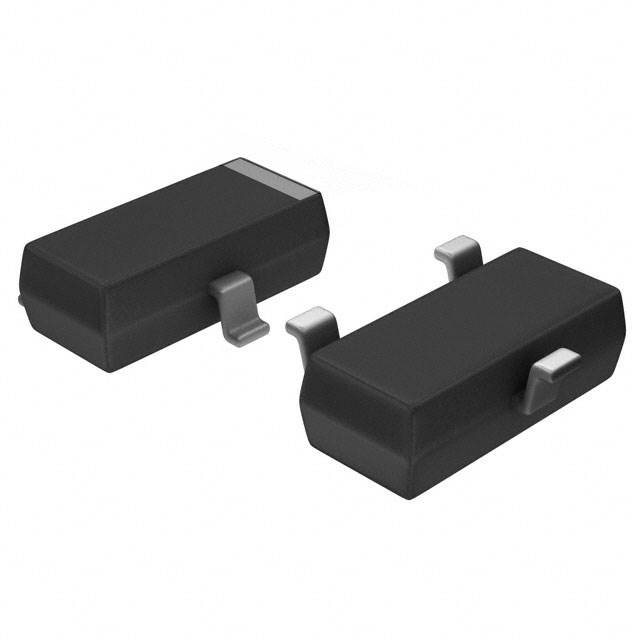
MMBF5485 vs IMBG120R022M2HXTMA1: Component Comparison for Hardware Engineers
Quick verdict
For high-frequency, low-current RF amplification and switching under 15 V, the MMBF5485 is the clear choice due to its JFET technology, low noise figure (4 dB), and small SOT-23 package. Conversely, for high-voltage, high-current power switching applications requiring ruggedness and high thermal dissipation, the IMBG120R022M2HXTMA1 SiC MOSFET dominates with its 1200 V rating, 87 A continuous current capability, and superior thermal properties.
Spec comparison table
| Spec | MMBF5485 | IMBG120R022M2HXTMA1 | Notes |
|---|---|---|---|
| Configuration / FET type | N-Channel JFET | N-Channel SiC MOSFET | Different technologies; JFET better for RF, SiC MOSFET for high power/high voltage |
| Voltage rating (drain/source max) | 25 V | 1200 V | IMBG120R022M2HXTMA1 supports 48× higher voltage, suitable for industrial/high-voltage |
| Current rating (continuous drain) | 10 mA | 87 A (Tc) | IMBG120R022M2HXTMA1 handles 8700× more current, for power applications |
| Maximum frequency | 400 MHz | Not specified (low, SiC MOSFETs typically <1 MHz) | MMBF5485 optimized for RF; IMBG120R022M2HXTMA1 not suitable for high-frequency small-signal applications |
| Gain | Not specified | Not specified | Not comparable; MMBF5485 is an RF transistor, IMBG120R022M2HXTMA1 is a power MOSFET |
| Noise figure | 4 dB | Not specified | Low noise figure favors MMBF5485 for sensitive analog/RF front ends |
| Output power max | Not specified | Not specified | Not comparable |
| Package / Mounting | SOT-23-3 (TO-236-3, SC-59) Surface Mount | PG-TO263-7-12 (TO-263-8, D2PAK) Surface Mount | MMBF5485 is small and low-profile; IMBG120R022M2HXTMA1 is large, designed for heat dissipation |
| Technology | JFET | Silicon Carbide FET (SiCFET) | SiC offers high-temperature, high-voltage, and fast switching advantages |
| Voltage test | 15 V | 1200 V (typ) | IMBG120R022M2HXTMA1 supports high voltage operation |
| Drive voltage (max / recommended) | Not specified | 15 V max drive, 18 V typical | IMBG120R022M2HXTMA1 requires dedicated gate drive circuitry at ~15-18 V |
| R_DS(on) max | Not specified | 21.6 mΩ @ 32.1 A, 18 V | Low on-resistance for a 1200 V MOSFET; MMBF5485 likely much higher resistance due to low current rating |
| Gate threshold voltage | Not specified | 3.5 V min, 4.2 V typ, 5.1 V max @ 10.1 mA | IMBG120R022M2HXTMA1 requires typical gate threshold >3.5 V, unlike JFET which has different biasing |
| Gate charge (Q_g) | Not specified | 71 nC @ 18 V | Relatively high gate charge means slower switching and higher gate drive losses |
| Gate-source voltage max | Not specified | +23 V / -10 V | Robust gate voltage ratings allow some margin in gate drive design |
| Input capacitance (C_iss) | Not specified | 2330 pF @ 800 V | Large input capacitance for power MOSFET; MMBF5485 optimized for high frequency (likely lower C_iss) |
| Power dissipation max | Not specified | 385 W (Tc) | IMBG120R022M2HXTMA1 supports high power dissipation with proper cooling |
| Operating temperature range | Not specified | -55°C to 175°C (junction) | IMBG120R022M2HXTMA1 supports very wide temperature range |
| Thermal resistance (typ) | Not specified | 0.39 K/W (typ) | Low thermal resistance allows efficient heat removal |
| Switching times (t_on, t_off) | Not specified | t_on 6 ns, t_off 11.3 ns | Fast switching for SiC MOSFETs, important in power conversion |
| Short circuit withstand time | Not specified | 2 µs | IMBG120R022M2HXTMA1 can handle short circuit events briefly |
| Gate leakage current | Not specified | 120 nA (typ) | Low gate leakage current typical for MOSFETs |
| Noise figure | 4 dB | Not specified | MMBF5485 designed for low-noise RF applications |
Note: Many specs for MMBF5485 are not directly comparable due to different device class and application focus.
Design trade-offs
The MMBF5485 is a low-voltage, low-current N-channel JFET optimized for RF applications up to 400 MHz. Its small SOT-23-3 package and low noise figure (4 dB) make it suitable for low-level analog signal amplification or small-signal switching in communication front-ends. Its current rating of only 10 mA and voltage test at 15 V limit its use to signal-level circuits, not power switching. The JFET technology provides a normally-on device with simple biasing, but it requires careful gate-source voltage control to maintain linearity and low distortion.
In contrast, the IMBG120R022M2HXTMA1 is a high-voltage (1200 V) Silicon Carbide MOSFET designed for power conversion applications such as motor drives, inverters, and industrial power supplies. It supports continuous drain currents up to 87 A (at case temperature) and dissipates up to 385 W with proper thermal management. The large PG-TO263-7-12 package facilitates heat sinking but occupies significantly more PCB area and requires more complex gate drive circuitry due to its 71 nC gate charge and gate threshold around 4 V. The SiC technology provides fast switching, low conduction losses (21.6 mΩ R_DS(on)), and high temperature capability (up to 175°C junction), enabling higher efficiency and power density designs. However, the high gate charge and need for 15-18 V drive voltage increase gate driver complexity and power loss.
Thermal design is critical for the IMBG120R022M2HXTMA1, requiring a solid copper area and possibly a heatsink or forced airflow to maintain case temperature. The MMBF5485, with its low power dissipation, typically requires minimal thermal consideration beyond standard PCB layout. Layout sensitivity differs significantly: the MMBF5485’s small-signal RF operation demands careful RF layout techniques to minimize parasitic capacitance and inductance, while the IMBG120R022M2HXTMA1 requires low-inductance, high-current PCB layout with thick copper and short gate drive loops to prevent oscillations and switching losses.
Cost at volume will also differ widely: the MMBF5485 is a small-signal transistor likely costing cents per unit, while the IMBG120R022M2HXTMA1 is a specialized power SiC MOSFET, likely costing several dollars each. This cost difference reflects their vastly different application domains.
Use-case fit
Choose MMBF5485 when…
- Designing RF front-end amplifiers or switches operating up to 400 MHz under 15 V.
- Low-noise, low-level signal amplification in communication devices or sensor interfaces.
- Space-constrained circuits requiring a small SOT-23-3 footprint.
- Circuits requiring a JFET input stage for linearity or specific biasing characteristics.
- Low power, low current switching or buffering in analog/RF domains.
Choose IMBG120R022M2HXTMA1 when…
- Building high-voltage (up to 1200 V) power converters such as motor drives or solar inverters.
- High-current switching applications requiring continuous currents up to 87 A.
- Designs demanding high-temperature operation up to 175°C junction.
- Applications needing fast switching with low conduction losses to improve efficiency.
- Systems that can accommodate large packages and require robust thermal management.
Drop-in compatibility
These parts are not pin-compatible or footprint-compatible. The MMBF5485 is a small-signal JFET in a 3-pin SOT-23-3 package, while the IMBG120R022M2HXTMA1 is a high-power SiC MOSFET in a 7-pin PG-TO263-7-12 package (D2PAK style). Substituting one for the other is not feasible without a complete redesign of the PCB and supporting circuitry, including gate drive and thermal management. Additionally, their electrical characteristics and intended applications